
Related Products
What Is an Accumulation Conveyor? How It Works, Types, and Benefits
Learn how accumulation conveyors work, their main types and benefits, and how they integrate with AGVs and AMRs for stable warehouse and production-line material flow.
Learn how accumulation conveyors work, their main types and benefits, and how they integrate with AGVs and AMRs for s...
In a conventional conveyor system, the primary function of the conveyor is to continuously move cartons, totes, pallets, or other loads from one location to another. In actual manufacturing and warehouse operations, however, upstream and downstream equipment do not always operate at exactly the same speed.
For example, a packaging line may continuously discharge products while a palletizer can only receive them at a fixed rate. Totes may continue entering a warehouse conveyor system, while the sorting equipment needs to release them individually according to order instructions. Without a place to temporarily hold these loads, the system may experience conveyor congestion, frequent equipment stoppages, or products pressing against one another.
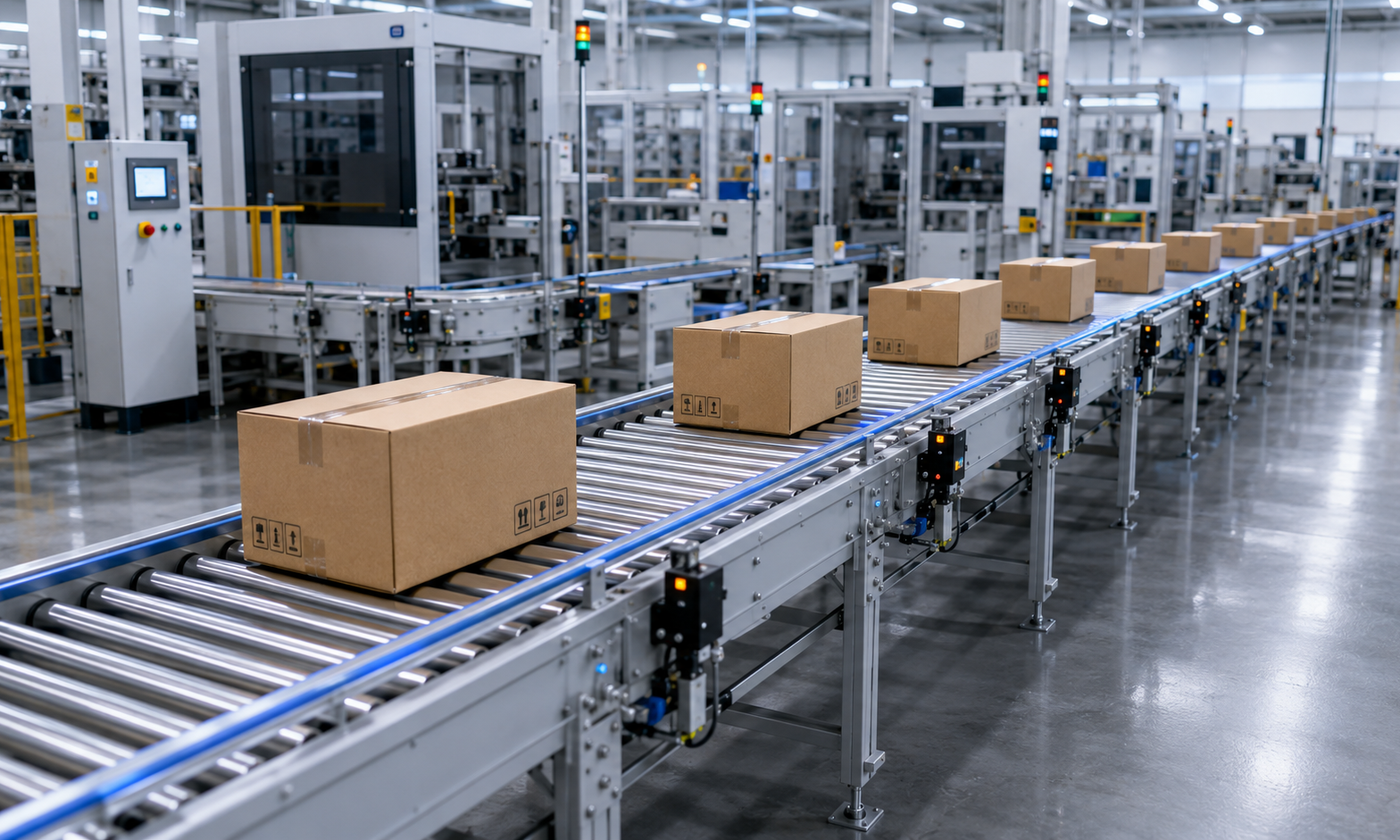
An accumulation conveyor is a conveyor system that temporarily holds products during transportation and releases them in a controlled sequence according to downstream demand.
Unlike a standard conveyor, an accumulation conveyor does more than transport products. It also provides buffering, queuing, product spacing, and flow-control functions. By creating a temporary buffer between different machines or operational processes, it helps maintain a more stable material flow throughout a production line or warehouse automation system.
How Does an Accumulation Conveyor Work?
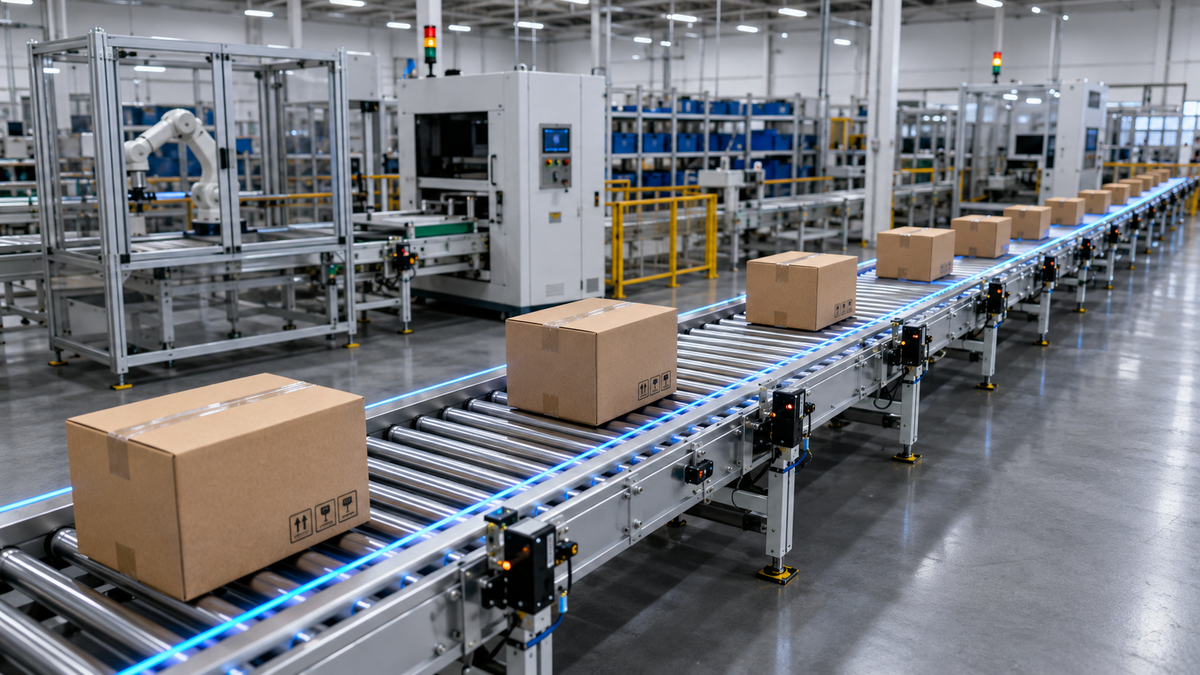
An accumulation conveyor normally divides the conveyor line into multiple independently controlled zones. Each zone is designed to accommodate one carton, tote, pallet, or other unit load.
Each zone is generally equipped with a sensor and a drive mechanism, such as a powered roller, motor, or clutch-controlled drive. When a load enters a zone, the sensor detects its position and sends a signal to the control system.
When the next zone is empty, the current zone continues operating and moves the load forward. When the next zone is already occupied, the current zone stops or reduces its drive force, allowing the load to remain temporarily in place.
For example, the basic operating sequence of a zero-pressure accumulation conveyor includes:
- A load enters the first conveyor zone.
- A sensor detects the load and checks the status of the downstream zone.
- If the downstream zone is available, the powered rollers continue running.
- If the downstream zone is occupied, the current zone stops.
- Once the downstream equipment sends a demand signal, the zones release the loads in sequence.
In a zero-pressure accumulation system, independently controlled conveyor zones maintain a gap between adjacent loads while they are waiting. This prevents cartons, totes, or packaged products from pushing against one another.
An accumulation conveyor system can also use different release modes. For example, it can release products one at a time, allowing cartons to enter scanning, sorting, or packaging equipment at a controlled spacing. Alternatively, it can activate several zones simultaneously and quickly discharge a group of products to the next process.
An accumulation conveyor therefore does not simply allow products to stop on the conveyor. It dynamically controls product flow according to equipment status, order instructions, and production takt time.
The Role of Accumulation Conveyor Systems in Industrial Operations
The primary role of an accumulation conveyor system is to create a buffer between different operational processes. This means upstream equipment does not have to follow every temporary change in the operating status of downstream equipment.
Balancing Different Equipment Processing Speeds
Processing, assembly, inspection, packaging, and palletizing equipment within the same production line often operate at different speeds.
When upstream equipment produces goods faster than downstream equipment can process them, an accumulation conveyor can temporarily hold the products instead of immediately stopping the upstream machine. Once downstream processing capacity becomes available, the system releases the products in sequence.
Reducing Full-Line Shutdowns
Without an accumulation buffer, a short stoppage at one machine may force an entire production line to stop.
An accumulation conveyor can hold a certain quantity of work-in-process inventory between machines. Even when one workstation temporarily stops, upstream equipment can continue operating for a period of time, reducing the effect of individual machine stoppages on total production capacity.
Providing Buffers for Sorting and Merging
In warehouse distribution centers, several conveyor lines may need to merge into one main conveyor. Cartons or totes may also need to wait for barcode scanning, weighing, labeling, or sorting instructions.
An accumulation conveyor controls the spacing between loads and releases them into merging or sorting equipment in a defined sequence. This reduces collisions and flow conflicts.
Accumulation conveyors are therefore commonly installed before sorting, merging, packaging, and palletizing equipment.
Maintaining a Continuous Supply to Manual Workstations
At picking, assembly, inspection, and packaging workstations, operator processing speed may change depending on the complexity of the task.
An accumulation conveyor can temporarily hold a defined number of totes or products in front of the workstation. This ensures that operators have a continuous supply of work without allowing too many products to enter the operating area at the same time.
Connecting Automated Equipment
An accumulation conveyor can serve as an interface between automated storage systems, sorters, palletizers, robotic workstations, AGVs, and AMRs.
Through sensors, PLCs, a WCS, or a WMS, the conveyor can confirm whether a load is in position and exchange signals such as permission to enter, ready for pickup, and transfer complete with other automated equipment.
Types of Accumulation Conveyors
An accumulation conveyor is not a single mechanical configuration. Depending on the accumulation method, drive type, and load being transported, accumulation conveyors can be divided into several common types.
Zero-Pressure Accumulation Conveyor
A zero-pressure accumulation conveyor divides the conveyor into multiple independently controlled zones. Each zone is normally equipped with a sensor and an individually controlled drive mechanism.
When a downstream zone is occupied, the upstream zone stops, maintaining a gap between adjacent products. The loads do not push against one another while waiting.
Zero-pressure accumulation conveyors are suitable for:
- Cartons and totes
- Easily deformed packaging
- Fragile products
- Loads with different sizes or weights
- Sorting systems that require controlled product spacing
Zero-pressure accumulation is one of the most commonly used accumulation methods in automated warehouses and distribution centers.
Minimum-Pressure Accumulation Conveyor
A minimum-pressure accumulation conveyor allows products to make light contact with one another while reducing the amount of pushing force applied by the conveyor rollers.
This system generally has a simpler structure than a zero-pressure system. It is suitable for products with strong outer packaging, relatively consistent dimensions, and a low risk of compression damage.
Compared with zero-pressure accumulation, minimum-pressure accumulation may require a lower initial equipment investment. However, the pressure at the discharge end must be controlled according to product weight, packaging strength, and the number of accumulated loads.
Roller Accumulation Conveyor
A roller accumulation conveyor uses powered rollers or motorized rollers to transport cartons, totes, pallets, and other products with flat and stable bottom surfaces.
Individual conveyor zones can start and stop independently. The system can also be combined with lift-and-transfer units, turntables, right-angle transfer modules, and sorting equipment.
Its modular construction makes it suitable for manufacturing plants, warehouses, and distribution centers.
Belt Accumulation Conveyor
A belt accumulation conveyor supports and moves products on a continuous belt. It is suitable for small products, loads with irregular bottoms, and items that cannot move reliably on rollers.
Some belt accumulation conveyors use multiple independently driven zones. When a product needs to wait, the belt within the relevant zone stops.
Pallet Accumulation Conveyor
A pallet accumulation conveyor is primarily used to transport and temporarily store pallets, tooling plates, and heavy unit loads.
Depending on the pallet base structure and transfer direction, the system may use rollers, chains, or a combination of chain and roller conveyors.
Pallet accumulation conveyors are commonly installed at:
- Production-line discharge points
- Palletizing areas
- Automated storage and retrieval system interfaces
- Warehouse inbound and outbound stations
- AGV transfer stations
Spiral and Mass-Flow Accumulation Systems
For bottles, cans, and small packaged products, manufacturers may use spiral conveyors, accumulation tables, or multi-lane accumulation systems.
These systems can provide additional buffering capacity within a limited floor area. They are commonly used in food, beverage, pharmaceutical, and packaging production lines.
A spiral conveyor can also combine vertical elevation changes with product accumulation.
Benefits of Accumulation Conveyors
Creating a Stable Material Buffer
An accumulation conveyor absorbs speed differences between upstream and downstream equipment, reducing the effect of material-flow fluctuations on the production line or warehouse system.
Reducing Product Damage
Zero-pressure or minimum-pressure control reduces the compressive force placed on products while they wait in line.
This helps minimize carton deformation, packaging damage, tote misalignment, product tipping, and other handling problems.
Improving Equipment Utilization
When downstream equipment temporarily stops, upstream equipment can continue producing and place products in the accumulation area.
This reduces frequent machine starts and stops and increases the effective operating time of production equipment.
Improving Sorting and Scanning Accuracy
By controlling the spacing between products, an accumulation conveyor allows cartons and totes to enter barcode scanners, weighing equipment, labeling machines, and sorters one at a time.
Consistent product spacing reduces identification errors caused by multiple products entering the detection area simultaneously.
Reducing Manual Intervention
When congestion occurs on a conventional conveyor line, employees may need to manually remove or rearrange products.
An automated accumulation system stops and releases products according to downstream conditions, reducing manual handling and on-site intervention.
Supporting Modular Expansion
Accumulation conveyors can be combined with straight conveyor sections, curves, lift-and-transfer modules, vertical lifts, sorters, and automated storage equipment.
When production capacity, workstation quantity, or warehouse layout changes, businesses can add conveyor zones or adjust control logic without necessarily rebuilding the entire system.
Reducing Energy Consumption and Operating Noise
A zone-driven conveyor only needs to activate the areas currently transporting products. Zones without products can remain stopped, reducing unnecessary continuous operation.
Which AGVs Are Compatible with Accumulation Conveyors?
Accumulation conveyors can interface with several types of AGVs and AMRs. However, the appropriate vehicle must be selected according to the load type, payload, transfer direction, and conveyor height.
Roller-Top AGV or Conveyor-Top AMR
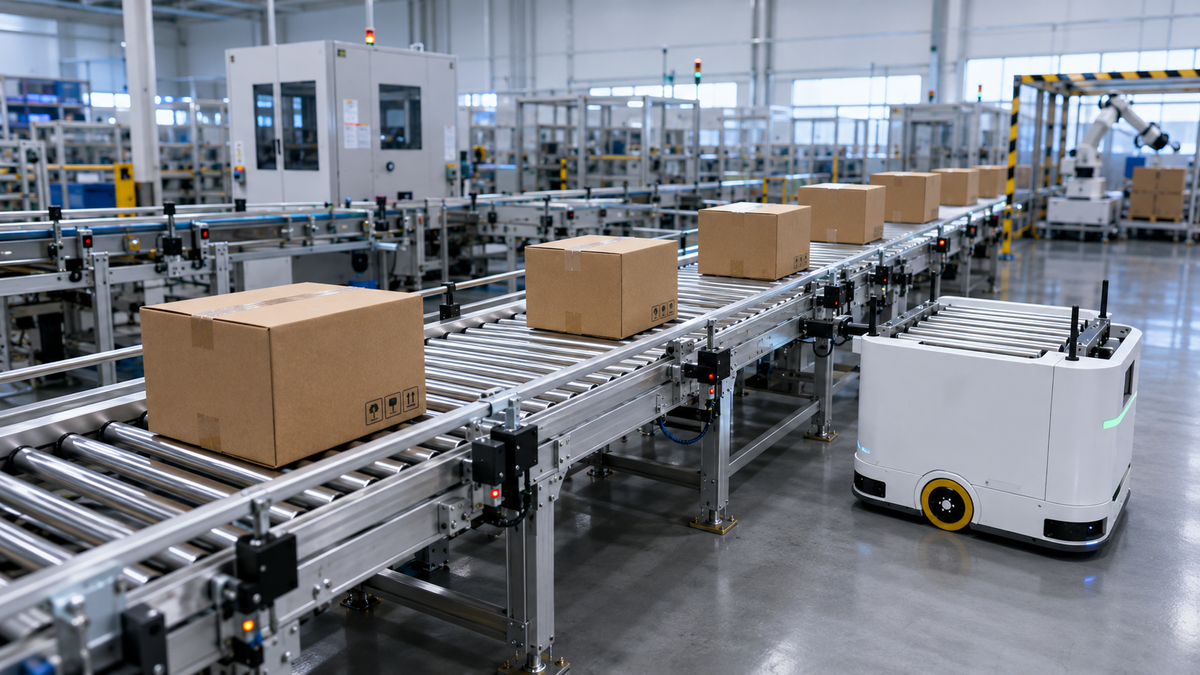
A roller-top AGV or conveyor-top AMR is equipped with a powered roller or belt conveyor module on top of the vehicle. This allows it to interface automatically with a fixed roller conveyor.
When the AGV arrives at the designated transfer position, the onboard conveyor and fixed conveyor start in synchronization. Cartons, totes, or pallets can then be transferred onto the vehicle or discharged from the vehicle onto the accumulation conveyor.
This configuration is suitable for:
- Tote transportation
- Carton handling
- Production-line material delivery
- Transfers between packaging lines and warehouses
- Flexible connections between multiple fixed conveyor stations
Pallet Conveyor AGV
A pallet conveyor AGV can be equipped with rollers, chains, or another horizontal transfer mechanism on top of the vehicle. It is used to handle standard pallets, tooling plates, and heavy unit loads.
It can connect with pallet accumulation conveyors, palletizer discharge points, automated storage system infeed stations, and outbound conveyor lines.
A deck-type AGV can generally be fitted with a horizontal transfer module for transporting pallets, totes, racks, containers, and other unit loads.
Forklift AGV
A forklift AGV can pick up a pallet from the end of a pallet accumulation conveyor or place a pallet onto a conveyor station.
Unlike a roller-top AGV, a forklift AGV does not necessarily require an onboard conveyor module. However, the fixed conveyor station must provide sufficient fork-entry clearance and include pallet-positioning and load-detection devices.
This configuration is suitable for:
- Finished-pallet transportation
- Raw-material inbound handling
- Production-line replenishment
- Transfers between palletizing and warehouse storage
- Automated storage and retrieval system interfaces
A forklift AGV can automatically pick up and place loads between storage racks, floor-staging areas, workstations, and fixed conveyors.
AMRs with Customized Top Modules
Some AMRs can be equipped with rollers, belts, lifting mechanisms, or customized fixtures according to the application.
For lightweight cartons and totes, a compact conveyor module may be sufficient. Pallets, engine components, and large tooling fixtures require an AMR platform with a higher payload and greater vehicle stability.
Customized top modules allow mobile robots to support different loads and transfer methods.
When integrating an AGV with an accumulation conveyor, businesses should evaluate several important factors:
- Whether the handoff heights of the AGV and conveyor are aligned
- Whether the roller or chain transfer directions match
- Whether the AGV can dock accurately
- Whether the bottom of the load is suitable for roller or chain conveying
- Whether the conveyor and AGV can exchange load-in-position, transfer-permission, and transfer-complete signals
- Whether load detection, mechanical stops, and anti-drop devices are installed
- Whether the WMS, WCS, PLC, and AGV fleet-management system can coordinate tasks
- Whether the conveyor transfer area has the necessary safety interlocks
Not every AGV can connect directly to an accumulation conveyor. The vehicle and conveyor station must be planned as an integrated system based on the load type, payload, transfer rate, mechanical interface, and control method.
By integrating accumulation conveyors with AGVs, AMRs, automated sorting equipment, and warehouse management systems, businesses can combine the high throughput of fixed conveyor systems with the flexibility of mobile robots, creating a more continuous, stable, and scalable intralogistics system.
Next Review
Move from article research to a scoped feasibility review.
Use the related products and solution paths below, then send your workflow and layout for a quick engineering review.
Related Solutions
Engineering Review