
Related Products
Fully Automated Warehouse: Key Components and How It Compares With Semi-Automated Warehouses
Explore the key systems in a fully automated warehouse, from receiving and AS/RS to picking and shipping, and compare full and semi-automated operations.
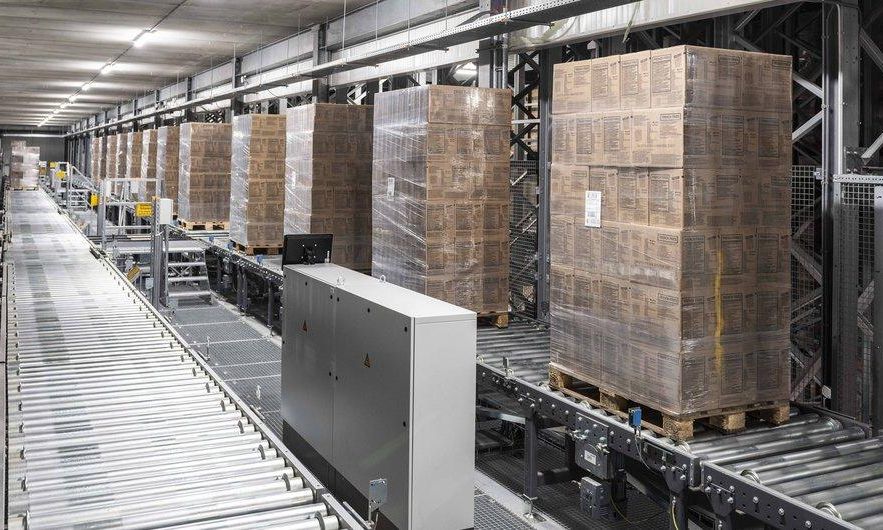
Explore the key systems in a fully automated warehouse, from receiving and AS/RS to picking and shipping, and compare...
In a fully automated warehouse, once goods have been received and verified, conveyors or AGVs can move them automatically into storage. When an order arrives, the system retrieves the required goods and sends them to picking, packing, and outbound areas.
From receiving to shipping, interconnected automation systems reduce the need for employees to repeatedly move, locate, and hand off goods between operations.
What Is a Fully Automated Warehouse?
A fully automated warehouse uses automated equipment and control systems to perform its main warehouse operations, allowing goods to move continuously through receiving, handling, storage, picking, and shipping.
Unlike a warehouse that automates only selected processes, a fully automated warehouse focuses on automatic handoffs throughout the workflow. For example, totes retrieved by an AS/RS can travel directly by conveyor to a robotic picking station, then move on to packing and sorting without employees repeatedly carrying or transferring the goods.
Keeping these systems running together also requires warehouse management and control systems to coordinate order tasks, inventory locations, and handoffs between equipment.
A fully automated warehouse, however, does not necessarily operate without people. Employees may still handle equipment maintenance, system monitoring, unusual loads, and certain special orders. The key is that standard workflows can run continuously without someone manually completing each step.
Key Components of a Fully Automated Warehouse
Automated Receiving and Internal Transport
Receiving in a fully automated warehouse typically begins with identifying and checking incoming goods.
When pallets or cartons enter an automated receiving line, barcode scanners capture product information, while weighing and dimensioning equipment checks whether loads meet downstream storage and transport requirements. Goods that pass the checks move on to automated transport; loads with information discrepancies or unsuitable handling characteristics are diverted to the appropriate area.
Once receiving is complete, goods need to reach the correct storage infeed point.
If receiving stations and storage systems are connected along fixed routes, conveyors can move goods directly between them. Forklift AGVs can handle pallet transfers between warehouse zones, while AMRs can transport certain totes or load carriers.
The equipment mix depends mainly on the types of loads being handled. Distribution centers that primarily handle standard cartons may use conveyors to link workstations. Warehouses focused on pallet storage may rely more heavily on AGVs for transfers between areas.
For goods that need to be depalletized before putaway, automated depalletizers can transfer cartons from pallets onto conveyors for delivery to the appropriate storage area.
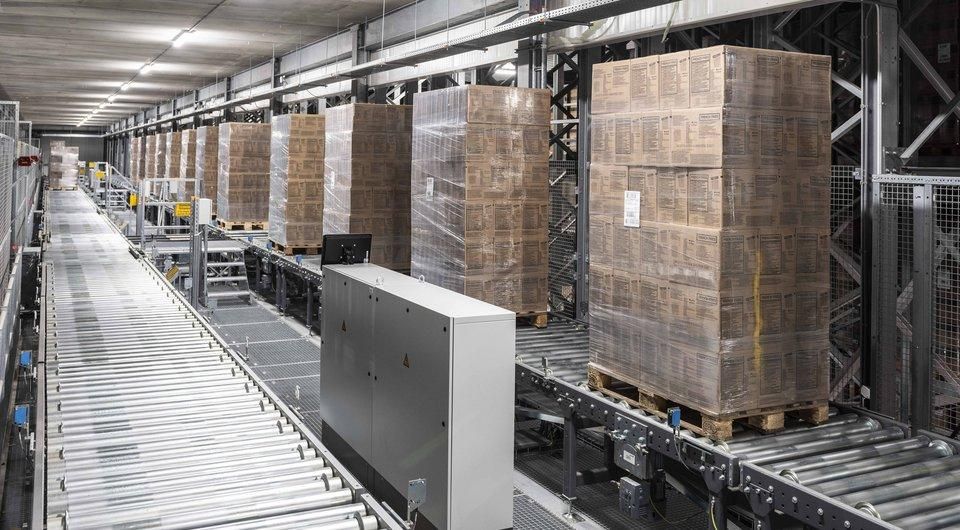
AS/RS
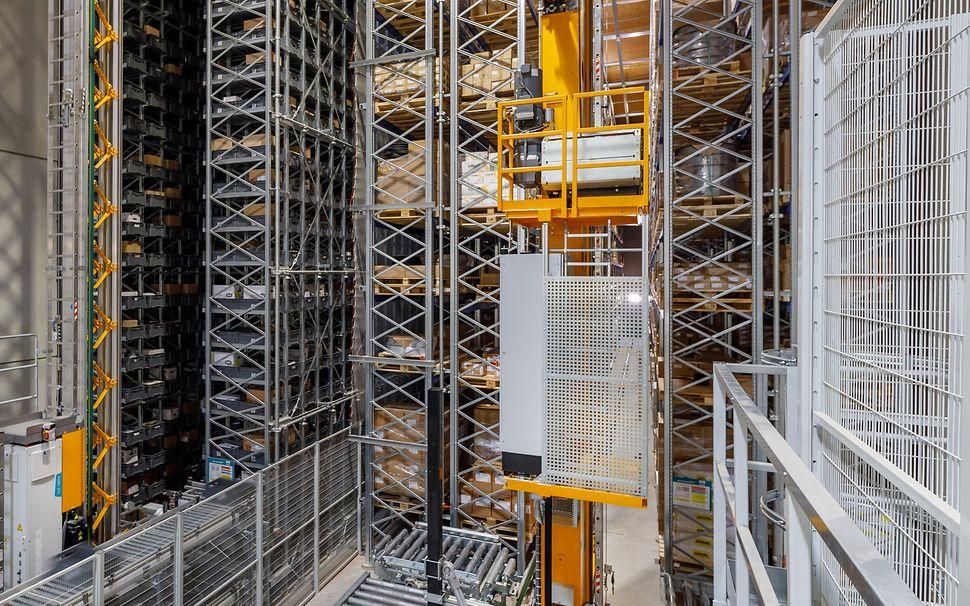
Once goods reach the storage area, an automated storage and retrieval system (AS/RS) puts them into assigned locations and retrieves them when needed.
Warehouses handling pallets may use a stacker-crane AS/RS. The crane travels along a rack aisle to store pallets in designated locations and retrieve them when outbound tasks arrive.
For totes or smaller products, tote-handling AS/RS and shuttle systems are other options.
During putaway, the system assigns storage locations based on available slots and storage rules. When a retrieval task arrives, it automatically brings out the required pallet or tote, so employees do not have to search for storage locations and move the goods themselves.
For example, the same warehouse may hold both full-pallet inventory and totes used for piece picking. Full-pallet orders can be retrieved directly from pallet storage, while products needed for piece picking can be sent from a tote-storage system to downstream picking equipment.
The AS/RS configuration also affects the warehouse’s outbound capacity. If many orders arrive in a short period, the storage system must retrieve enough goods to keep downstream picking and shipping equipment supplied.
Alongside the number of storage locations, it is therefore important to consider how many loads the stacker cranes, shuttles, and storage infeed and outfeed points can handle per hour.
Automated Picking and Shipping
Outbound operations in a fully automated warehouse do not always involve robots picking items one by one. The process depends mainly on whether orders are fulfilled by pallet, case, or individual unit.
Full-pallet orders can be retrieved directly from the AS/RS and transported by AGV or conveyor to the outbound staging area. If repalletizing, stretch wrapping, or labeling is required, the loads can pass through the corresponding automated equipment.
Full-case orders usually do not require cartons to be opened. The system can retrieve the required cases and send them through conveyors and sorters to the appropriate shipping lanes.
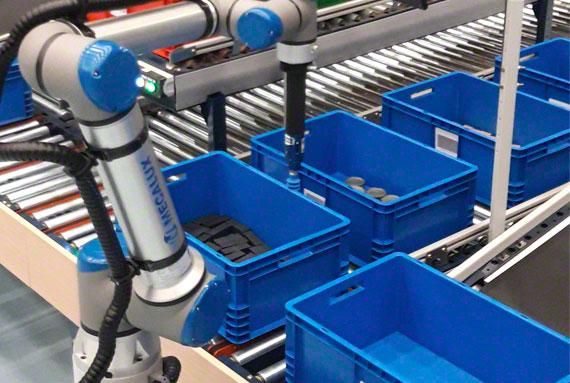
Piece-picking orders require specific quantities of products to be taken from totes or other storage units. Robotic picking systems can handle these tasks: a robotic arm uses vision and an end effector to grasp products and place them in the appropriate order container.
Piece picking generally places more complex demands on the equipment. Product size, shape, packaging material, and grasping position all affect whether a robot can handle an item reliably. The vision and gripping setup therefore needs to suit the products being handled.
After picking, orders can move through automated case sealing, weighing, labeling, and sorting. Sorters route cartons to different shipping lanes based on order destinations or transport routes, where the next handoff depends on the loading method.
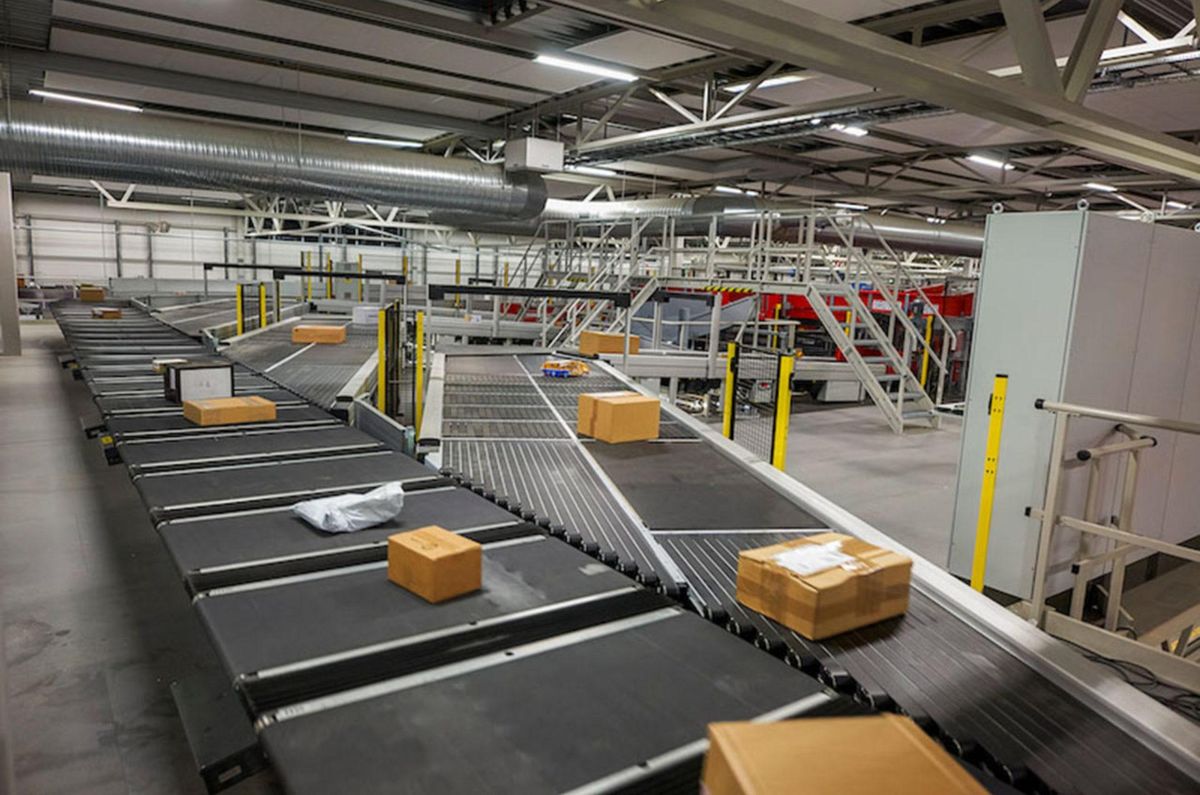
If a warehouse handles full-pallet, full-case, and piece-picking orders, the orders can follow different outbound routes rather than all passing through the same picking system.
A fully automated process that includes piece picking might look like this:
AS/RS retrieval → Conveyor transport → Robotic picking → Automated packing → Automated sorting → Shipping
Fully Automated vs. Semi-Automated Warehouses
A fully automated warehouse and a semi-automated warehouse may use the same types of equipment, such as AGVs, AS/RS, and automated conveyors. The main differences are how much of the operation is automated and whether goods still require manual handling between processes.
| Comparison | Fully Automated Warehouse | Semi-Automated Warehouse |
|---|---|---|
| Automation coverage | Major warehouse processes are automated and connected. | Automation is applied to selected processes. |
| Human involvement | Routine standard tasks require less direct labor; staff mainly monitor systems, maintain equipment, and handle exceptions. | Employees still take part directly in picking, packing, or material handling. |
| Workflow continuity | Multiple automated systems can carry out tasks in sequence. | Some stages depend on manual work and handoffs. |
| Initial investment | Usually requires greater investment in equipment and system integration. | Can retain more existing facilities and invest in stages. |
| System complexity | Multiple automated processes require coordinated planning and control. | Individual operations can be upgraded separately. |
| Suitable applications | Higher-volume warehouses with standardized processes and relatively stable operating requirements. | Warehouses with more variable requirements or a current need to automate only certain tasks. |
A warehouse may already use an AS/RS to store and retrieve goods automatically, yet still rely on employees to pick individual items, pack orders, and carry them to the outbound area. When many orders arrive at once, the manual picking and packing stations may struggle to keep up even if the storage system can supply goods quickly enough.
If picking, packing, and sorting are also automated, the warehouse can reduce its dependence on manual work at those stages. As long as equipment throughput is balanced, orders can move continuously between systems.
Greater automation also makes the warehouse more dependent on the coordinated operation of the full system. A failure on a critical conveyor line or at an automated picking station can affect multiple downstream processes. Planning therefore needs to account for equipment redundancy, buffer capacity, maintenance, and exception handling.
For warehouses with stable order volumes and highly standardized processes, full automation can reduce repetitive manual work over the long term and support more continuous order fulfillment. Warehouses that are already operating and do not yet need a complete overhaul can retain existing workflows and automate the most labor-intensive or capacity-constrained processes first.
If you are planning a fully automated warehouse or upgrading an existing facility, Coolyne can provide a free automation feasibility assessment and ROI analysis based on your warehouse layout, product types, order volumes, and workflows. This can help you determine a suitable automation solution and the scale of investment.
Next Review
Move from article research to a scoped feasibility review.
Use the related products and solution paths below, then send your workflow and layout for a quick engineering review.
Related Solutions
Engineering Review