
Related Products
Goods to Person: How G2P Picking Systems Improve Warehouse Efficiency
Learn how goods-to-person picking systems work, including G2P processes, AS/RS, AGV and AMR options, benefits, and how to choose the right solution.
Learn how goods-to-person picking systems work, including G2P processes, AS/RS, AGV and AMR options, benefits, and ho...
In a conventional warehouse, pickers typically push carts through multiple aisles, search for items based on order instructions, and transport them to verification or packing areas. As SKU counts and order volumes increase, walking, searching, and manual handling can become major constraints on picking performance.
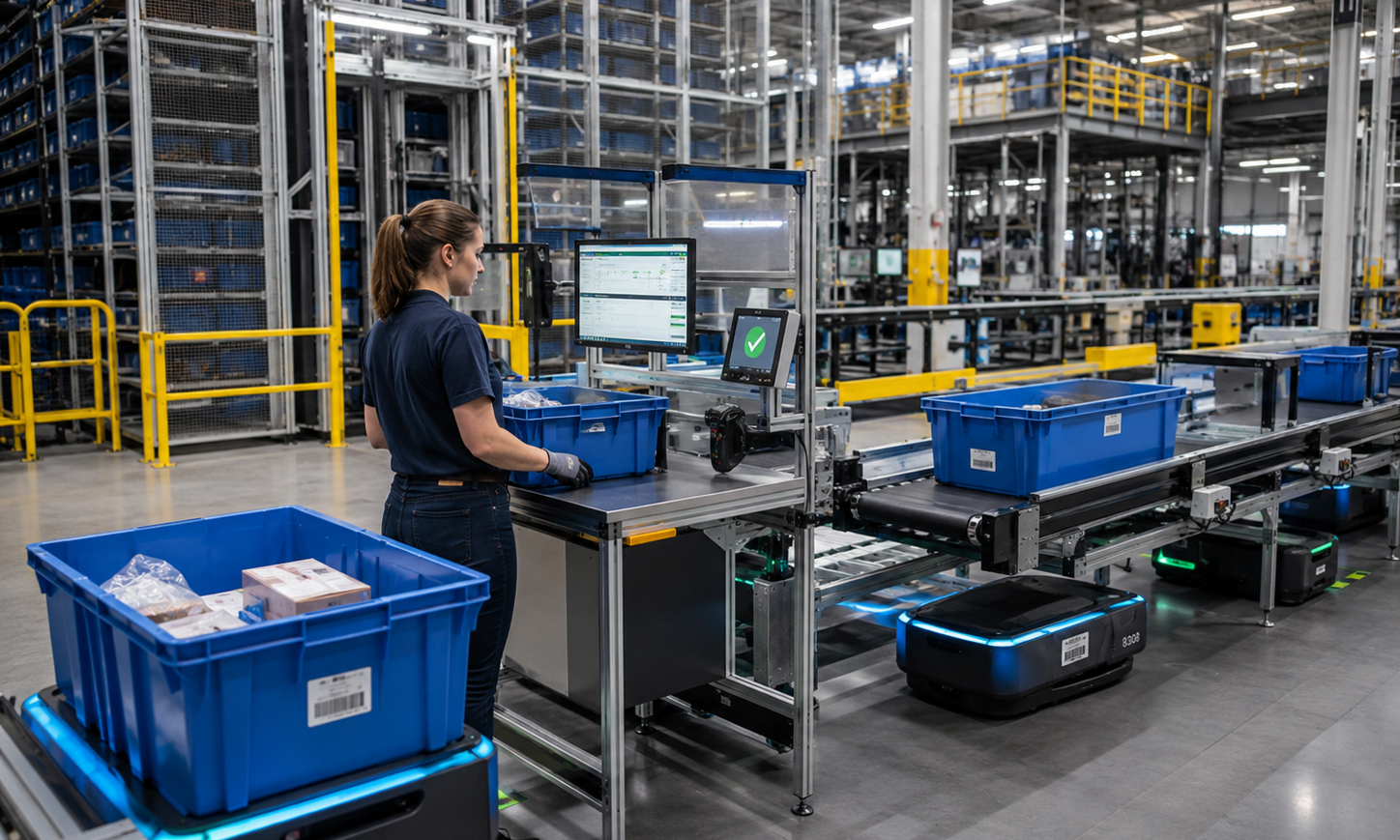
Goods-to-person picking changes this operating model. Automated storage and handling equipment, coordinated by warehouse software, brings the required inventory directly to a fixed workstation, allowing operators to focus on picking, confirmation, and order allocation.
This approach is widely used in e-commerce warehouses, retail distribution centers, third-party logistics facilities, parts warehouses, and manufacturing intralogistics operations.
What Is a Goods-to-Person System?
Goods to Person, commonly abbreviated as G2P, is an order fulfillment model in which automated equipment delivers the required inventory to a fixed picking workstation.
In this model, operators no longer need to travel to multiple storage locations to find products. Warehouse software identifies the inventory required for each order, directs automated equipment to retrieve the appropriate tote, pallet, or mobile rack, and sends it to the assigned workstation.
Once the inventory arrives, the system tells the operator which item and quantity to pick. After picking is completed, the source load carrier returns to storage, while the order container moves to verification, packing, consolidation, or shipping.
The purpose of goods to person automation is not necessarily to replace operators entirely. Its primary role is to reduce long walking distances, location searches, and repetitive handling so that employees can concentrate on actual picking and exception management.
How Does the Goods-to-Person Picking Process Work?
A complete G2P picking process is typically coordinated by warehouse software and follows the steps below.
1. Receive and Analyze Orders
After an order enters the WMS, the system identifies its SKUs, quantities, inventory locations, priority, and shipping deadline.
The software may also group orders into batches or waves based on order similarity, item locations, and workstation workload, reducing unnecessary repeat retrievals of the same inventory container.
2. Generate Picking Tasks
The WMS, WES, or WCS generates retrieval and transport tasks based on order requirements and determines:
- which inventory container must be retrieved;
- which machine or robot should execute the task;
- which workstation should receive the inventory; and
- the sequence in which tasks should be completed.
Effective task allocation helps reduce equipment waiting time and keeps the picking stations continuously supplied.
3. Retrieve and Transport the Inventory
Stacker cranes, shuttles, AGVs, AMRs, or other automated equipment retrieve the target tote, pallet, or rack from its assigned storage location.
The inventory is then transported to the appropriate picking workstation by conveyor equipment or mobile robots.
4. Guide the Operator Through Picking
When the inventory arrives, screens, electronic labels, light indicators, or projection systems tell the operator:
- which source container to pick from;
- which product to select;
- how many units are required; and
- which order container should receive the items.
The operator confirms completion through a button, scanner, weighing device, or software interface.
5. Route Source and Order Containers
After the current task is completed, the source container may return to storage or continue to another workstation for additional orders.
Depending on its completion status, the order container either proceeds to another picking cycle or moves to verification, packing, weighing, labeling, and shipping.
6. Update Inventory and Task Status
The system records each pick, load-carrier movement, and inventory change so that stock quantities, storage locations, and order progress remain synchronized.
Components of a Goods-to-Person System
A goods-to-person system is not a single machine. It is an integrated automation solution composed of storage, transport, workstations, software, and picking-assistance technologies.
Automated Storage Area
The storage area holds products, parts, or materials in standardized locations that automated retrieval equipment can access.
System design typically considers:
- product dimensions and weight;
- the number of SKUs;
- inventory turnover;
- required storage density;
- replenishment frequency; and
- fire protection and safety requirements.
Inventory may be stored in totes, pallets, mobile racks, pallet boxes, or purpose-built returnable containers.
Transport and Conveyance System
The transport system connects the storage area with the picking workstations and moves the required inventory according to software instructions.
Its main functions include:
- retrieving inventory from storage;
- transporting loads between areas or floors;
- routing load carriers to different workstations; and
- returning completed source loads to storage.
Transport capacity must be matched to peak order demand and the number of workstations. Otherwise, equipment queues or workstation starvation can limit overall performance.
Picking Workstations
The picking workstation is where operators remove inventory from source containers and allocate it to orders. A typical workstation may include:
- source-container infeed and outfeed positions;
- order-container positions;
- a display or operator terminal;
- scanning equipment;
- lights or electronic labels;
- weighing and verification devices; and
- safety guards or protective devices.
A well-designed workstation also reduces unnecessary bending, reaching, turning, and repetitive lifting.
Software Control System
Software coordinates orders, inventory, equipment, and workstations and is central to stable G2P operation.
Common software layers include:
- a Warehouse Management System (WMS);
- a Warehouse Execution System (WES);
- a Warehouse Control System (WCS);
- robot or equipment fleet management;
- inventory management modules; and
- order optimization modules.
In addition to issuing tasks, the software must manage equipment faults, task congestion, inventory discrepancies, and changes in order priority.
Picking-Assistance System
To reduce mispicks and omissions, workstations may also use:
- pick-to-light displays;
- put-to-light sortation walls;
- barcode or QR code scanners;
- RFID identification;
- vision systems;
- weight verification; and
- voice or projection guidance.
These technologies help verify the correct item, quantity, and destination order container.
Types of Goods-to-Person Picking Systems
Goods-to-person systems can be divided into several main categories based on their storage method and material-handling technology.
AS/RS Goods-to-Person Systems
An AS/RS goods-to-person system uses stacker cranes, shuttles, or other automated storage and retrieval equipment to retrieve totes or pallets from high-density racking and deliver them to picking workstations.
Common configurations include:
- Mini Load AS/RS;
- multi-level shuttle systems;
- four-way shuttle systems; and
- pallet AS/RS.
These systems generally provide high storage density and stable throughput, making them suitable for warehouses with many SKUs, high order volumes, and relatively predictable operating processes.
AGV/AMR Goods-to-Person Systems
AGV/AMR goods-to-person systems use mobile robots to transport racks, tote shelves, pallets, or other inventory carriers to fixed picking workstations. After picking, the robot returns the carrier to storage or moves it to the next processing location.
These systems usually require less fixed conveyor infrastructure and can often be expanded by adding robots and workstations as order volumes grow. They are well suited to facilities that prefer phased deployment or need to preserve flexibility for future layout changes.
AGVs are generally better suited to fixed routes, stable processes, and highly repetitive tasks. AMRs can adapt their routes based on warehouse maps and real-time conditions, making them more suitable for complex traffic patterns or frequently changing layouts.
Conveyor-Based Goods-to-Person Systems
Conveyor-based systems use roller conveyors, belt conveyors, lifts, and diverting equipment to move inventory containers continuously between storage and picking workstations.
This approach is suitable for facilities with clearly defined material flows, high processing volumes, and stable operating processes. It can provide consistent and continuous transport capacity.
However, conveyor routes are relatively fixed, so future expansion, workstation changes, and business growth should be considered during the design stage.
Vertical Lift Modules and Carousels
A vertical lift module retrieves the tray containing the required item and presents it at an operator access opening. A carousel rotates its internal shelves until the target storage location reaches the operator.
These systems use limited floor space and are suitable for storing:
- tools;
- electronic components;
- maintenance parts;
- medical supplies;
- small high-value items; and
- low- to medium-velocity components.
They are commonly used in manufacturing parts stores, maintenance centers, and smaller warehouses where floor space is limited.
Hybrid Goods-to-Person Systems
Large facilities often combine multiple technologies according to product characteristics and order profiles.
For example, fast-moving small items may be handled by a shuttle system, medium- and slow-moving inventory by AGVs or AMRs, full pallets by a pallet AS/RS, and oversized or irregular products by manual or forklift picking.
A hybrid system allows each technology to handle the products and flow rates for which it is best suited, but it also requires stronger software integration and more careful process design.
Benefits of Goods-to-Person Automation
Less Walking and Searching
In conventional picking, employees repeatedly walk between aisles and verify storage locations. A G2P system delivers inventory to the workstation, allowing operators to spend more time on actual picking.
Higher Picking Productivity
Inventory arrives at the workstation according to a controlled system rhythm, so the operator does not need to search for the next item.
Batch picking, multi-order put operations, and order consolidation can also reduce the number of times the same source container must be retrieved.
Lower Risk of Mispicks and Omissions
Lights, displays, scanning, and weighing guide each step and reduce reliance on paper pick lists and operator memory.
If the wrong item or quantity is detected, the system can prompt the operator to verify the task before it continues.
Higher Storage Density
Automated storage areas do not require wide picking aisles for employees and carts, allowing racking to be built higher and closer together.
For companies facing high space costs or insufficient warehouse capacity, this can delay the need for expansion or relocation.
Improved Ergonomics
The system can present inventory at a suitable working height, reducing long walking distances, climbing, bending, and repetitive manual handling.
Deep or heavy containers may also be paired with lifting platforms, tilting devices, or other mechanical assistance.
More Consistent Operations
Manual picking performance can vary with employee experience, fatigue, and warehouse congestion. Standardized tasks and coordinated equipment scheduling make hourly and daily processing capacity easier to predict.
Better Inventory Visibility
Each load-carrier movement, pick, and inventory change is recorded, helping improve stock accuracy and making it easier to identify discrepancies or abnormal orders.
Scalable Capacity
A modular G2P system may be expanded by adding robots, workstations, storage modules, or operating shifts.
Actual scalability still depends on the software architecture, storage capacity, aisle design, and whether upstream and downstream processes have sufficient remaining capacity.
Goods-to-Person Picking vs. Person-to-Goods Picking
The fundamental difference is whether warehouse travel is performed by people or by automated equipment.
In a person-to-goods operation, employees travel to multiple storage locations to retrieve inventory. In a goods-to-person operation, the system delivers the required inventory to a fixed workstation.
| Comparison | Goods-to-Person Picking | Person-to-Goods Picking |
|---|---|---|
| Operating model | Inventory is delivered to a fixed workstation | Employees travel to multiple storage locations |
| Employee travel | Limited walking | Longer walking distances |
| Processing capacity | Suitable for continuous, high-frequency order processing | More affected by employee speed and travel distance |
| Storage layout | Supports high-density storage | Requires aisles for manual picking |
| Accuracy control | Supported by software and picking-assistance devices | More dependent on employee experience and procedures |
| Flexibility | Depends on the selected automation technology | Locations and staffing can be adjusted relatively easily |
| Initial investment | Usually higher | Usually lower |
| Implementation complexity | Requires equipment and software integration | Relatively simple system structure |
| Best suited for | Many SKUs, high order volumes, and strict fulfillment times | Lower volumes, simple processes, or oversized products |
Person-to-goods picking is not unsuitable for every warehouse. For businesses with low order volumes, a limited number of SKUs, oversized products, or highly unpredictable demand, manual picking may still offer lower implementation costs and greater short-term flexibility.
Goods-to-person systems are generally more suitable when picking routes are long, order volumes are high, SKU profiles are complex, labor costs are rising, or warehouse space is constrained.
Before choosing a model, companies should evaluate order volume, SKU characteristics, product dimensions, peak throughput, available floor area and clear height, labor costs, expansion requirements, and the expected payback period.
Coolyne Offers a Free Goods-to-Person Assessment and ROI Analysis
Based on your order volume, SKU profile, warehouse layout, and current picking process, Coolyne can provide a free preliminary assessment of whether a goods-to-person system is suitable for your operation and recommend an AS/RS, AGV/AMR, or hybrid solution.
We can also estimate the required equipment, expected productivity gains, labor savings, and payback period, helping you evaluate project feasibility and investment value before implementation.
To discuss your warehouse requirements, contact Coolyne for a free initial assessment and ROI analysis.
Coolyne | Goods-to-Person Automation
Next Review
Move from article research to a scoped feasibility review.
Use the related products and solution paths below, then send your workflow and layout for a quick engineering review.
Related Solutions
Engineering Review