
600kg Lifting AGV

Rated Load600kg
Max No-load Speed1.5m/s
Lifting Height60mm
Navigation ModeLaser SLAM + QR Code
Positioning Accuracy±10mm
Battery Life / Charge8h
Lifting automated robots move racks, carts, and custom load platforms to automate repetitive warehouse and manufacturing material handling.
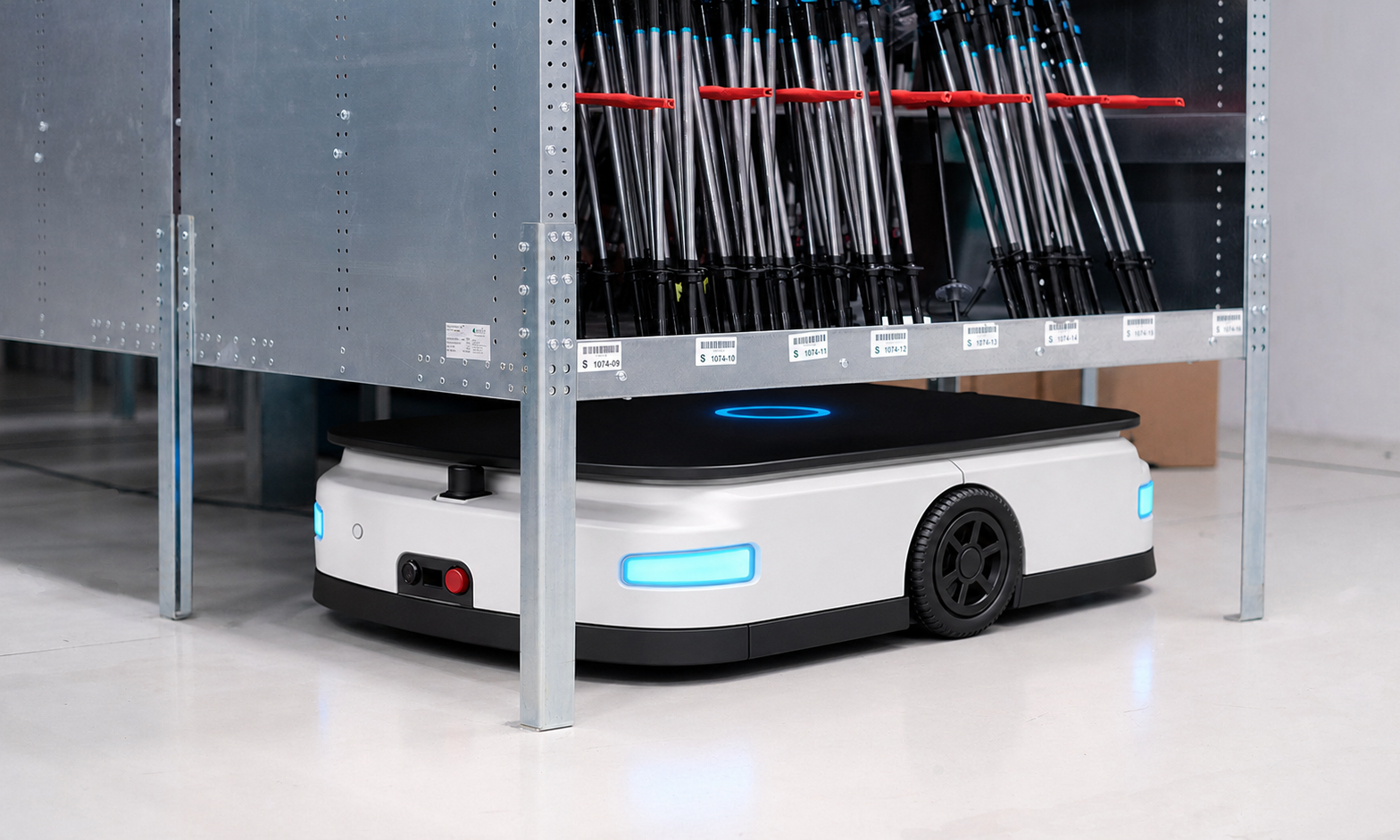
Lifting automated robots move racks, carts, and custom load platforms to automate repetitive warehouse and manufactur...
In warehouses and manufacturing facilities, many materials are not placed directly on the floor. Instead, they are transported on mobile racks, material carts, transfer carriers, or custom load platforms.
When these carriers are mainly moved by workers or require manually operated forklifts for frequent short-distance transfers, repetitive handling, waiting time, and logistics coordination can gradually become bottlenecks as task volumes increase.

Lifting automated robots use an integrated lifting mechanism to travel underneath a compatible carrier, raise the entire carrier, and transport it automatically. This allows point-to-point material movements that previously relied on workers or forklifts to be converted into automated logistics tasks.
A lifting automated robot is a mobile material-handling robot that integrates a mobile base, autonomous navigation, a lifting mechanism, safety sensors, and a control system. It can move underneath a compatible carrier, lift the carrier off the floor, and transport it to a specified destination.
A typical operating cycle is:
Receive task → Travel to pickup point → Move underneath carrier → Position → Lift carrier → Transport automatically → Reach destination → Lower carrier → Depart
Unlike a forklift AGV, which uses forks to pick up pallets from the front or side, a lifting automated robot usually collects a load by driving underneath the carrier.
As a result, this type of robot normally works with mobile racks, carts, or other carriers that have a compatible underside. The robot and the carrier should be designed as a complete material-handling unit.
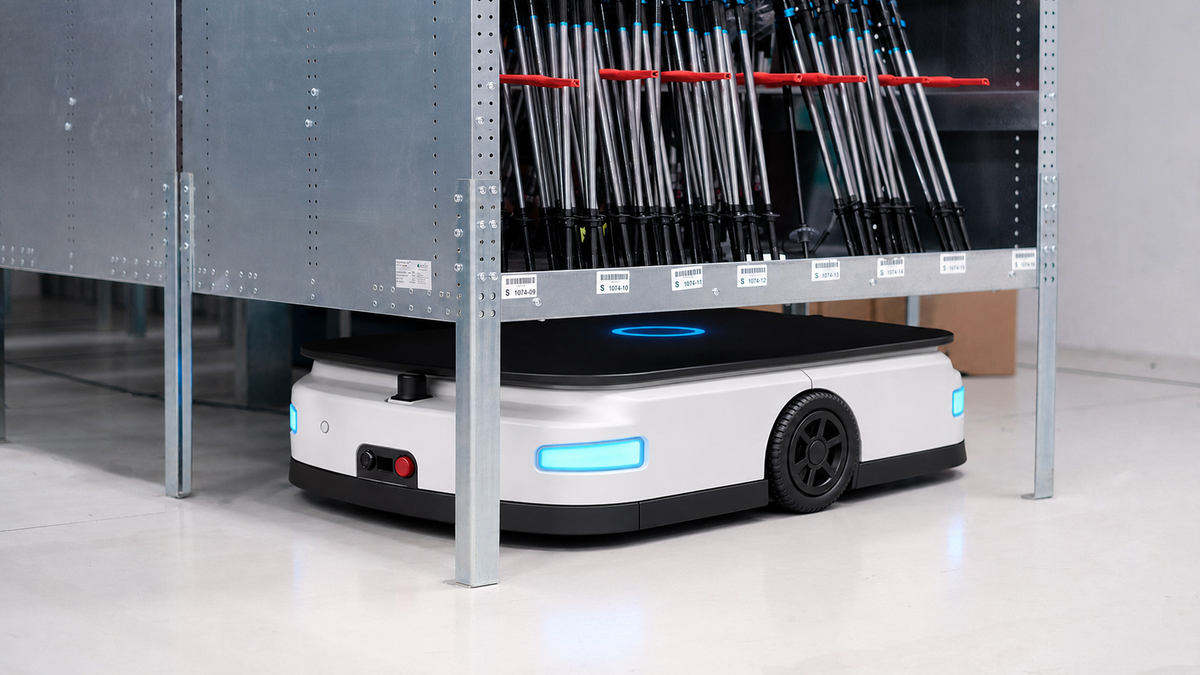
A lifting automated robot usually does not transport individual products directly. Instead, it lifts a load carrier, which then supports the actual materials being moved.
For this reason, the carrier structure, dimensions, and underside clearance directly affect whether the robot can pick up, transport, and place the load reliably.
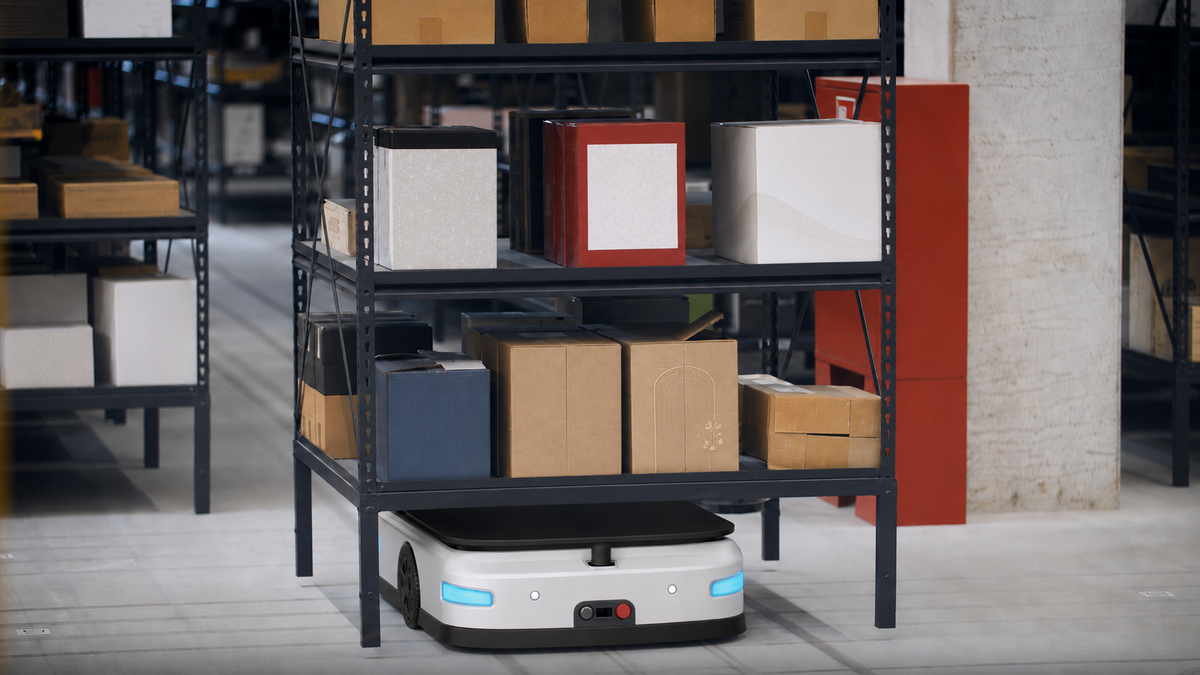
Mobile racks are one of the most common load carriers used with lifting automated robots. The robot travels underneath the rack, lifts the entire rack, and transports it to the assigned location.
Typical applications include:
For example, in a Goods-to-Person system, the robot can move a rack containing multiple SKUs from the storage area to a fixed picking station. After the operator completes the pick, the robot returns the rack to storage.
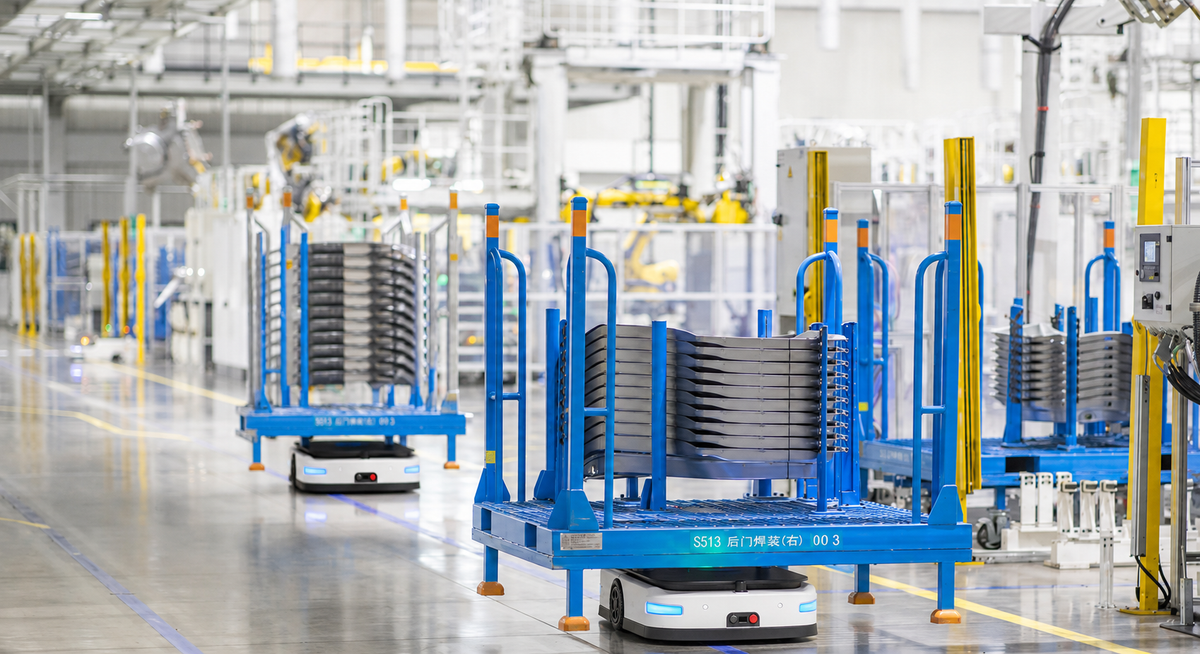
Manufacturing plants frequently use material carts, transfer carts, and mobile racks to move components or work-in-process between warehouses, line-side areas, and production stations.
If the underside of the carrier is compatible with the robot, the lifting automated robot can lift and transport the entire carrier directly.
Common applications include:
This approach allows a facility to keep its existing carrier-based logistics concept while automating transport that previously depended on workers pushing or towing carts.
If cartons, totes, or other goods do not have an underside that can be lifted directly by the robot, a dedicated load platform can be designed for the application.
Platform design typically considers:
The robot transports the platform, while the platform is designed to accommodate the specific goods. This allows the same robot base to support different types of materials through different carrier designs.
In some manufacturing applications, a carrier is used not only for transport but also to secure, position, or protect the workpiece.
Examples include:
Unlike ordinary material carts, these carriers may also need to maintain workpiece orientation, provide positioning references, or interface with production equipment. As long as the underside structure, payload, and positioning method are compatible with the robot, lifting automated robots can transfer them automatically between production processes.
To achieve true material handling automation, the original process that relies on manual decisions and transport needs to be converted into standardized logistics tasks that a system can identify, trigger, and execute.
For example, a traditional replenishment process may look like this:
Production line runs low on material → Operator notifies warehouse → Worker locates material cart → Cart is delivered → Empty cart is returned
After automation, the process can become:
Production line generates replenishment demand → System creates task → Robot is dispatched → Full cart is picked up automatically → Cart is delivered to the line → Empty carrier is returned later
Several key elements are required to make this process work.
The robot needs to know exactly where to collect a carrier and where to place it. Fixed or identifiable pickup stations, drop-off stations, buffer areas, and line-side stations therefore need to be planned.
Each station should allow the robot to move underneath the carrier reliably and complete positioning, lifting, and lowering operations.
The robot, carrier, and material need a stable relationship in terms of dimensions and payload.
For example, the project should verify whether:
Only when the carrier is standardized can the robot perform repeated pickup and drop-off tasks reliably.
The robot also needs to know when a transport task should be performed. Tasks can be generated by WMS, MES, WCS, PLCs, production equipment, or an operator call button.
For example, when component inventory at a production line falls below a replenishment threshold, the MES can issue a replenishment request and the fleet management system can create a transport task.
When multiple robots operate in the same system, a centralized fleet management system is needed to coordinate vehicles and tasks.
The system can assign the appropriate robot based on:
In this way, a lifting automated robot becomes part of the overall automated material flow rather than operating as an isolated transport device.
Lifting automated robots are not suitable replacements for every forklift task. For high-level stacking, complex ad hoc work, or direct handling of standard pallets, forklifts still have clear advantages.
However, for point-to-point transport tasks with standardized carriers, repetitive routes, and clearly defined pickup and drop-off points, lifting automated robots offer several advantages.
Warehouses and production lines often involve repeated transport along the same routes. For high-frequency point-to-point movements, robots can perform these tasks continuously and reduce the need for forklift drivers to repeat the same trips throughout a shift.
Manual transport performance can vary with operator experience, shift conditions, task scheduling, and waiting time. Robots follow standardized task logic, helping make travel cycles on the same route more consistent.
For line-side delivery and WIP handling, this consistency can help material flow stay aligned with production demand.
If materials are already placed on carts, mobile racks, or transfer carriers, a conventional forklift may require an additional pallet or another handling step before the load can be transported.
A lifting automated robot can pick up the entire carrier and move the carrier and materials together, reducing unnecessary secondary transfers.
Robot tasks can be managed through a centralized system, giving operators clearer visibility into which tasks are in progress, which robot is executing each task, task priority, completion status, and exceptions.
This can reduce uncertainty in manual dispatching and make internal logistics more transparent.
Manually operated forklifts often share warehouse and production traffic areas with workers, other vehicles, and production equipment.
For fixed and repetitive routes, lifting automated robots can operate according to predefined traffic rules and fleet-control logic, reducing the frequency of manually driven vehicles traveling through these areas.
With appropriate route planning and safety design, this can improve the organization of internal logistics traffic.
Coolyne can evaluate a project through the following process:
Current logistics analysis → Carrier compatibility assessment → Task volume calculation → Robot selection → Fleet sizing → Station and route planning → Multi-robot dispatching → MES/WMS/WCS integration → Implementation
Project design typically considers:
For warehouses and factories that already use material carts, mobile racks, or transfer carriers, Coolyne can first analyze high-frequency, repetitive logistics tasks with clearly defined origins and destinations to determine which processes are best suited for lifting robot automation.
Coolyne can also evaluate project feasibility and ROI based on actual task volumes and system configuration, helping determine the appropriate number of robots and scope of automation.
If you are evaluating a lifting automated robot project, contact Coolyne to discuss your material handling requirements and receive a project feasibility and ROI assessment.
Next Review
Use the related products and solution paths below, then send your workflow and layout for a quick engineering review.
Related Products
Related Solutions
Engineering Review