
Related Products
Miniload Automated Warehouse: A Complete Guide to Mini Load ASRS
Learn how a miniload automated warehouse works, its components, features, advantages and disadvantages, and how Coolyne can deploy a Mini Load ASRS for your operation.
Learn how a miniload automated warehouse works, its components, features, advantages and disadvantages, and how Cooly...
As the number of warehouse SKUs increases, order sizes become smaller, and delivery expectations grow more demanding, traditional manual processes for locating, transporting, and picking goods are becoming increasingly difficult to sustain. This is particularly true in industries such as e-commerce, retail distribution, automotive parts, electronics manufacturing, and pharmaceuticals, where companies must store large quantities of small items within a limited space while maintaining fast and accurate inbound and outbound operations.
A miniload automated warehouse, also known as a Mini Load Automated Storage and Retrieval System or Mini Load ASRS, is a specialized type of automated storage and retrieval system (ASRS) designed specifically for the storage, retrieval, and transportation of small loads.
The system typically uses totes, cartons, or trays as standardized load carriers. By combining high-bay racking, stacker cranes, conveyor equipment, picking stations, and warehouse control software, it can automate the entire process from receiving and storage to retrieval, picking, and outbound distribution.
What Is a Mini Load System?
A Mini Load Automated Storage and Retrieval System is an ASRS designed specifically to handle small and medium-weight unit loads. Unlike a pallet ASRS, which primarily stores full pallets, a Mini Load ASRS usually handles:
- Plastic totes
- Reusable containers
- Cartons
- Trays
- Parts trays
Other standardized small-load carriers.
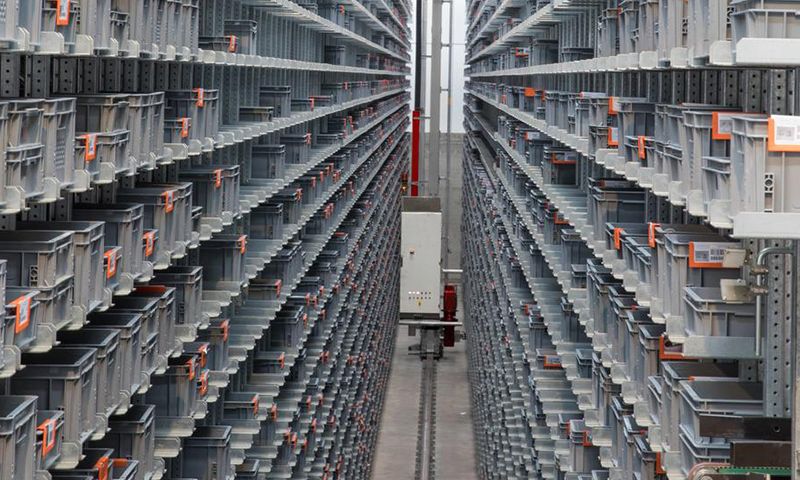
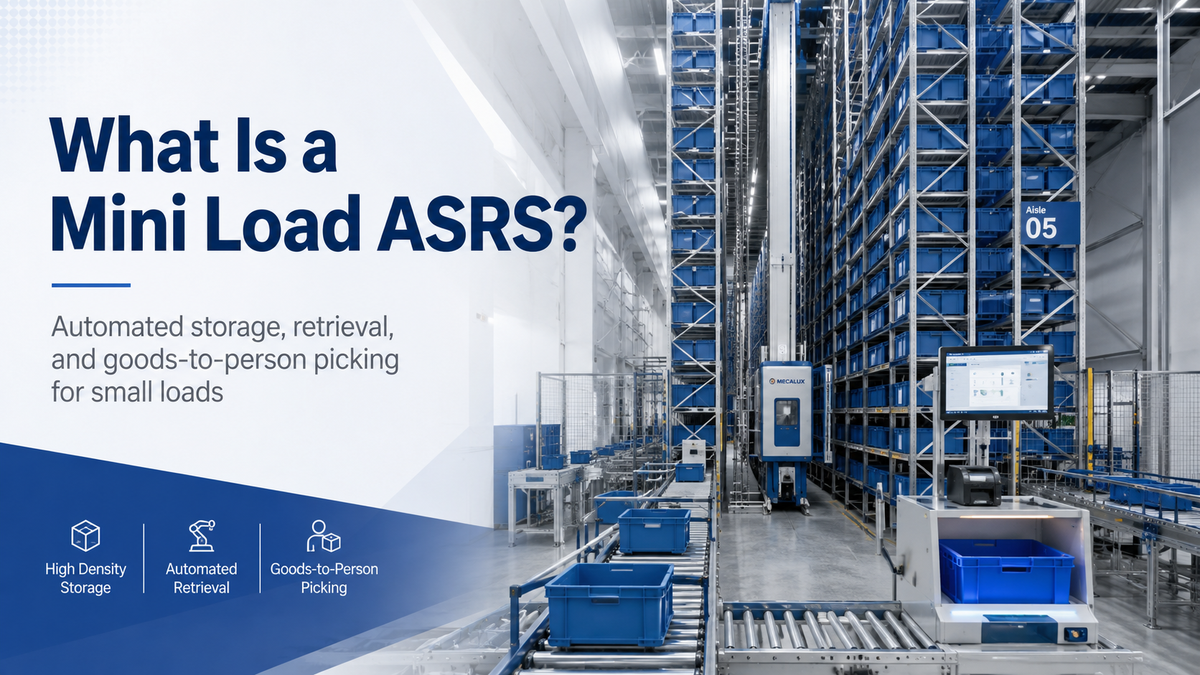
A traditional Mini Load system normally consists of two rows of high-bay racking separated by a narrow aisle. A Mini Load stacker crane travels horizontally and vertically along the aisle. A telescopic fork, extraction device, or gripping mechanism on the crane places containers into storage locations or retrieves them from the racking. The containers are then transferred by conveyors to receiving stations, outbound stations, or order-picking workstations.
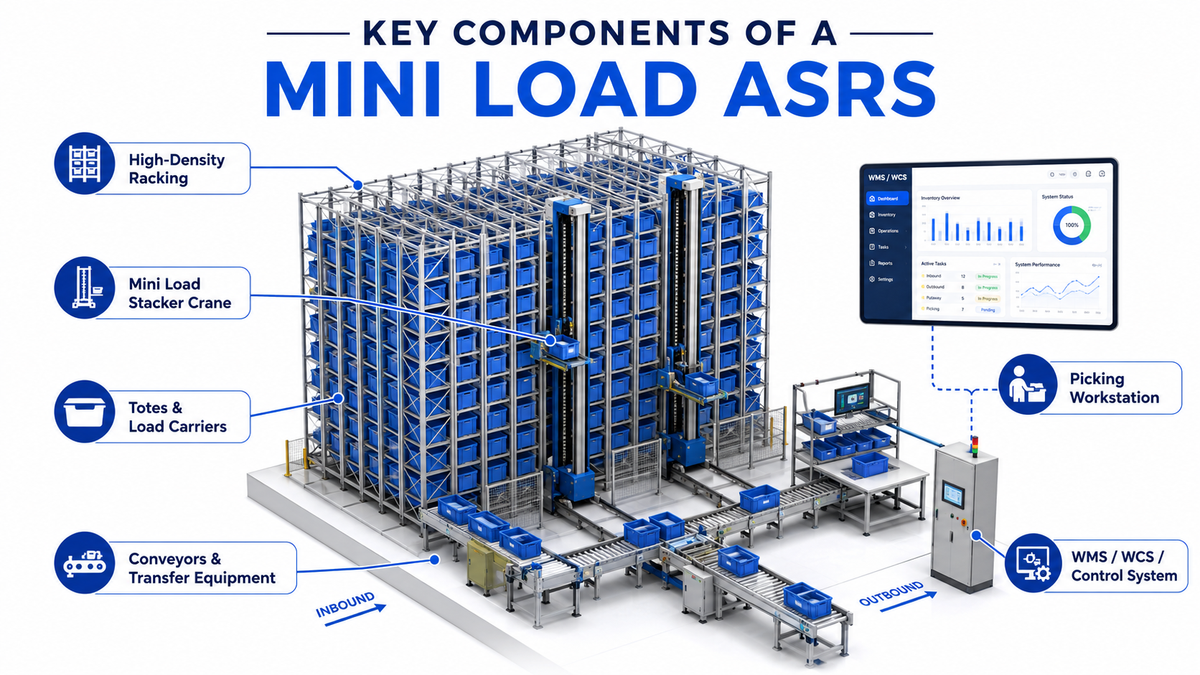
A typical Mini Load system includes racking, automated stacker cranes, inbound and outbound conveyors, picking workstations, and software that controls material flow.
In order-picking applications, a miniload automated warehouse usually operates according to the goods-to-person principle. The system automatically retrieves the required inventory and delivers the tote to the operator. After the required quantity has been picked, the tote containing the remaining inventory is automatically returned to its assigned storage location.
This approach significantly reduces the time employees spend walking through the warehouse, searching for items, and manually transporting inventory.
Components of a Mini Load System
A complete Mini Load Automated Storage and Retrieval System consists of much more than stacker cranes and racking. It combines mechanical equipment, conveyor technology, control systems, and management software into one integrated solution.
1. High-Density Racking System
The racking system stores totes, cartons, trays, and other load carriers. Depending on the warehouse height, building structure, and storage requirements, it can be designed with single-deep, double-deep, or multi-deep storage configurations.
Because stacker cranes require narrower aisles than manual forklifts, a Mini Load system can reduce the amount of floor space dedicated to aisles while making better use of the building’s vertical space.
2. Mini Load Stacker Cranes
The stacker crane is the core piece of equipment responsible for automatically storing and retrieving loads. It travels within a fixed aisle and combines horizontal movement, vertical lifting, and load-handling operations to place containers into designated locations or retrieve them from the racking.
Depending on load weight, warehouse height, and throughput requirements, the system may use single-mast or double-mast stacker cranes. These cranes can also be equipped with single-load, double-load, or multi-load handling devices.
Different system configurations can support single-deep, double-deep, or multi-deep storage, depending on the required storage capacity and access efficiency.
3. Totes and Standardized Load Carriers
Totes do more than hold inventory. They are also the load units directly handled by the automated system. Their dimensions, bottom flatness, structural strength, weight, and resistance to deformation can all affect operational stability.
During the system design stage, companies need to define:
- Tote length, width, and height
- Empty and maximum loaded weight
- Whether products may extend beyond the edges of the container
- Whether antistatic, low-temperature-resistant, or food-grade materials are required
Whether different SKUs can share the same tote.
Standardized and automation-compatible load carriers help ensure smooth transportation, accurate positioning, and reliable storage and retrieval.
4. Conveyor and Transfer Equipment
The conveyor system connects the receiving stations, racking area, stacker cranes, picking workstations, and outbound area. Common equipment includes roller conveyors, belt conveyors, vertical lifts, transfer units, directional change devices, and accumulation conveyors.
Together, these devices form the system’s material flow network, allowing totes to move continuously and accurately between different operational areas.
5. Picking Workstations
In a goods-to-person operation, the system automatically delivers the required tote to an ergonomically designed picking position. Operators do not need to enter the racking area. Instead, they complete each task according to instructions displayed on a screen, pick-to-light system, or voice-picking device.
Picking workstations can also integrate:
- Barcode scanning
- Weight verification
- Electronic labels
- Order-container conveyors
Automatic packing and sealing equipment.
These technologies can further improve picking accuracy and standardize the order fulfillment process.
6. WMS, WCS, and Equipment Control Systems
The Warehouse Management System, or WMS, manages inventory, orders, batches, and storage locations. The Warehouse Control System, or WCS, coordinates tasks among stacker cranes, conveyors, lifts, and picking stations. PLCs and equipment control systems execute the actual mechanical movements.
By integrating the Mini Load ASRS with an ERP, MES, or other business system, the warehouse can automatically schedule receiving, putaway, replenishment, picking, and outbound tasks according to production plans and customer orders.
Features of a Mini Load System
High-Density Vertical Storage
A Mini Load system uses high-bay racking and narrow aisles to increase storage capacity per unit of floor space. It is particularly suitable for companies facing high real estate costs, limited warehouse space, or the need to expand storage capacity within an existing facility.
Fast and Accurate Storage and Retrieval
Stacker cranes can travel directly to assigned storage locations according to system instructions, eliminating the need for employees to manually search for inventory.
The combination of automated positioning, standardized load carriers, and software-controlled task execution allows the system to complete storage and retrieval operations quickly and accurately.
Suitable for Many SKUs and Small Items
A miniload automated warehouse is particularly suitable for operations that handle a large number of SKUs, small products, and frequently moving inventory. Typical applications include:
- Electronic components
- Automotive spare parts
- Hardware and tools
- Pharmaceutical products
E-commerce merchandise.
Goods-to-Person Picking
The system automatically delivers the required inventory to a fixed workstation, reducing operator walking, bending, and climbing. It also makes the picking process more consistent and easier to standardize.
Automated Inventory Tracking
Every tote, storage location, and storage or retrieval task can be recorded by the system. This gives companies real-time visibility into inventory quantities, locations, and task status.
Barcode scanning, weight verification, and machine vision can also be integrated to further reduce inventory and picking errors.
Multiple Storage-Depth Configurations
Single-deep storage provides direct access to every tote and uses relatively simple control logic. Double-deep or multi-deep storage increases storage density but requires more advanced load-handling equipment, inventory strategies, and task scheduling.
The appropriate configuration depends on the required storage capacity, SKU profile, inventory turnover rate, and system throughput.
Advantages and Disadvantages of a Mini Load System
Main Advantages of a Mini Load ASRS
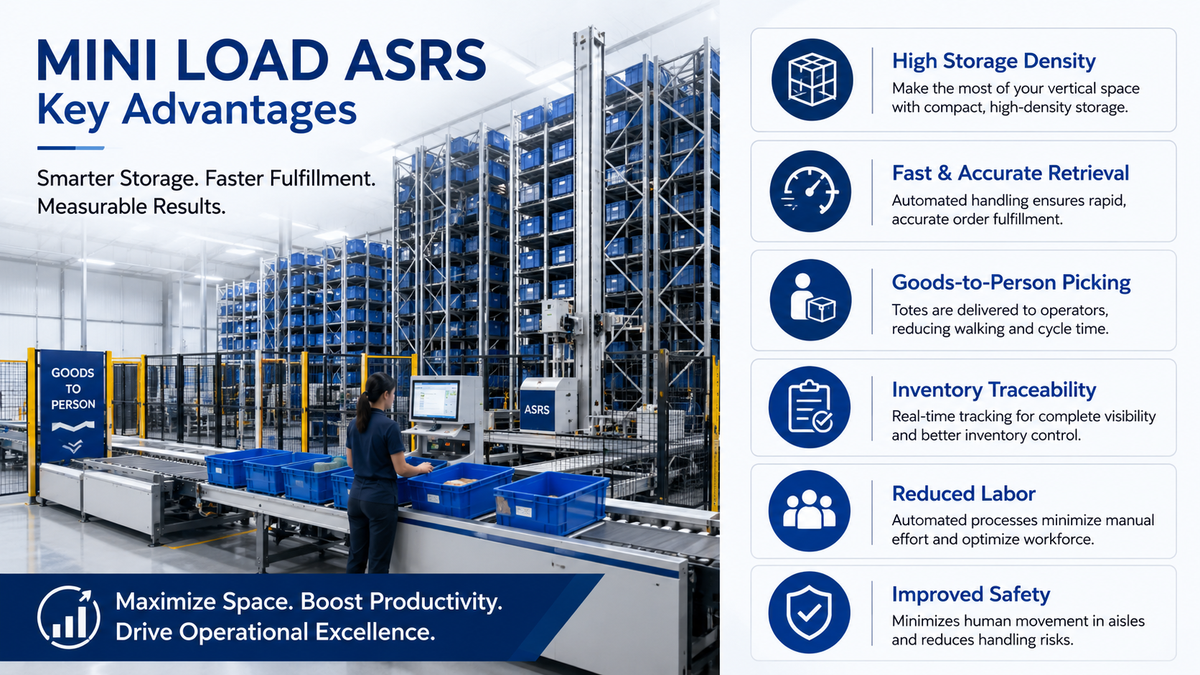
Improved space utilization. High-bay racking, narrow aisles, and compact storage locations allow companies to store more inventory within a limited footprint. This may reduce or delay the need to expand the building or rent additional warehouse space.
Higher warehouse throughput. Automated equipment can continuously perform storage and retrieval tasks. Task sequencing, dual-cycle operations, and dynamic inventory allocation can reduce empty travel and increase overall system throughput.
Greater inventory and picking accuracy. Because the system executes tasks according to barcode, order, and storage-location data, it can reduce problems such as misplaced inventory, incorrect SKU selection, and inconsistencies between physical stock and inventory records.
Less non-value-added manual work. Goods-to-person picking reduces the amount of time employees spend walking between shelves, searching for products, and transporting inventory. Workers can focus more on picking, verification, and exception handling.
Improved working conditions and safety. Employees do not need to enter high-bay, narrow-aisle, or low-temperature storage areas. They also have less need to climb ladders or manually carry heavier totes, which can help reduce certain workplace risks.
Better inventory traceability. The system can record the complete journey of each tote through receiving, storage, movement, picking, and outbound processing. This supports inventory counts, batch management, and operational analysis.
Potential Disadvantages of a Mini Load ASRS
Higher initial investment. A Mini Load ASRS requires racking, stacker cranes, conveyor equipment, control software, safety systems, and system integration. Its initial investment is generally higher than that of conventional racking and manual picking.
Greater need for standardized load carriers. Totes with inconsistent dimensions, deformed bottoms, or products extending beyond their edges may interfere with stable transportation and retrieval. Companies often need to standardize container specifications and packaging methods before deployment.
Equipment failures can affect the overall process. If a stacker crane, main conveyor, or control system fails, the related aisle or operating area may become temporarily unavailable. The system design should therefore consider equipment redundancy, buffer capacity, manual contingency processes, and spare-parts planning.
Future adjustments require careful planning. Racking height, aisle quantity, and equipment capacity are generally determined during the initial project design. If SKU dimensions, inventory profiles, or peak order volumes change significantly in the future, modifying the system may be more complex than adjusting conventional racking.
It is not suitable for every warehouse. If a company has only a few SKUs, low inventory turnover, irregularly shaped products, or limited daily storage and retrieval activity, the efficiency gains may not be sufficient to justify the investment.
A detailed throughput analysis and ROI assessment should therefore be completed before the project begins.
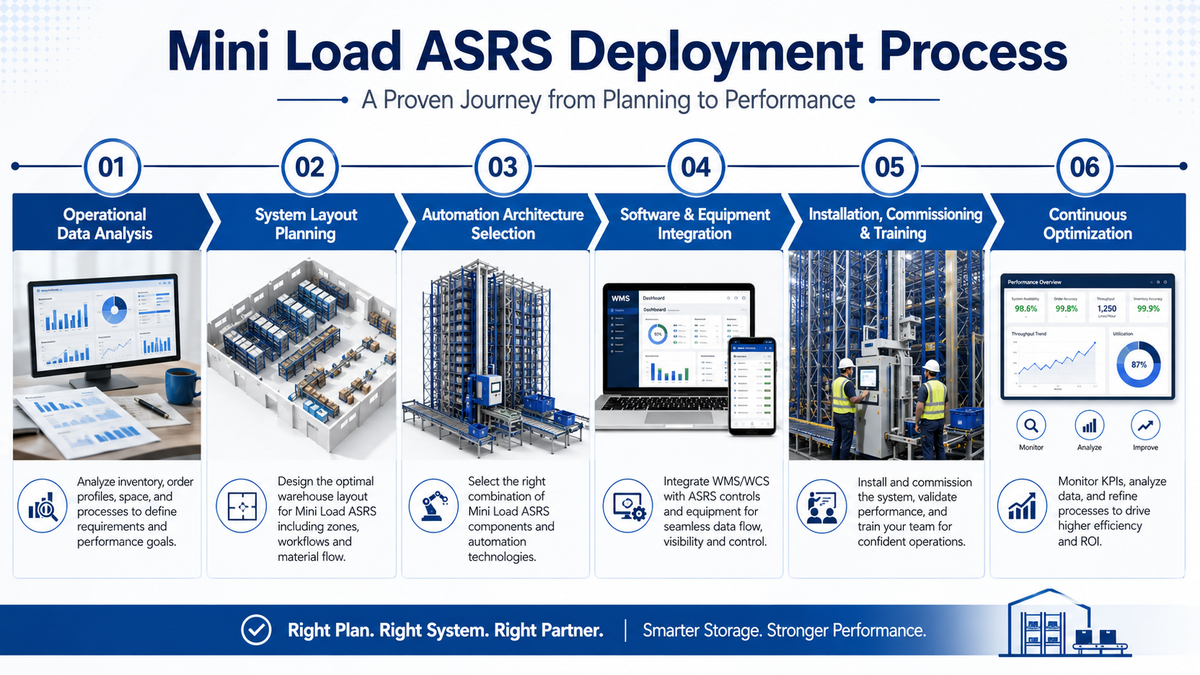
How Coolyne Can Deploy a Mini Load System for Your Operation
Deploying a miniload automated warehouse requires storage equipment, material handling equipment, software, and actual business processes to be planned as one integrated system.
Based on your warehouse conditions, inventory profile, and order requirements, Coolyne can develop a customized automated storage and picking solution for your operation.
1. Analyze Operational and Material Data
At the beginning of the project, key information must be collected, including:
- Warehouse dimensions
- Number of SKUs
- Tote specifications
- Inventory volume
- Inbound and outbound frequency
- Order profiles
Projected future growth.
Coolyne can use this information to identify normal throughput, peak throughput, and storage capacity requirements.
2. Plan the System Layout
Based on the building height, column grid, fire safety requirements, and existing operational areas, the system layout can define the racking height, number of aisles, storage depth, workstation locations, and conveyor routes.
A well-planned layout reduces unnecessary transfers, prevents material flow conflicts, and creates a more direct path between receiving, storage, picking, and outbound operations.
3. Select the Appropriate Automation Architecture
Depending on storage capacity, access frequency, and budget, Coolyne can evaluate a stacker-crane-based Mini Load ASRS, a shuttle system, or another small-item automated storage solution.
System selection should not be based solely on equipment speed. Peak throughput, redundancy, scalability, maintenance requirements, and future operational changes must also be considered.
4. Integrate Warehouse Software and Existing Equipment
Coolyne can help connect the warehouse management, warehouse control, and equipment execution layers so that orders, inventory, and automation equipment remain synchronized.
Depending on project requirements, the Mini Load system can also be integrated with:
- ERP systems
- MES platforms
- Conveyor systems
- AGVs
- AMRs
Other warehouse automation equipment.
This integration enables information and materials to move through the operation in a coordinated way.
5. Complete Installation, Commissioning, and Training
After the equipment has been installed, the project should undergo individual equipment testing, interface testing, load testing, and exception-recovery testing. These steps confirm that the system can operate reliably under real order conditions.
Operators and maintenance personnel should also receive training in daily operation, basic troubleshooting, emergency procedures, and system safety.
6. Continuously Optimize System Performance
After the system goes live, operational data can be used to analyze equipment utilization, order waiting times, workstation efficiency, and inventory distribution.
Storage allocation, task scheduling, replenishment strategies, and picking processes can then be optimized to improve the system’s long-term performance.
Whether a Mini Load ASRS is suitable for your warehouse ultimately depends on your product dimensions, SKU profile, storage capacity, order throughput, and return-on-investment goals.
Contact Coolyne to discuss your warehouse automation requirements and receive a customized system planning and implementation solution.
Next Review
Move from article research to a scoped feasibility review.
Use the related products and solution paths below, then send your workflow and layout for a quick engineering review.
Related Solutions
Engineering Review