
Related Products
Mobile Manipulator Robot: What It Is and When It Fits
Learn what a mobile manipulator robot is, how it differs from AMRs and fixed robot cells, and when it makes sense in automation.
Learn what a mobile manipulator robot is, how it differs from AMRs and fixed robot cells, and when it makes sense in...
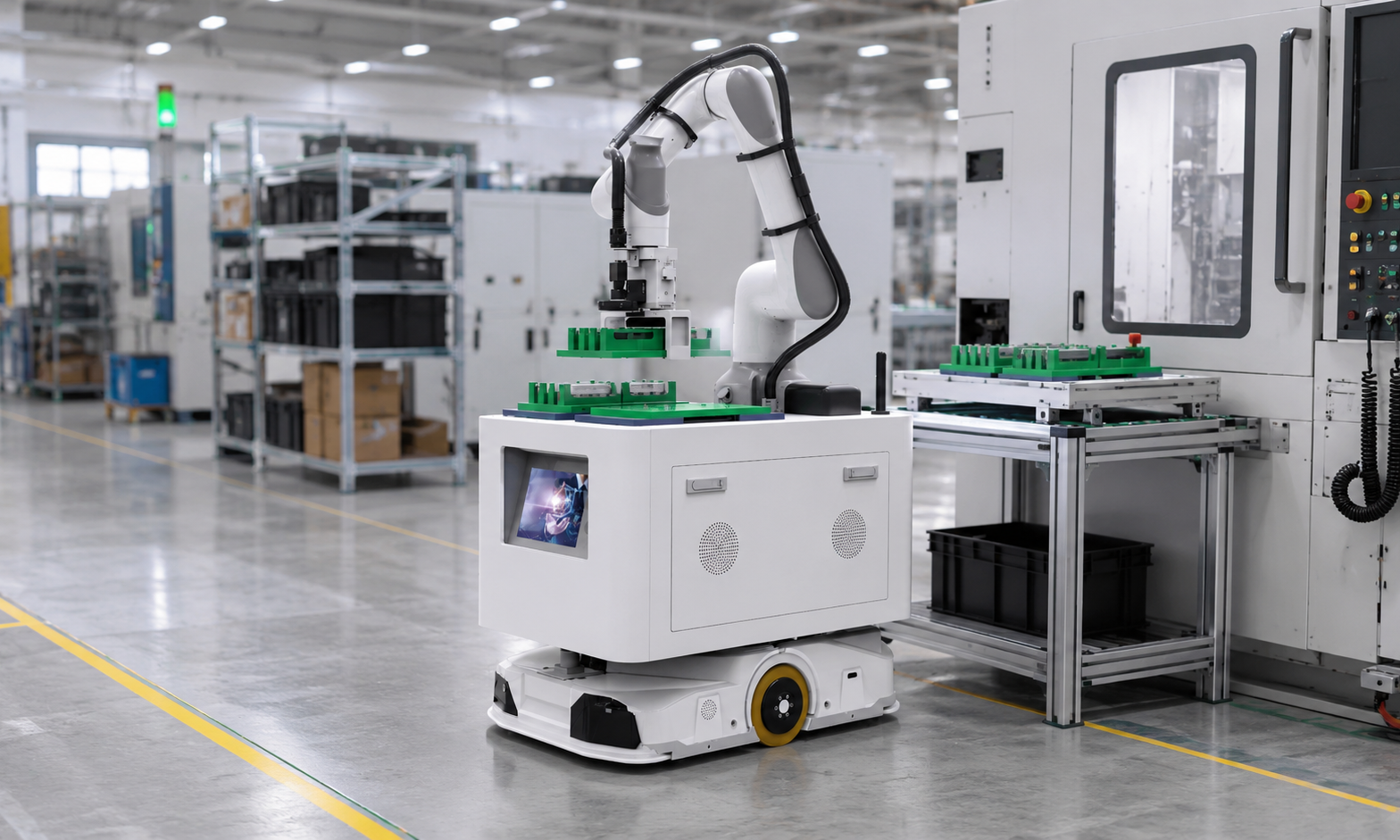
A mobile manipulator robot is a robot that can travel to a workstation and then use an arm to pick, place, load, inspect, or otherwise handle something there. It is useful in jobs that need both movement and manipulation in the same workflow, not just one or the other.
The category is relevant in factories, warehouses, labs, and mixed intralogistics environments where work does not stay in one exact spot. If a task is too spread out for a fixed robot cell but too hands-on for a transport robot alone, mobile manipulation becomes a realistic option.
What makes a robot a mobile manipulator?
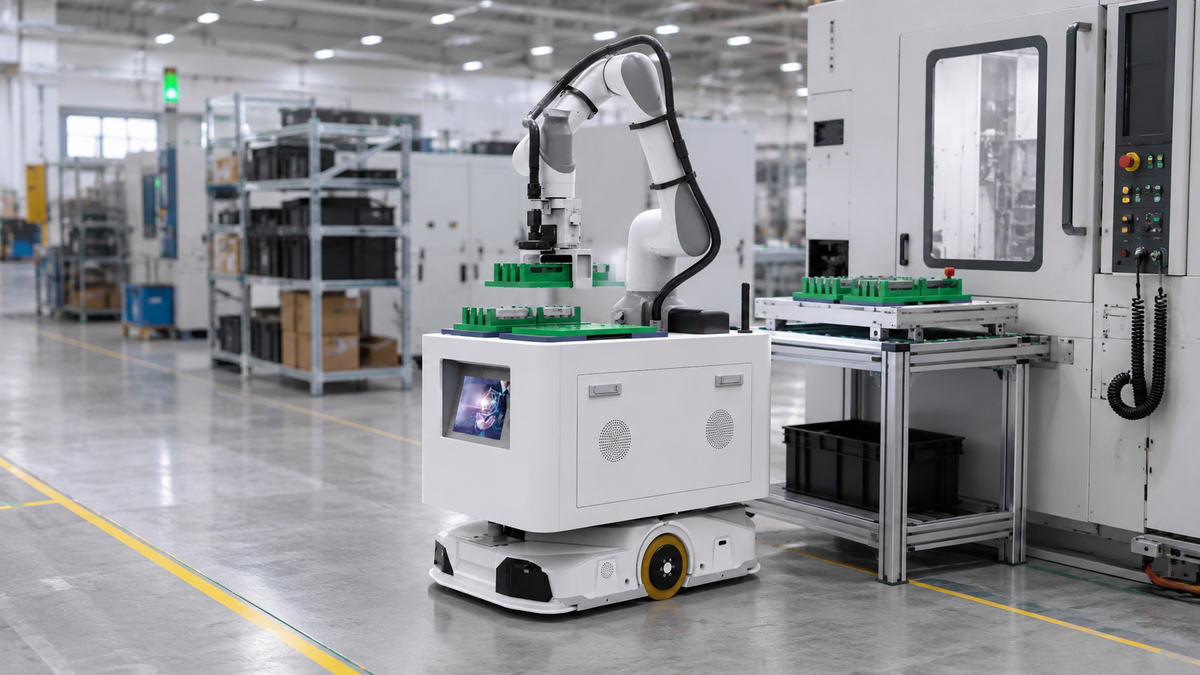
Not every robot with a base and an arm belongs in this category. A robot becomes a mobile manipulator when the travel, stopping position, and arm action are planned as one task rather than as two loosely connected steps.
Why mobility and manipulation have to work as one system
In robotics literature, a mobile manipulator is usually described as a mobile base equipped with a robot arm. A common control pattern is to drive the base to a location, stop, and then let the arm do the more precise work. Some tasks also require the base and the arm joints to move in coordination rather than one after the other.
The job changes in a practical way. The robot is not just carrying a tool from place to place. The same system is responsible for reaching the work point, establishing a usable position, and then handling the part there.
How it differs from AMRs, AGVs, and fixed robot cells
An AMR mainly moves material between points. An AGV usually follows a more fixed transport path. A fixed robot cell stays in one work envelope and repeats manipulation there. A mobile manipulator overlaps with all three, but it owns both the travel and the part interaction.
If the robot only moves carts, racks, totes, or pallets, it is closer to a transport robot. If it only picks and places inside one permanent station, it is closer to a fixed cell. Mobile manipulation sits between those categories because the task itself spans travel plus handling.
When does a mobile manipulator make more sense than a fixed robot?
This category makes more sense when one robot needs to serve several work points instead of one permanent station. This usually happens when machines are spaced apart, when layouts change, or when the work is too distributed to justify a dedicated robot cell at every point.
The advantage becomes clearer when the process itself includes movement plus handling. One system can travel to a machine, rack, conveyor, or inspection point, do the arm work there, and then move on to the next stop. This is different from building several small fixed cells or asking people to keep walking parts between them.
It is usually less attractive when the job happens in one exact position and demands the shortest possible cycle time. In that kind of process, a fixed robot cell is often easier to guard, easier to tune, and easier to optimize for repeatability.
What jobs can mobile manipulator robots do?
The best examples are jobs where parts need to be reached, positioned, and handled across more than one location. In commercial systems, common target applications include machine tending, pick and place, tote or tray transfer, inspection support, and material handling between stations.
Coolyne's Composite Mobile Robot is one example of this category, positioned for factory and intralogistics tasks that need both mobile travel and robotic arm handling.
Machine tending, part feeding, and cross-station handling
Machine tending is one of the clearest fits. The robot can move to a CNC, press, or other machine, load or unload a part, and then continue to the next station instead of staying tied to one asset. The same logic applies to part feeding and cross-station handling, where material has to reach several points but still needs controlled placement.
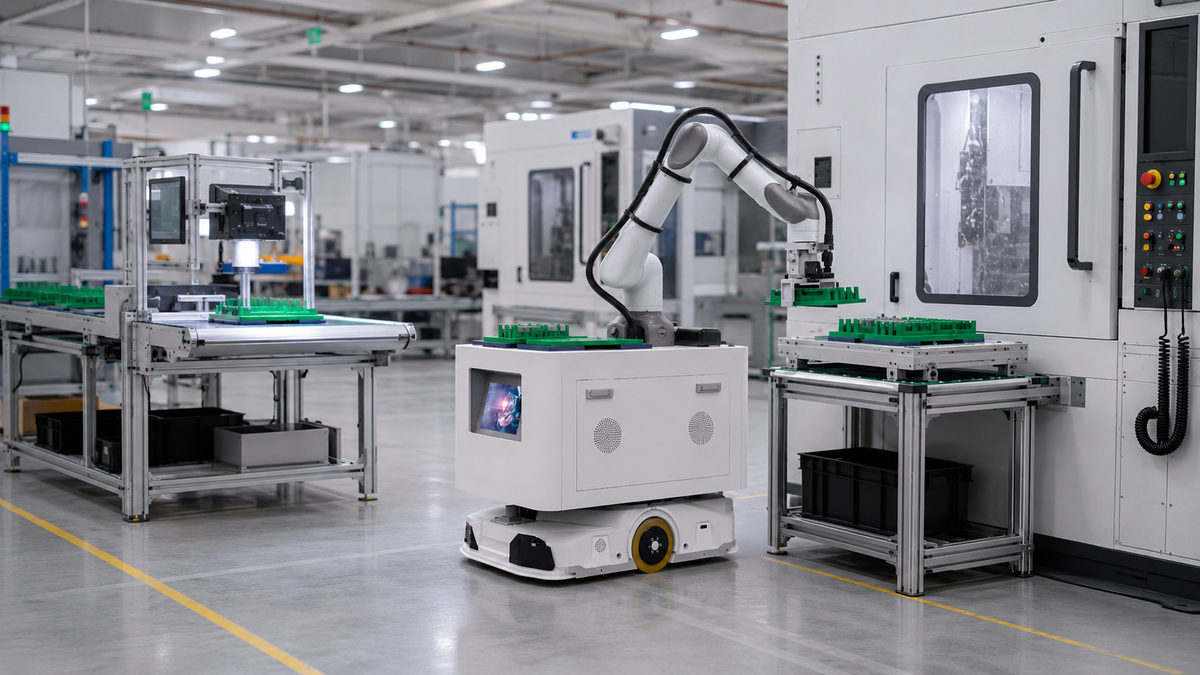
This becomes especially practical when several stations are close enough to share one robotic resource, but far enough apart that manual walking, loading, and unloading still consume time and labor.
Picking, transfer, inspection, and intralogistics support
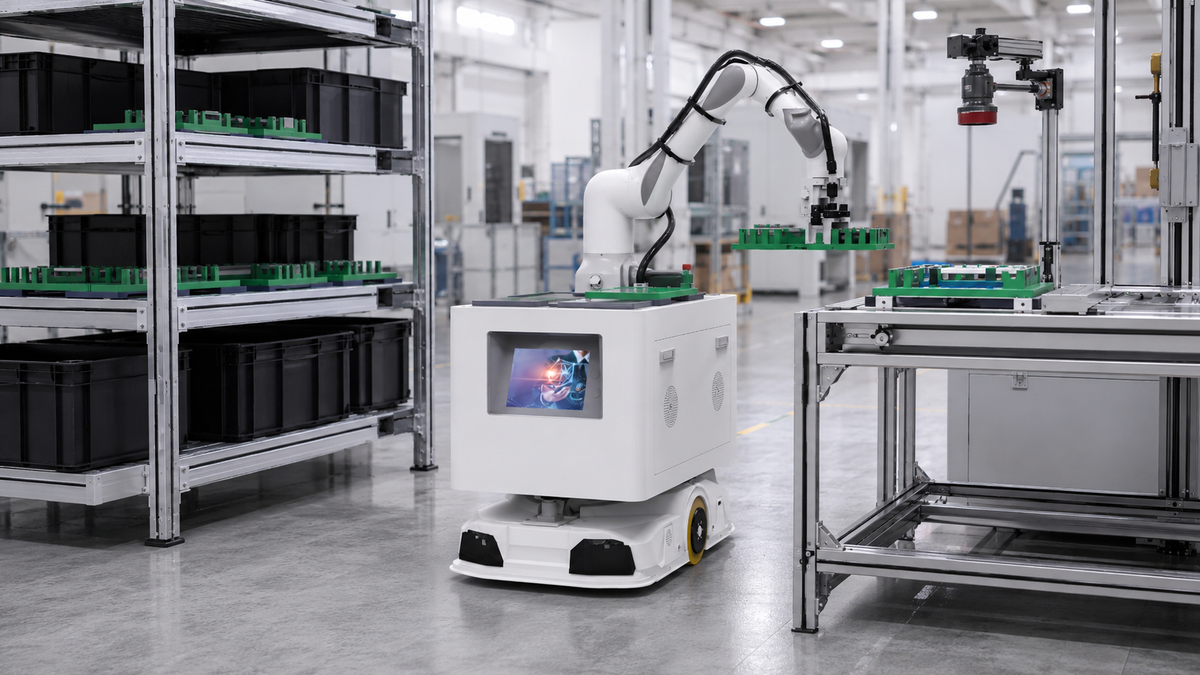
Mobile manipulators also show up in picking, tray or tote transfer, inspection support, and internal logistics tasks that involve more than simple transport. A robot may need to pick from a rack, present a part to a scanner or camera, place it into a fixture, or hand it off to another step in a repeatable way.
Those tasks sit in the middle ground between transport and full workcell automation. The robot is not only moving the object between destinations. It is changing the state or position of the object as part of the move.
Why is mobile manipulation harder than it looks?
Mobile manipulation combines two hard problems in one machine. The robot has to travel through a live environment and then perform arm motion accurately enough for the task once it arrives.
Stopping accuracy matters as much as arm precision
A fixed arm starts from a stable base. A mobile manipulator does not. It has to navigate, stop in a repeatable pose, confirm where the workstation really is, and only then execute the arm motion. Tight tolerances make that chain harder very quickly.
Mobile manipulator systems therefore place heavy emphasis on docking accuracy, workstation references, cameras, lasers, or other sensing aids. The arm can be accurate on its own and still miss the job if the robot does not arrive in the right place or orientation.
Real facilities add safety and integration work
Real sites add people, forklifts, aisle constraints, changing pallets, lighting variation, and software handoffs. A mobile manipulator has to move safely through that environment and still complete the arm task at the end of the route. This usually creates more integration work than a fixed robot inside a tightly controlled cell.
The difficulty is not only in the robot hardware. It is in getting navigation, safety behavior, workstation alignment, grippers, vision, and upstream or downstream systems to behave reliably in one flow.
Why are more operations looking at mobile manipulators now?
More operations now need automation beyond one fixed workstation. At the same time, mobile robotics, vision, sensing, and system software have improved enough to make more of these projects practical than they were a few years ago.
More operations now need automation beyond fixed workstations
Many workflows now stretch across staging zones, machines, buffers, racks, and handoff points instead of staying inside one boxed-off cell. In that layout, the automation gap often appears between stations rather than inside a single station.
Better mobile robotics, vision, and software make them more practical
As navigation, perception, docking, and software integration improve, mobile manipulators become more usable for jobs that once felt too fragile or too complex. The category still has clear limits, but it now fits more real production and warehouse tasks than a pure lab concept ever could.
A mobile manipulator robot is worth studying when a task truly needs both movement and handling in one flow. If the job only needs transport, a simpler mobile robot may fit better. If it only needs fast, repeated motion in one exact location, a fixed cell usually remains the cleaner answer.
If your workflow already looks like a mobile manipulation job, Coolyne's Composite Mobile Robot is a practical next example to review. If you are still sorting out task fit, contact Coolyne for a short feasibility discussion.
Next Review
Move from article research to a scoped feasibility review.
Use the related products and solution paths below, then send your workflow and layout for a quick engineering review.
Related Solutions
Engineering Review