
Related Products
Pallet Picking: What Is It and How Can It Be Automated?
Learn what pallet picking means, how it differs from case picking, its key warehouse benefits, and how automated forklifts, AGVs, and WMS/WCS systems can automate full-pallet workflows.
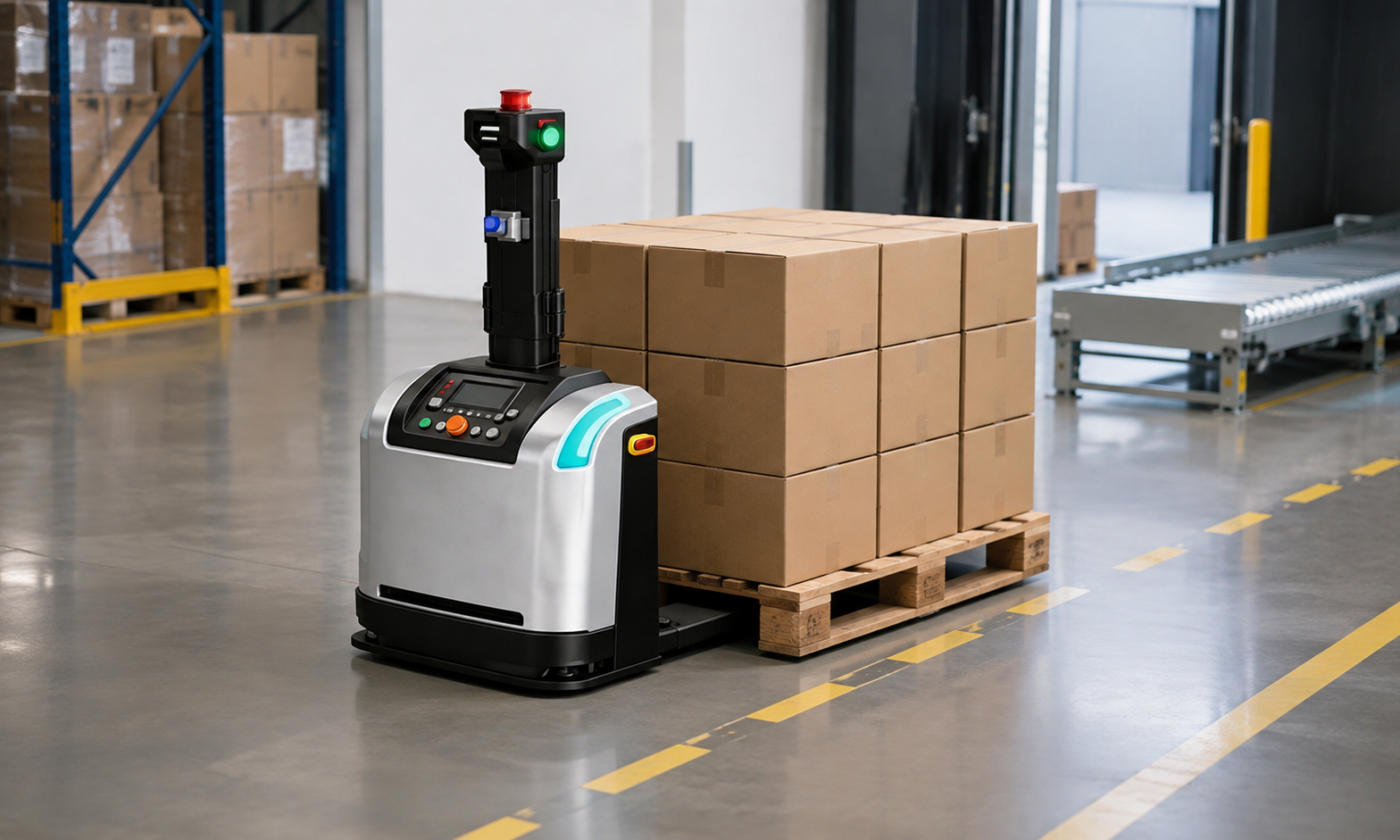
Learn what pallet picking means, how it differs from case picking, its key warehouse benefits, and how automated fork...
In warehouse picking operations, not every order needs to be broken down into cases or individual items. When a customer orders a full pallet of goods, or when a warehouse needs to move an entire pallet directly from storage to the shipping area, picking by pallet is often more efficient.
This process is known as Pallet Picking. It is widely used in manufacturing, retail distribution centers, food and beverage operations, third-party logistics (3PL), and other warehouses that handle large volumes of full-pallet orders.
This article explains how pallet picking works, how it differs from Case Picking, its main advantages, and how pallet picking is gradually becoming automated.
What Is Pallet Picking?
Pallet Picking, also known as Full Pallet Picking, is a warehouse picking method in which a complete pallet is treated as the smallest picking unit. The designated pallet is retrieved from its storage location and transported to a staging area, shipping area, production line, or another specified destination.
For example, a distribution center may receive an order requiring:
- 1 pallet of beverages
- 2 pallets of packaged food
- 3 pallets of the same type of industrial component
If these products are already stored as complete pallet loads, there is no need to break down the pallets and pick individual cases. Instead, the entire pallet can be retrieved directly according to the order.
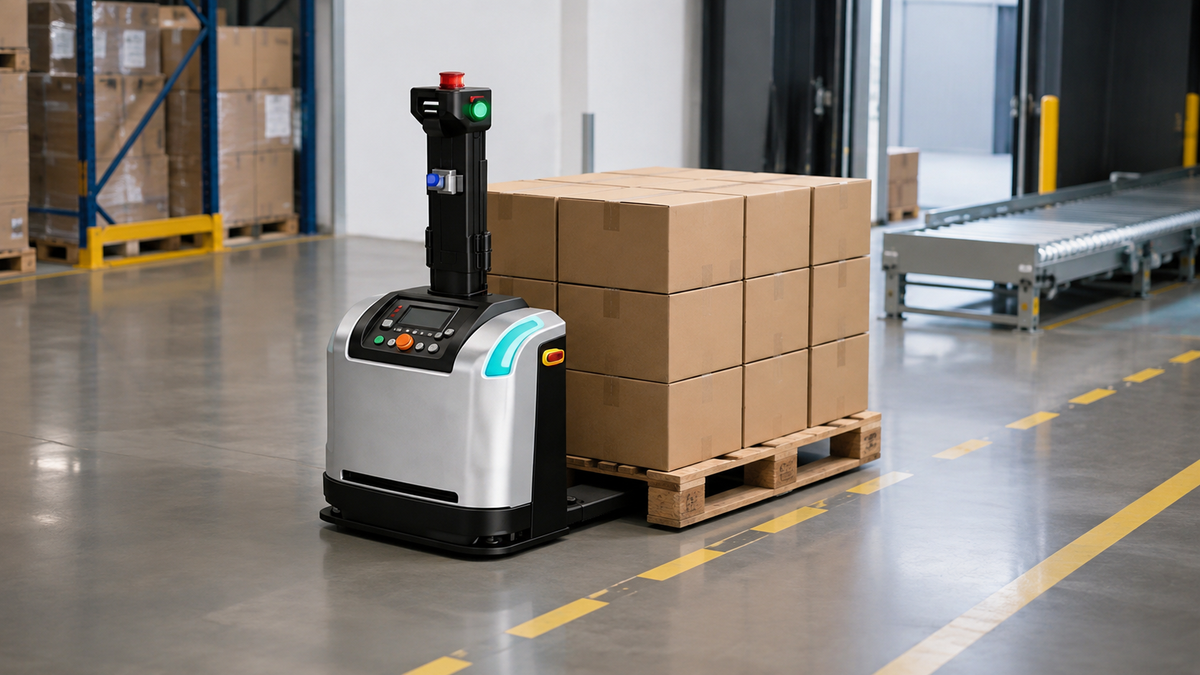
A typical pallet picking process can be summarized as:
Order generated -> Inventory location identified -> Target pallet located -> Pallet retrieved -> Transported to staging or shipping area -> Task confirmed
In traditional warehouses, these steps are usually completed with manually operated forklifts. In automated warehouses, automated forklifts, AGVs, conveyor equipment, and WMS/WCS platforms can perform some or all of these operations.
Because pallets are generally larger and heavier than cases or individual items, Pallet Picking relies more heavily on forklifts, pallet-handling equipment, and other material handling systems than Piece Picking or Case Picking.
Pallet Picking vs. Case Picking
Pallet Picking and Case Picking are both warehouse order-picking methods, but the most important difference is the unit being picked.
| Comparison | Pallet Picking | Case Picking |
|---|---|---|
| Picking unit | Full pallet | Full case/carton |
| Pallet breakdown required | Usually no | Usually requires removing cases from a pallet |
| Load per pick | Large | Medium |
| Common equipment | Forklifts, automated forklifts, pallet-handling AGVs | Manual picking, conveyors, AGVs, picking equipment |
| Typical order | Full-pallet order | Multi-case order |
| Common applications | Wholesale, manufacturing, bulk distribution | Retail, e-commerce, distribution centers |
For example, suppose one pallet contains 50 cases of a product.
If an order requires all 50 cases, the warehouse can retrieve the entire pallet. This is Pallet Picking.
If the order requires only 10 cases, those cases must be picked from the pallet. This is Case Picking.
Therefore, Pallet Picking and Case Picking are not competing technologies. They are different picking methods used for different order quantities.
Many distribution centers use Pallet Picking, Case Picking, and Piece Picking at the same time, selecting the appropriate method based on order quantity and how inventory is stored.
4 Advantages of Pallet Picking
1. Higher Picking Efficiency for Large Orders
For full-pallet orders, or orders close to a full pallet quantity, Pallet Picking allows the entire pallet to be retrieved directly from storage without picking, scanning, moving, and restacking individual cases.
This reduces the number of handling steps required for each order and can improve both order-processing speed and warehouse throughput.
As a result, Pallet Picking is particularly efficient in wholesale distribution, food and beverage operations, manufacturing, and other environments where full-pallet orders account for a significant share of outbound volume.
2. Less Manual Handling
Case Picking and Piece Picking often require workers to handle products repeatedly, while Pallet Picking relies primarily on forklifts or other pallet-handling equipment.
Reducing direct manual handling is especially important for heavier products, including:
- Food and beverages
- Industrial raw materials
- Automotive components
- Home appliances
- Packaging materials
Using mechanical equipment for pallet movement reduces repetitive manual handling while helping maintain efficient warehouse operations.
3. Lower Risk of Product Damage
Full-pallet shipping reduces the need to break down pallets, restack products, and repeatedly handle individual goods.
Every additional handling step can increase the risk of crushed packaging, load shifting, reduced pallet stability, or product damage.
When an order can be shipped as a complete pallet, the original pallet load can remain largely intact throughout the fulfillment process.
This is particularly beneficial for products with fragile packaging, damage-sensitive goods, or loads that need to maintain a stable stacking configuration.
4. A Simpler Order Fulfillment Process
Full-pallet orders do not require complex pallet breakdown and reassembly, making the process from storage to shipping much more direct.
For example, Case Picking may involve:
Storage -> Pallet breakdown -> Case picking -> Restacking -> Transport -> Shipping
Pallet Picking can simplify this to:
Storage -> Full-pallet transport -> Shipping
For warehouses with a high proportion of full-pallet orders, a simpler process also makes it easier to plan storage locations, transport routes, and operating cycles.
Automation Is the Future of Pallet Picking
Traditional Pallet Picking typically depends heavily on forklift operators.
After an order is generated, an operator must drive to the designated storage location, identify the correct pallet, retrieve it, and transport it to the staging or shipping area.
As order volumes increase, this model can become constrained by workforce availability, driving efficiency, travel distances, and forklift scheduling.
For this reason, more warehouses are beginning to automate repetitive pallet-handling tasks.
In an automated environment, pallet locating, retrieval, and transportation tasks traditionally performed by forklift operators can instead be handled by automated forklifts or AGVs.
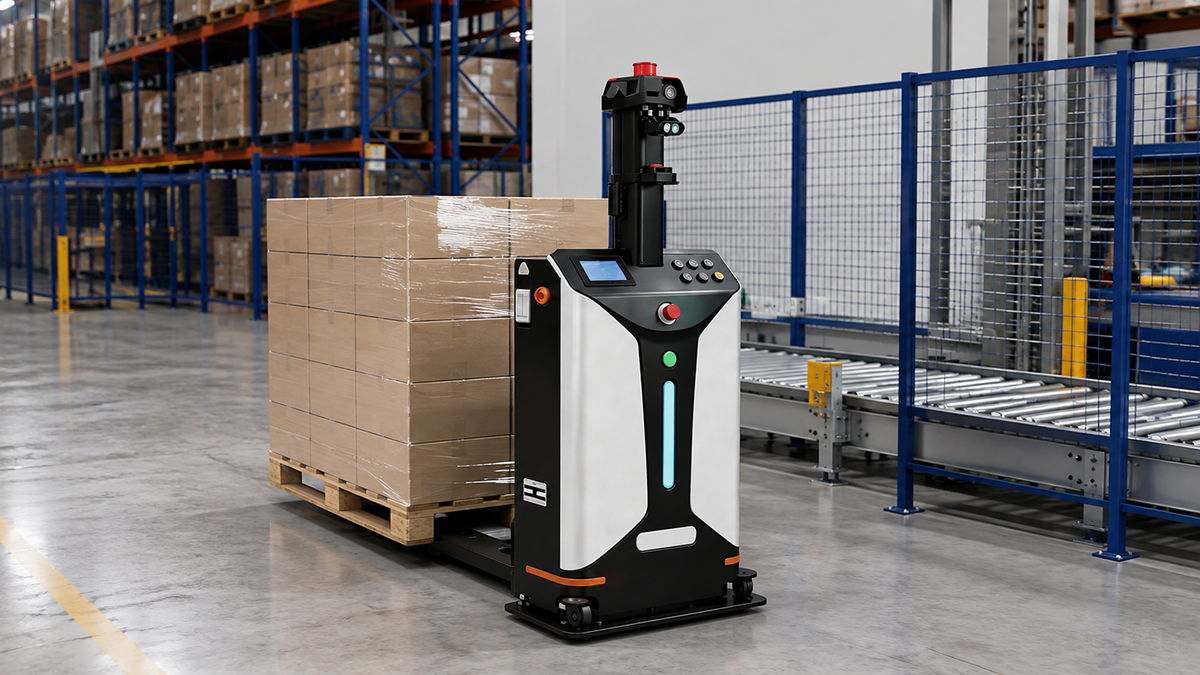
The WMS/WCS generates tasks based on order and inventory information, while the fleet management system assigns those tasks to the appropriate equipment. The vehicle then travels to the designated location, picks up the pallet, transports it to its destination, and reports the task status back to the system.
This approach is particularly suitable for:
- Pallet transport along fixed routes
- High-frequency full-pallet inbound and outbound operations
- Pallet delivery between warehouses and production lines
- Automated storage and retrieval of finished-goods pallets
- Multi-shift or 24/7 logistics operations
Because pallets are relatively standardized in size and handling method, they can also be effectively integrated with automated forklifts, AGVs, AS/RS, pallet conveyors, and automated palletizing equipment.
As equipment and software systems become increasingly interconnected, Pallet Picking can evolve from a standalone forklift operation into an integrated part of a broader warehouse and intralogistics automation system.
Coolyne Provides Free Automated Pallet Picking Solutions
Pallet Picking processes vary from one warehouse to another.
Pallet dimensions and weight, rack type, lifting height, aisle width, transport distance, order frequency, and the existing WMS can all affect the design of an automation solution. Therefore, before selecting an automated forklift or AGV, it is important to first analyze actual pallet flows and operational requirements.
Coolyne can design an automated pallet picking solution based on your warehouse layout, pallet specifications, transport routes, and throughput requirements, integrating automated forklifts, AGVs, fleet management systems, and your existing warehouse systems.
If you are evaluating a Pallet Picking automation project, contact us for a free project feasibility assessment and ROI analysis.
Next Review
Move from article research to a scoped feasibility review.
Use the related products and solution paths below, then send your workflow and layout for a quick engineering review.
Related Solutions
Engineering Review