
Related Products
Conveyor AGV: How Roller AGVs Enable Automated Load Transfer
Learn how Conveyor AGVs and Roller AGVs automate load transfer between conveyors, AS/RS, production lines, and warehouse stations.
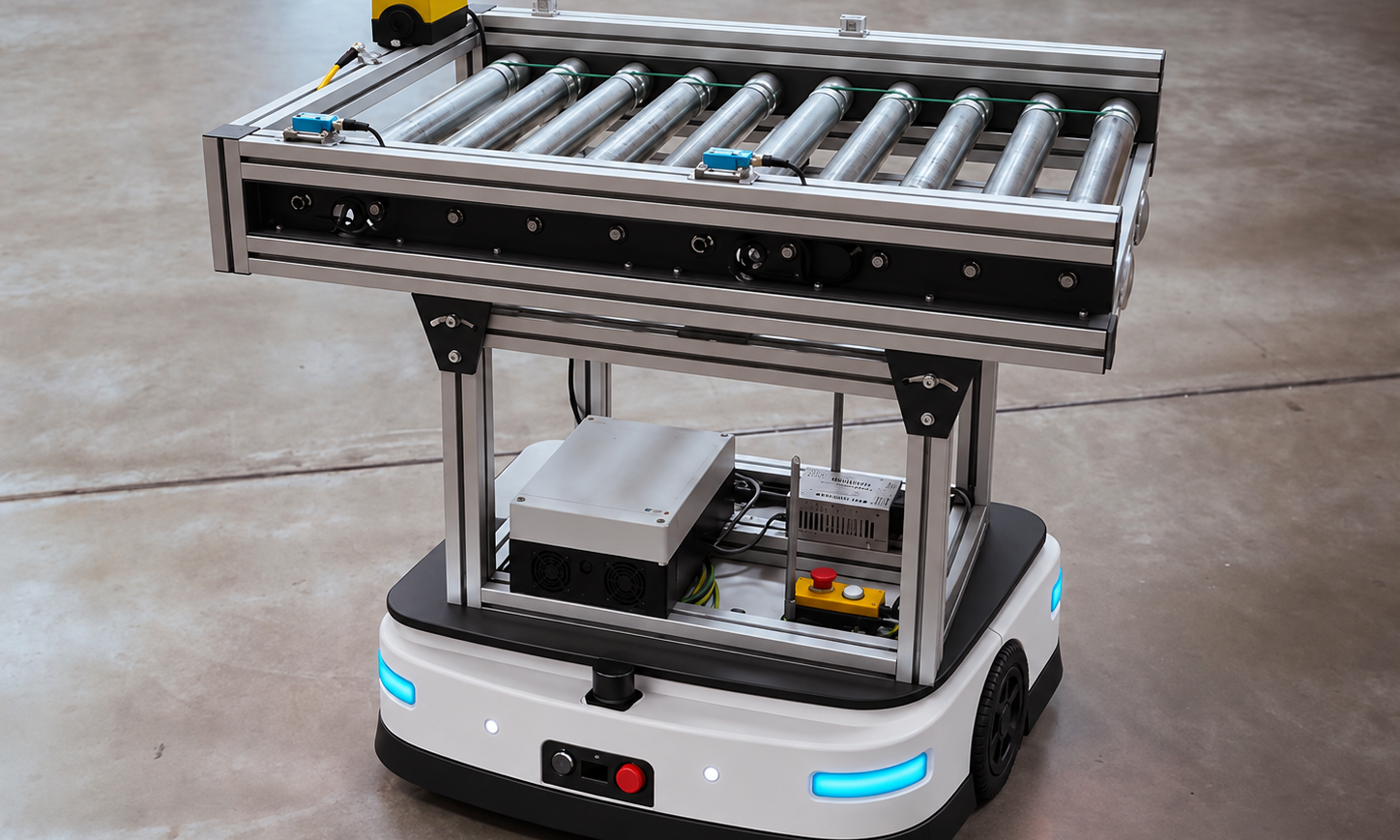
Learn how Conveyor AGVs and Roller AGVs automate load transfer between conveyors, AS/RS, production lines, and wareho...
In many manufacturing plants and automated warehouses, the real challenge in maintaining a continuous material flow is not whether a load can move from Point A to Point B, but whether it can automatically enter the next piece of equipment after it arrives.
A conventional AGV can transport a pallet, tote, or carrier to a designated location. But if an operator still has to push the load onto a conveyor after the vehicle arrives, the logistics process still contains a manual handoff.
A Conveyor AGV, also commonly called a Roller AGV, is designed for this type of application.
It integrates a roller conveyor or other transfer mechanism on the mobile base, allowing the AGV to exchange loads directly with fixed conveyors, AS/RS interfaces, production lines, or buffer stations.
The core value of a Conveyor AGV is therefore not simply mobility. It connects transportation and equipment handoff into a continuous material flow.
What Is a Conveyor AGV?
A Conveyor AGV typically consists of a mobile base and a roller conveyor mounted on top.
The base handles navigation, positioning, and transport, while the top rollers move the load onto or off the vehicle.
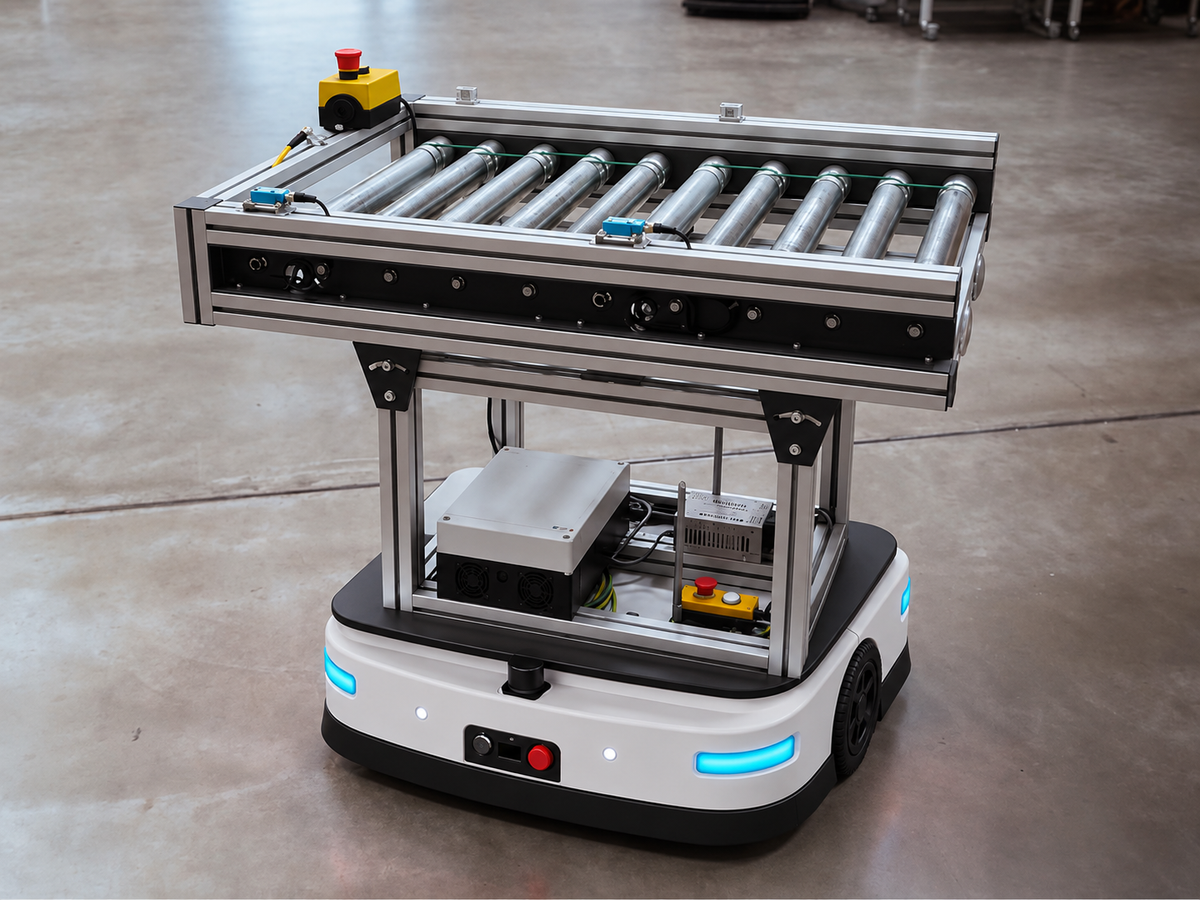
Its main difference from a conventional transport AGV lies in the load-transfer method.
A standard AGV often only moves the load to the destination area, after which another device or an operator is still required to unload it.
A Conveyor AGV can dock directly with fixed conveying equipment and automatically transfer the load into or out of the vehicle.
Conveyor → Conveyor AGV → Transport → Conveyor / Production Line / AS/RS
For this reason, Roller AGVs are especially suitable for applications with relatively standardized loads, fixed transfer points, and upstream or downstream equipment that already provides an automated transfer interface.
How Does a Conveyor AGV Complete Automatic Load Transfer?
A Conveyor AGV does not normally start its rollers immediately after reaching a station.
A reliable automatic handoff first requires the vehicle and the fixed equipment to confirm position and status.
The AGV must dock accurately.
If the vehicle is noticeably misaligned with the conveyor, a pallet or tote may shift, jam, or even fall during transfer. Conveyor AGVs therefore usually require more precise station positioning than simple point-to-point transport vehicles.
Once docking is confirmed, the AGV, PLC, or WCS can begin the handshake sequence.
AGV Arrived → Station Ready → Load Confirmed → Roller Start → Load Transfer → Transfer Complete → AGV Release
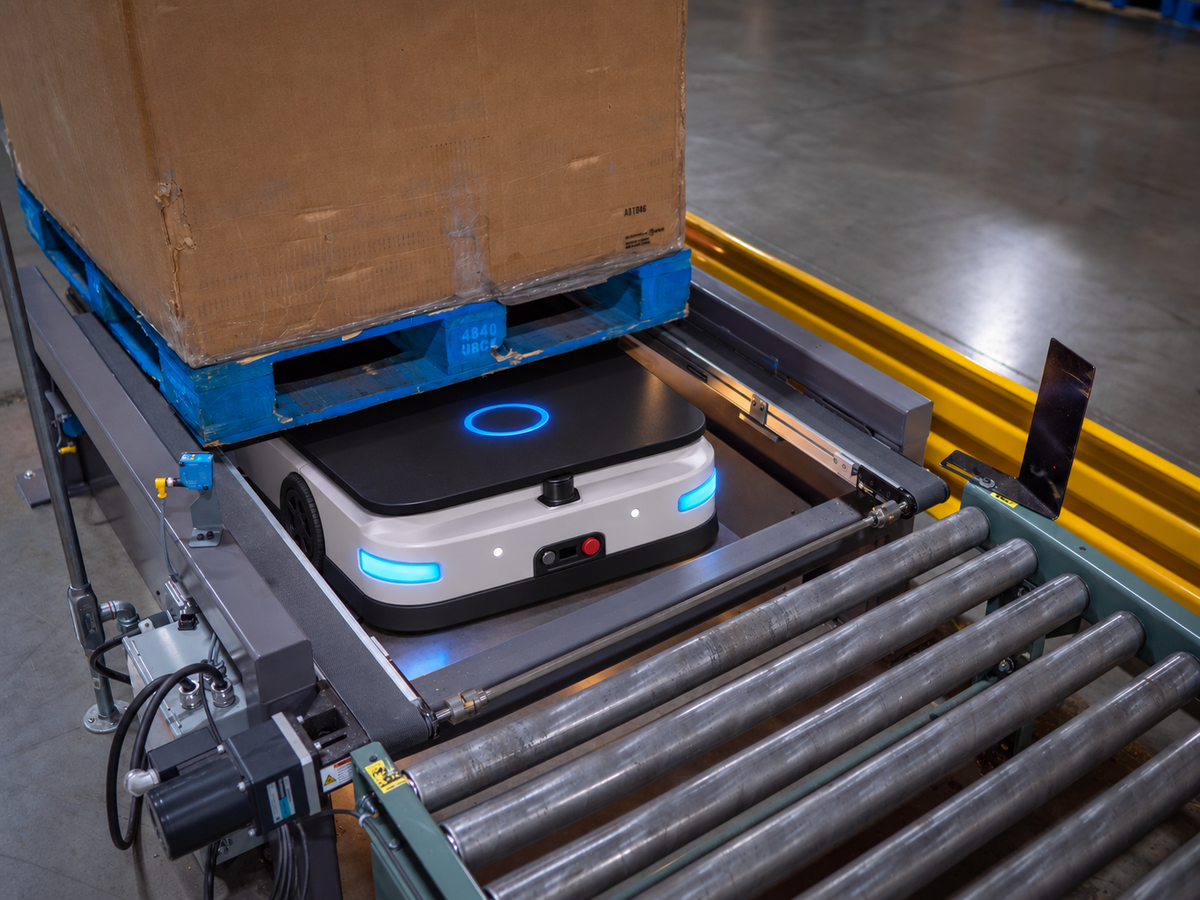
During loading, sensors need to confirm that the load has fully entered the vehicle and reached the correct position.
During unloading, the system first needs to confirm that the destination conveyor or workstation is ready to receive the load.
If the downstream equipment is not ready, the AGV should not start the rollers even if it has already reached the station.
The stability of a Conveyor AGV project therefore depends heavily on docking, handshake logic, and load detection, not only on navigation accuracy.
Why the Transfer Station Often Determines the AGV Design
Many Conveyor AGV projects are effectively designed backward from the conditions at the transfer station.
The first factor to define is the load.
The size, weight, underside structure, and center of gravity of the pallet or tote directly affect roller width, vehicle dimensions, and drive requirements.
A 1,200 × 1,000 mm pallet and a small tote, for example, cannot use exactly the same roller layout.
The underside of the load is equally important.
If the contact area with the rollers is insufficient, the load may vibrate or jam during transfer. Smaller totes may also require a tighter roller pitch.
The second critical parameter is transfer height.
The height of the AGV's top module needs to match the fixed conveyor, AS/RS interface, or production equipment. A large height difference can create impact and unstable transfer.
Transfer direction also affects the mechanical design.
Some projects require side transfer, others use front or rear transfer, and some require bidirectional rollers. These choices affect roller arrangement, vehicle approach direction, and station layout.
In practice, a Conveyor AGV is often not designed first and then imposed on the station. The usual approach is to define the load, station height, transfer direction, and required cycle time, and then design the AGV top module and base around those conditions.
How Conveyor AGVs Fit into Manufacturing and Warehouse Material Flow
A Conveyor AGV is most valuable when it connects sections of material flow that would otherwise remain separated between fixed pieces of automation.
A manufacturing plant, for example, may use the following flow:
AS/RS Outfeed → Conveyor → Conveyor AGV → Production Line → Finished Goods
Raw materials leave the AS/RS and move onto a fixed conveyor.
The Conveyor AGV arrives at the outbound station, automatically receives the pallet, and transports it to the production line.
After production, finished goods can move back into a conveyor or storage area through a similar process.
Connecting the entire plant with fixed conveyors can reduce layout flexibility and make long-distance conveyor installation expensive.
A Conveyor AGV allows fixed transfer interfaces to remain near the equipment while the longer transport distance is handled by a mobile robot.
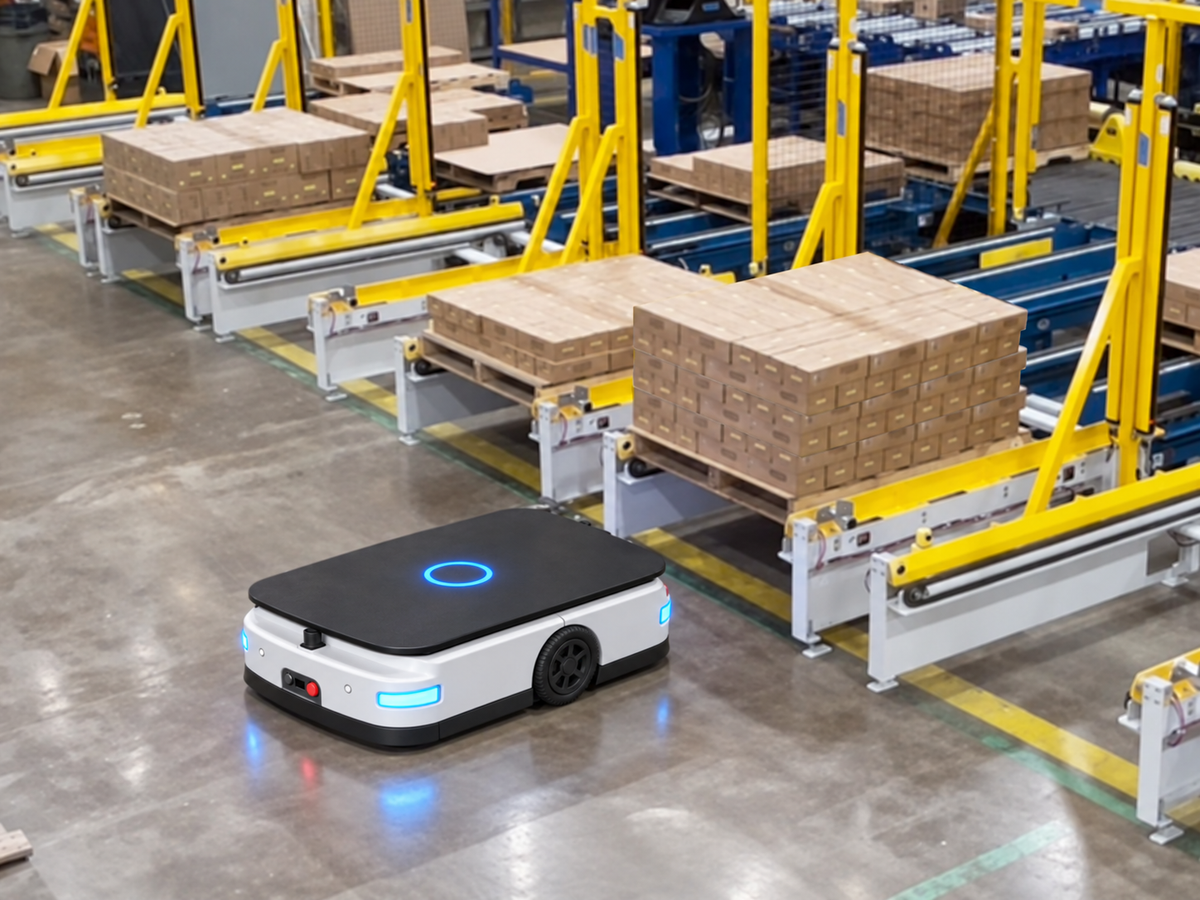
WIP transfer between production processes follows the same logic.
After one process is completed, the load can move onto a fixed conveyor, be picked up by a Roller AGV, and then be delivered to the next machining, assembly, or testing station.
This is particularly useful in manufacturing layouts where workstations are fixed but the distance between processes is relatively long.
In warehousing, Conveyor AGVs commonly connect AS/RS, sorters, packaging lines, buffer areas, and inbound or outbound stations.
They do not replace every fixed conveyor. Instead, they add a mobile automated transfer link between fixed pieces of equipment.
Conveyor AGV vs. Lifting AGV: Which Transfer Method Fits the Process?
Conveyor AGVs and Lifting AGVs can both automate material transport, but they handle the load interface in completely different ways.
A Conveyor AGV actively moves the load into or out of the vehicle using rollers.
The upstream and downstream stations therefore usually need a matching conveyor or transfer station.
A Lifting AGV moves underneath a rack, material cart, or dedicated carrier and raises the entire load with a lifting mechanism.
The load itself does not need to move across rollers.
If a factory already uses conveyors extensively, a Roller AGV can often connect directly to the existing equipment.
An AS/RS interface that already uses a roller conveyor, for example, can transfer pallets directly to a Conveyor AGV.
If the main load units are racks, material carts, or carriers that can be lifted from underneath, a Lifting AGV usually requires a simpler station design.
For line-side delivery, a Lifting AGV can bring an entire rack to the workstation and remove the empty rack without building a separate roller station.
The choice between the two should therefore start with the existing load interface rather than a simple comparison of AGV speed, payload, or navigation technology.
How Conveyor AGVs Integrate with RCS, WCS and PLCs
Automatic load transfer with a Conveyor AGV requires several systems to work together.
The business task may originate from MES or WMS.
For example, after WMS creates a pallet outbound task, the RCS decides which AGV should execute it and manages the vehicle route and traffic.
When the vehicle reaches the transfer station, the local handoff is typically coordinated with the PLC, WCS, or equipment controller.
The responsibilities can be understood simply as follows:
MES / WMS - creates the production or logistics task
RCS - handles AGV assignment, routing, and traffic control
PLC / WCS - manages station, conveyor, and load-transfer status
Conveyor AGV - executes the actual transport and roller transfer
The AGV therefore does not need to decide on its own whether the downstream equipment can accept the load.
It executes the transfer only after the required system conditions have been confirmed.
If several stations generate tasks at the same time, the RCS also needs to prevent too many vehicles from converging on the same area, reducing queues and traffic conflicts.
Where Conveyor AGV Projects Usually Go Wrong
When a Conveyor AGV project encounters problems, the AGV itself is often not the root cause.
The first common issue is inconsistent station interfaces.
If different conveyors use different heights, effective widths, roller directions, or docking positions, each station may require its own mechanical adaptation.
The second issue is insufficient load standardization.
Variation in pallet dimensions, underside structure, or load center of gravity increases uncertainty during roller transfer.
For a system that depends on automatic handoff, load consistency is usually more important than it is for a conventional transport AGV.
The third issue is underestimating peak throughput.
Average daily task volume may be moderate, while certain production batches or outbound peaks generate a large number of tasks within a short period.
If vehicle quantity, buffer capacity, and station cycle time are designed only around averages, congestion can appear during peak periods.
Exception handling also needs to be defined in advance.
What happens if a sensor fails halfway through a transfer? What happens if the destination conveyor stops unexpectedly? What happens if the AGV reaches the station but the load is not ready? These conditions directly affect long-term system stability.
The value of a Conveyor AGV comes from maintaining a continuous automated material flow. Moving from Point A to Point B is only one part of that process. Transfer-station design, load interfaces, handshake logic, and exception recovery are often what determine whether the system remains reliable over time.
If you are evaluating a Conveyor AGV, Roller AGV, or automated material-handling project for manufacturing or warehousing, you can contact Coolyne to discuss your loads, station interfaces, transport cycle times, and system integration requirements.
Next Review
Move from article research to a scoped feasibility review.
Use the related products and solution paths below, then send your workflow and layout for a quick engineering review.
Related Solutions
Engineering Review