
Related Products
Robot Control System for AGVs: What Is an RCS?
Learn how a Robot Control System coordinates AGV fleets, including task management, scheduling, traffic control, charging, station handoffs, and system integration.
Learn how a Robot Control System coordinates AGV fleets, including task management, scheduling, traffic control, char...
When a factory or warehouse expands from a single AGV to a fleet of robots, issues such as task assignment, route conflicts, charging, and station occupancy quickly become more complex.
An onboard vehicle controller can handle the positioning, movement, and obstacle avoidance of a single AGV, but it cannot coordinate an entire robot fleet by itself. A Robot Control System (RCS) is the software control layer used to manage these fleet-level tasks and operating decisions.
What Is a Robot Control System in an AGV System?
In an AGV system, the Robot Control System typically sits between upper-level business systems and the mobile robot fleet.
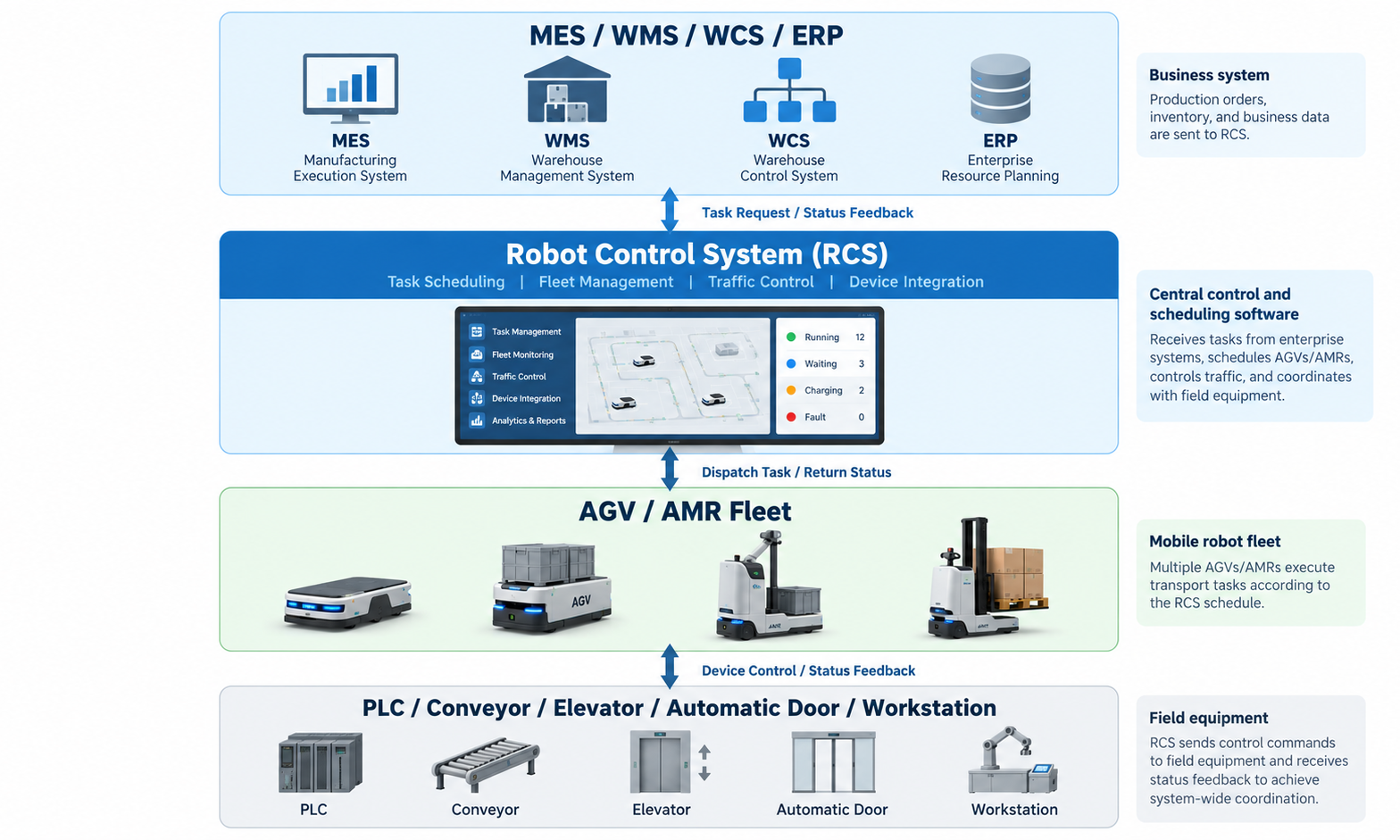
A typical architecture can be represented as:
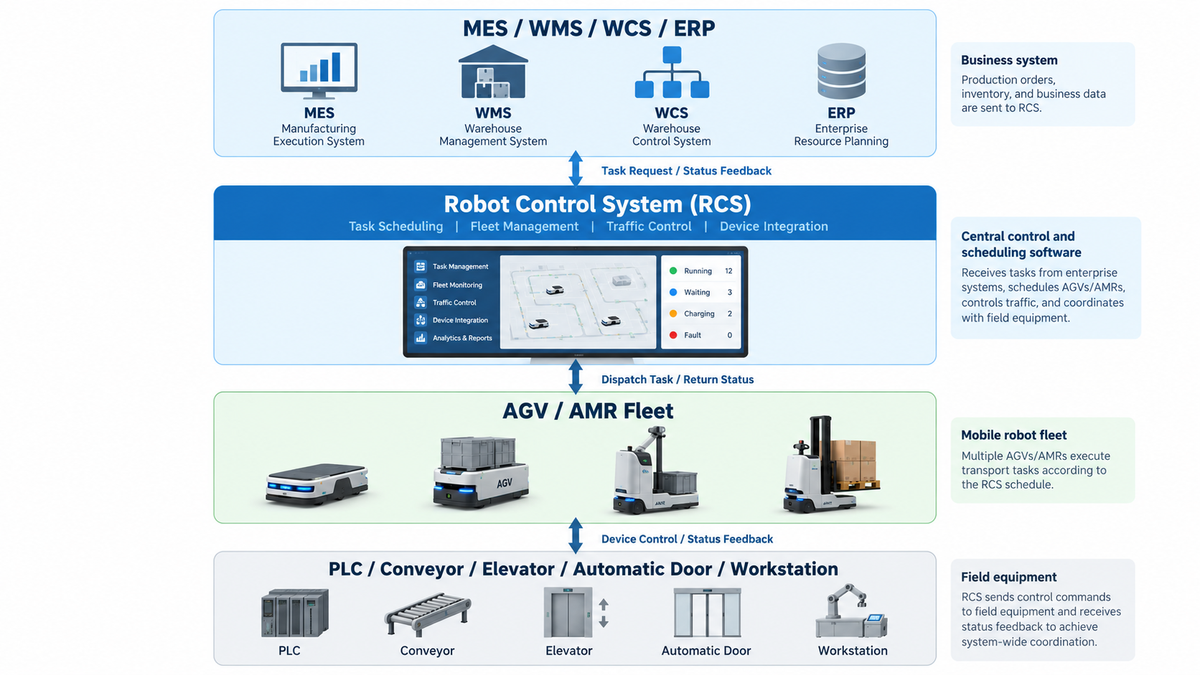
MES / WMS / WCS / ERP
Robot Control System (RCS)
AGV / AMR Fleet
PLC / Conveyor / Elevator / Automatic Door / Workstation
MES, WMS, and other business systems manage production, inventory, and logistics requirements. The RCS converts those requirements into transport tasks that robots can execute and coordinates the operation of multiple AGVs.
Each AGV still has its own onboard controller, which handles motor control, steering, positioning, safety sensors, and basic motion control.
The two systems operate at different levels:
- The AGV controller manages the individual vehicle.
- The RCS manages the robot fleet.
Depending on the manufacturer, similar software may also be referred to as a Fleet Management System, Robot Scheduling System, or Fleet Control System. The terminology varies, but the core functions generally focus on task management, vehicle scheduling, and multi-robot coordination.
What Does an RCS Do in Automated Warehouse and Factory Logistics?
Once a transport task enters the RCS, the system must decide how that task is queued, which vehicle should execute it, which route should be used, and how traffic, charging, and exceptions should be handled during execution.
Receive and Manage Transport Tasks
When a transport task enters the RCS, it is added to the task queue.
A task typically includes the pickup location, destination, carrier information, task priority, and current execution status.
The RCS tracks the task through its full lifecycle, from pending and assigned to in progress and completed. It can also manage task cancellation, retries, pauses, and priority changes.
If multiple tasks enter the system at the same time, the RCS must determine which tasks should be executed first according to predefined rules.
Assign the Right AGV
The RCS selects a suitable robot from the currently available fleet.
Selection criteria may include:
- Current vehicle location
- Task status
- Battery level
- Vehicle type
- Payload capacity
- Task priority
The AGV closest to the pickup point is not always the best choice.
For example, one AGV may be only 20 meters away but already close to its charging threshold. Another may be 50 meters away, idle, and fully charged. Based on the scheduling rules, the RCS may assign the second vehicle instead.
Plan and Manage AGV Routes
After the vehicle is selected, the RCS assigns a transport route based on the map, the origin and destination, and the current state of the traffic network.
Route planning may need to account for one-way aisles, restricted zones, temporarily closed areas, and sections where congestion is already developing.
If the original route becomes unavailable, a system with dynamic path planning can calculate an alternative route.
Manage Multi-AGV Traffic
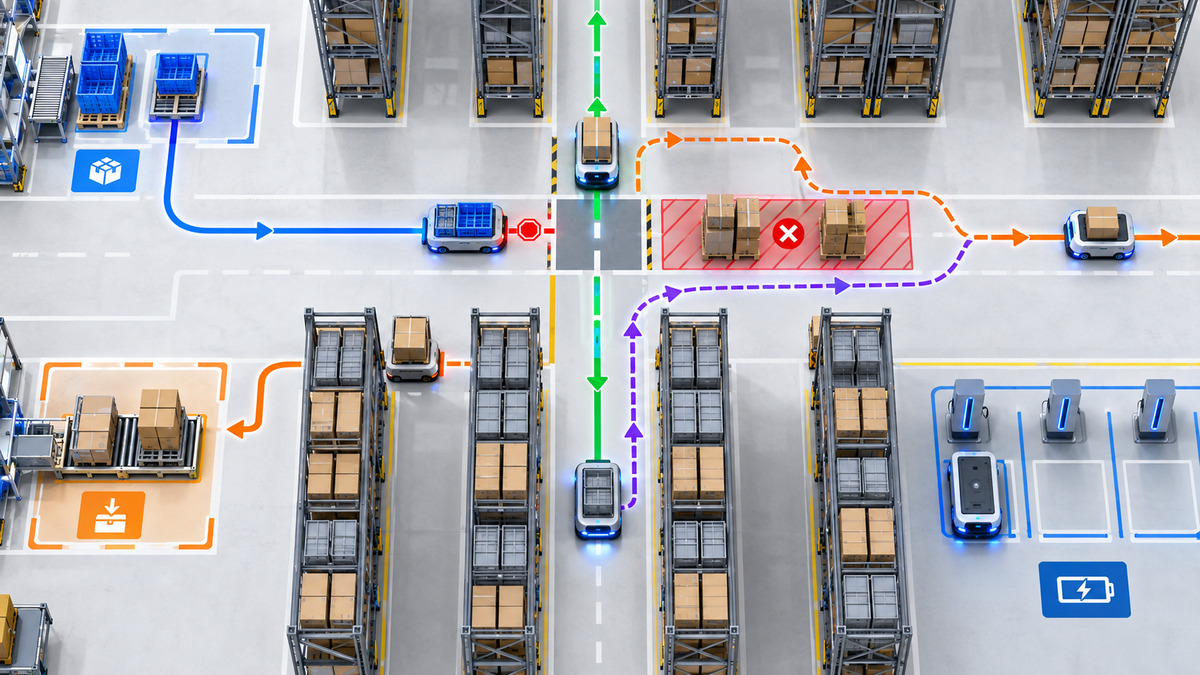
When dozens of AGVs share the same map, route conflicts are unavoidable.
Intersections, narrow aisles, shared stations, elevator entrances, and charging areas may all be requested by multiple vehicles at the same time.
The RCS can use zone locking, right-of-way rules, and waiting logic to control access to shared areas and reduce the risk of robots blocking one another.
This type of traffic management is different from onboard safety obstacle avoidance.
Safety sensors prevent an AGV from physically colliding with people or obstacles, while the RCS manages fleet-level traffic order and flow.
Manage Stations and Load Handoffs
The RCS also needs to know whether pickup and drop-off stations are available.
If the destination still contains the previous load, the new task cannot complete unloading. If the pickup location is not ready, the vehicle may need to wait.
Based on station status, the RCS can allow the task to continue, place the vehicle on hold, or temporarily adjust the task.
This type of station management helps prevent multiple robots from competing for the same operating area.
Manage Charging and Battery Status
The RCS continuously monitors vehicle battery levels and schedules charging according to current task demand and charger availability.
In a multi-vehicle system, if too many AGVs enter charging mode at the same time, the effective transport capacity of the fleet can drop significantly.
The system therefore needs to balance low-battery protection, current transport demand, and charger availability. Some projects also use opportunity charging, allowing robots to recharge during short idle periods rather than waiting until battery levels become low enough to require a longer charging session.
Handle Exceptions and Robot Failures
During actual operation, AGVs may encounter vehicle faults, blocked routes, failed pickups, unavailable destination stations, or communication interruptions.
The RCS can respond differently depending on the type of exception, for example by:
- Waiting
- Retrying
- Recalculating the route
- Reassigning the task to another vehicle
- Temporarily disabling a station
- Requesting manual intervention
Exception-handling logic directly affects how quickly a multi-robot system can recover after a disruption.
Monitor the Entire AGV Fleet
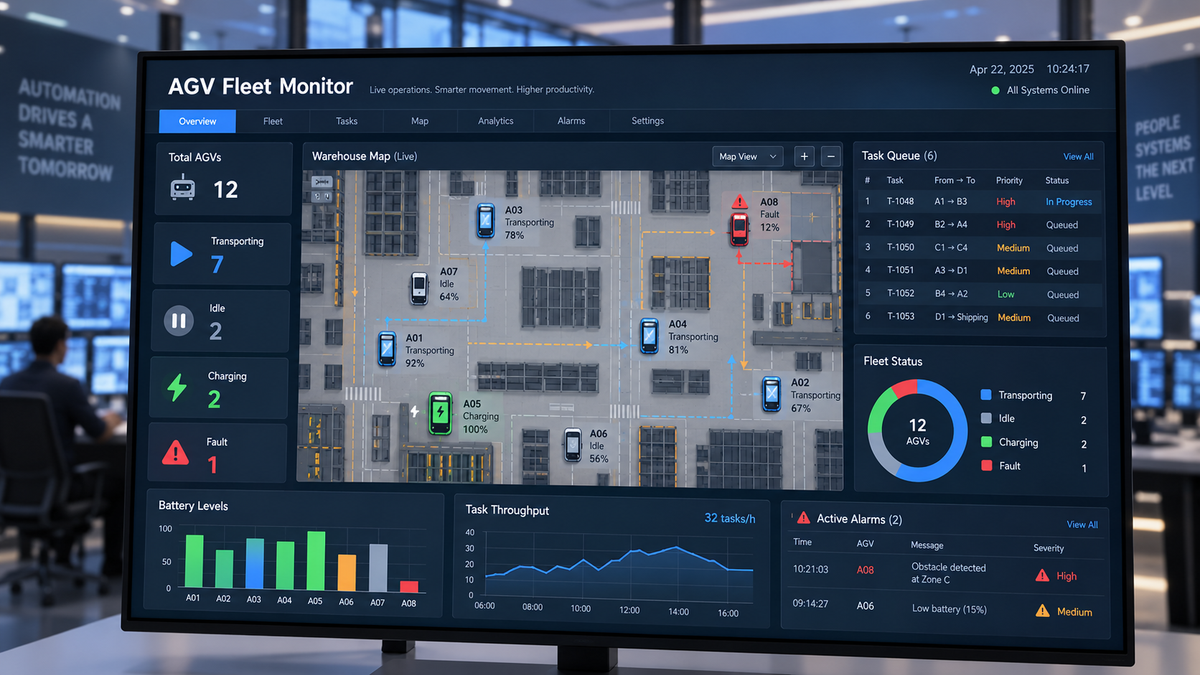
The RCS needs real-time visibility into the entire fleet, including vehicle location, battery level, task status, alarms, and online/offline status.
Through a unified interface, operators can see which vehicles are transporting loads, waiting, charging, or experiencing faults without checking each robot individually.
These real-time status data are primarily used for scheduling and operational control rather than replacing MES, WMS, or other upper-level business systems.
What Systems Can an RCS Integrate With?
An RCS usually needs to connect both to upper-level business systems and to field automation equipment.
MES, WMS, WCS, or ERP systems can provide transport requirements such as line-side replenishment, WIP transfer, inventory movement, inbound handling, and outbound handling. Task data may include pickup location, destination, material or carrier information, priority, and planned execution conditions.
The RCS converts these data into specific robot transport tasks.
On the field side, the RCS can communicate through PLCs or equipment interfaces with conveyors, automatic doors, elevators, AS/RS equipment, production machines, and workstations.
For example, before an AGV passes through an automatic door, the system needs to confirm that the door is open. When using an elevator, the RCS may coordinate elevator calls, floor selection, and entry/exit status. When transferring a pallet to or from a conveyor, the system must confirm that the equipment is ready to release or receive the load.
The full data flow can be represented as:
MES / WMS / ERP generates the logistics request
RCS creates and schedules the transport task
AGV executes the transport
PLC / Conveyor / Elevator / AS/RS / Workstation completes the handoff
Task status is returned to the upper-level system
Through this integration, a logistics request can move from the business system all the way to physical transport and equipment interaction, while execution results are returned automatically without requiring manual data transfer between systems.
How Coolyne Integrates RCS into an Existing AGV Project
Existing factories often already use MES, WMS, PLCs, and other automation systems. Coolyne can integrate the RCS into this existing architecture by defining task interfaces, station handshakes, vehicle status feedback, and traffic-control rules.
The system is then configured around the actual AGV fleet, transport routes, stations, and peripheral equipment, with testing covering multi-vehicle scheduling, handoffs, and exception recovery.
For factories with existing production or warehouse systems, the RCS can serve as the execution and fleet scheduling layer without rebuilding the entire software architecture.
If you are evaluating an RCS integration project, you can contact Coolyne to discuss your current AGV system and interface requirements.
Next Review
Move from article research to a scoped feasibility review.
Use the related products and solution paths below, then send your workflow and layout for a quick engineering review.
Related Solutions
Engineering Review