
Related Products
What Are Industrial Robots? How They Work, Types, and Common Uses
Learn what industrial robots are, how they work in factories, the main types, common uses, and the latest global installed-base figure.
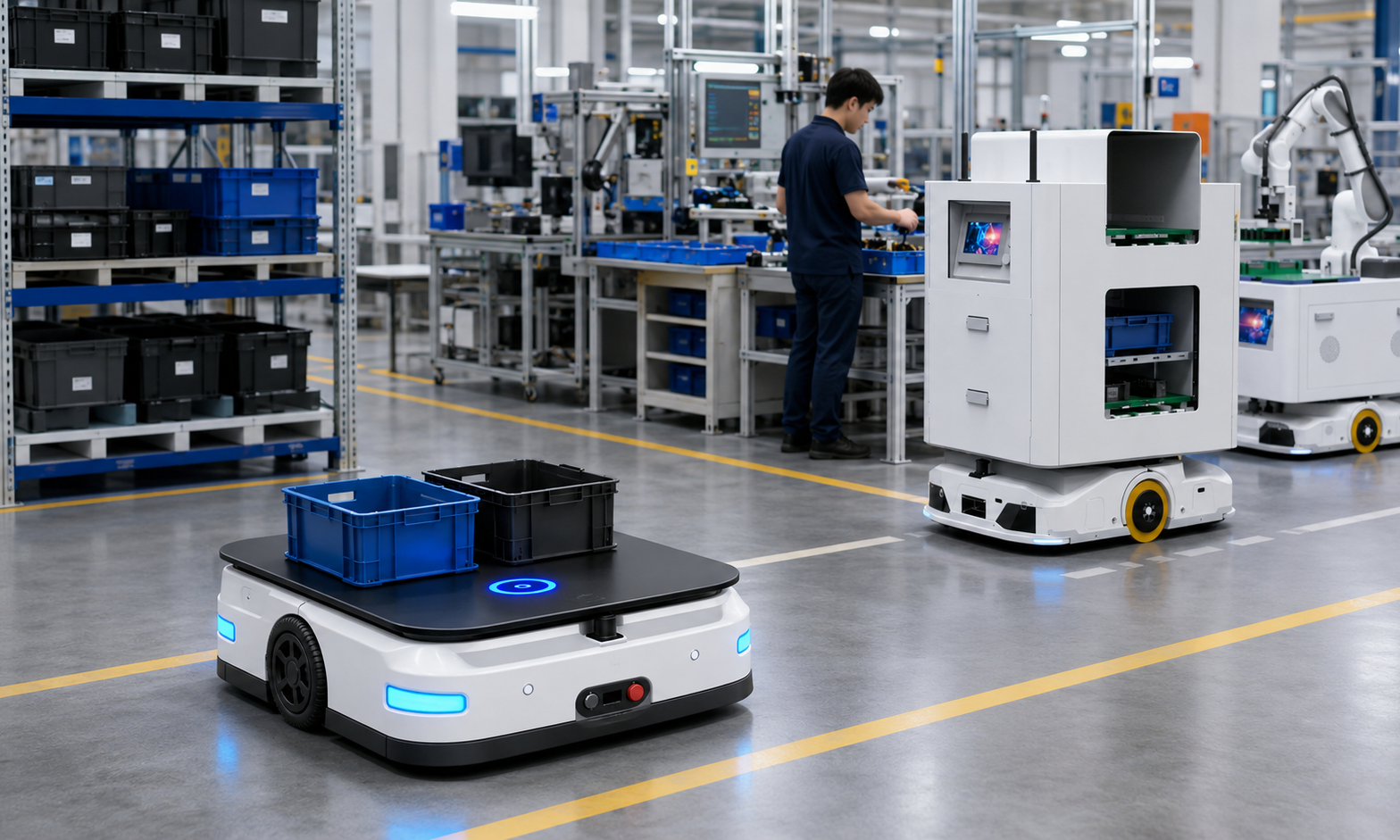
Learn what industrial robots are, how they work in factories, the main types, common uses, and the latest global inst...
Industrial robots are programmable automation systems used in factories and similar industrial settings to perform repeatable physical tasks such as welding, assembly, machine tending, inspection, packaging, pick and place, palletizing, and material transfer.
What Are Industrial Robots?
An industrial robot is a programmable machine that performs physical work inside an industrial process. The official definition used by theInternational Federation of Roboticsdescribes industrial robots as automatically controlled, reprogrammable, multipurpose manipulators used in industrial automation environments. In factory use, these robots are typically integrated into production cells or other controlled workflows.
Industrial robots, cobots, AMRs, and service robots refer to different equipment categories. A traditional industrial robot is typically a multi-axis manipulator installed in a defined production cell. A cobot is an industrial robot designed for closer human interaction and different application and safety requirements. An AMR is a mobile robot used to move material through a facility. A service robot is usually classified by the service it provides or the environment it serves, rather than by a specific arm structure or robot shape.
How Do Industrial Robots Work in Factories?
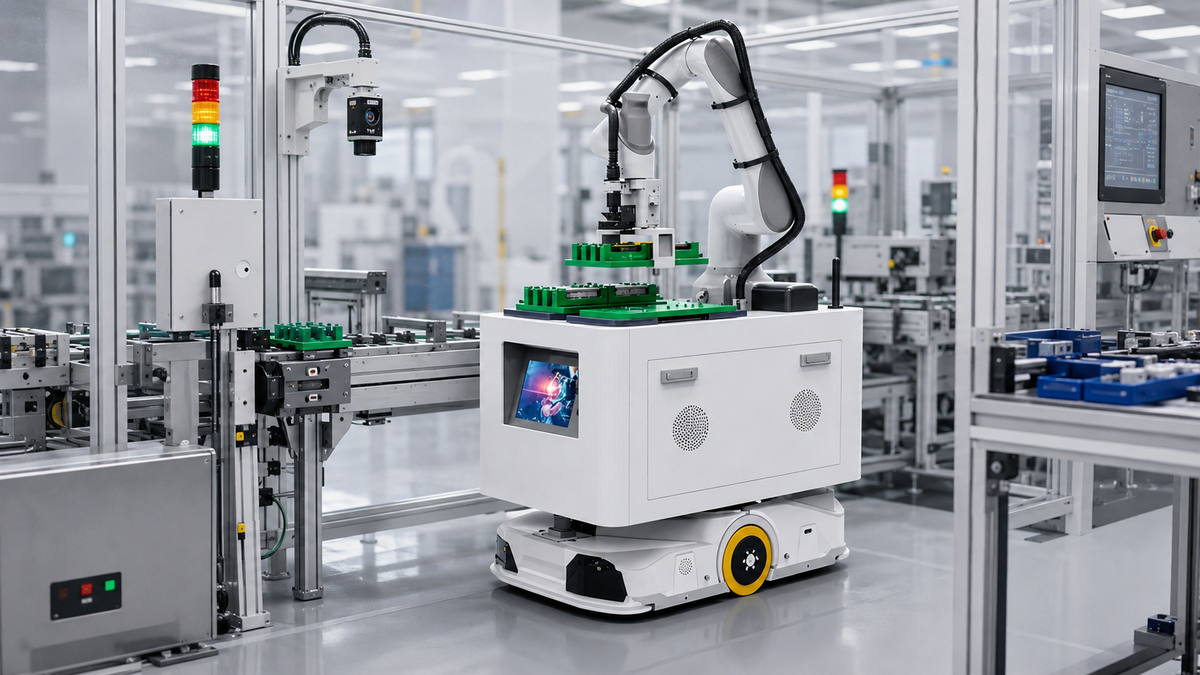
In factories, an industrial robot works as part of a system rather than as a standalone arm. The core elements commonly include the robot body, a controller, sensors, an end effector, fixtures, safety devices, and the surrounding cell logic. The controller sends motion commands. Sensors confirm position, detect parts, or monitor safety conditions. The end effector performs the physical task, such as gripping, welding, cutting, spraying, or placing parts.
In many factories, the robot is linked to conveyors, CNC machines, feeders, scanners, pallets, and safety controls so that parts can be presented, processed, checked, and transferred in sequence.
What Do Industrial Robots Do? Common Tasks and Applications
Industrial robots perform repeatable physical tasks such as welding, assembly, machine tending, inspection, packaging, pick and place, palletizing, and material transfer. In factories and warehouses, these applications usually fall into two broad groups: production tasks performed at a workstation, and material-handling tasks that move parts, cartons, or pallets between steps.
Workstation production tasks such as assembly, welding, machine tending, inspection, and packaging
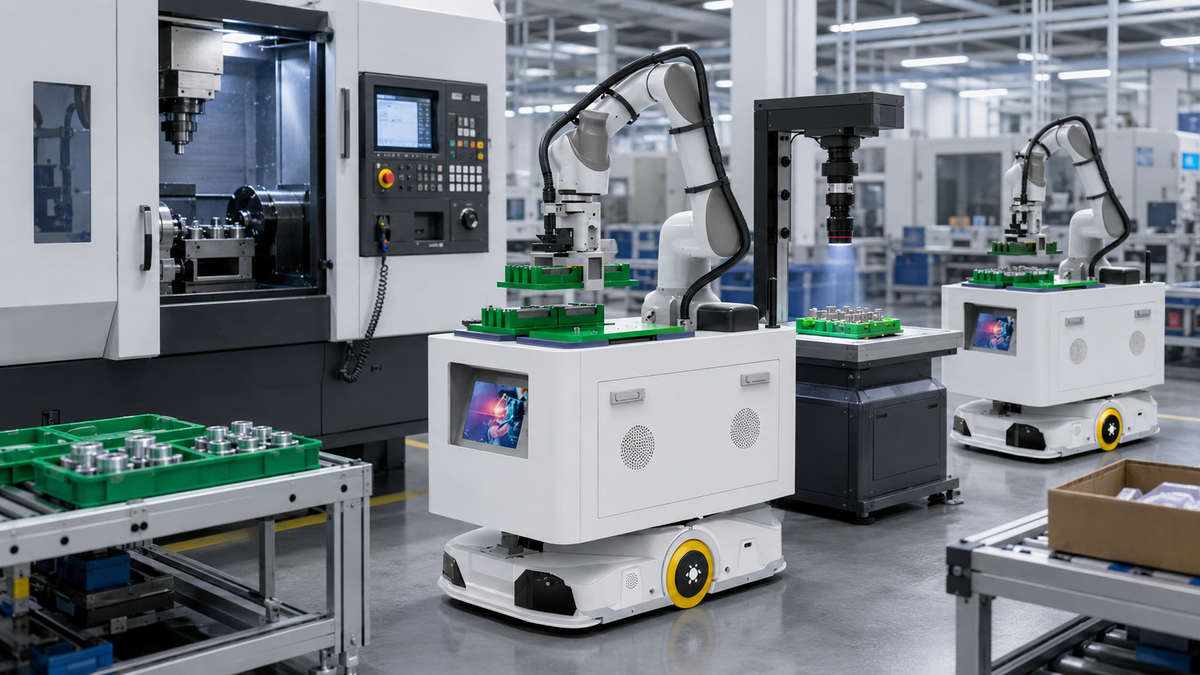
On the production side, industrial robots commonly handle assembly, screwdriving, welding, cutting, gluing, machine tending, inspection, and packaging. These tasks are usually performed at a fixed workstation, where the robot repeats a defined motion for processing, assembly, or quality control. Common applications include welding cells, CNC loading stations, inspection cells, and automated packaging lines. Welding cells rely on programmed path control. Machine-tending stations usually load and unload equipment such as CNC machines or presses. Inspection cells are often paired with vision systems, gauges, or pass-fail checks.
Material-flow tasks such as handling, palletizing, pick and place, and intralogistics
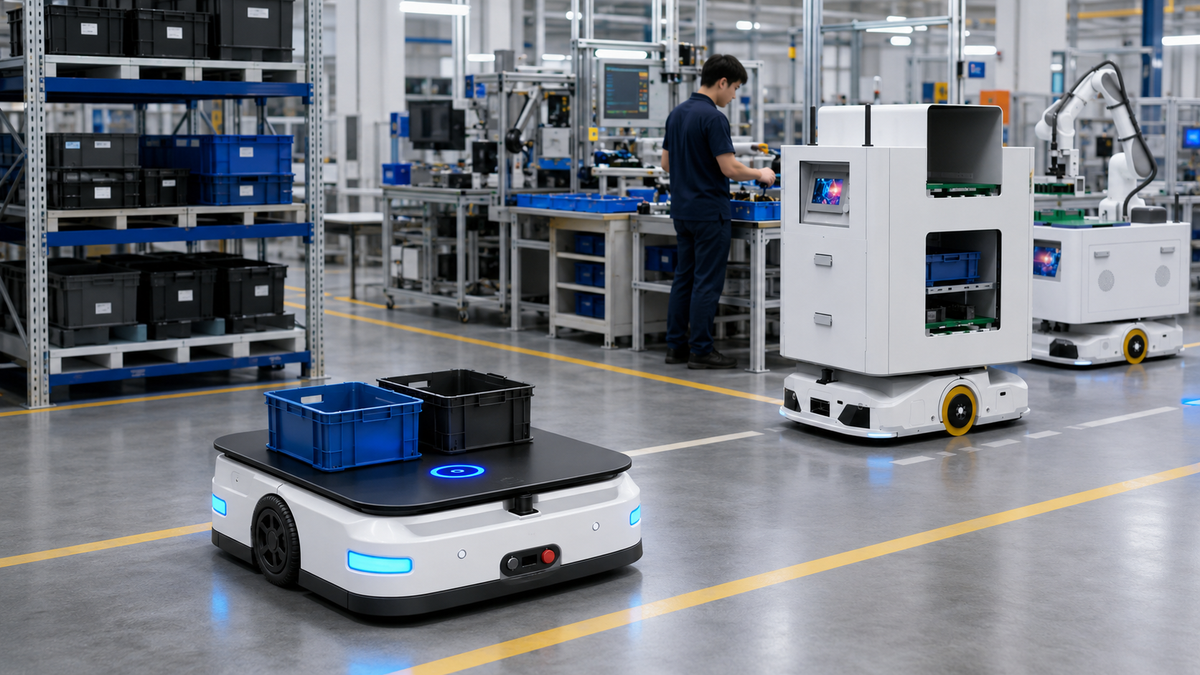
Material handling, palletizing, pick and place, carton transfer, line-side delivery, and repetitive handoff tasks between workstations are also common robot applications. These tasks are mainly about moving material between steps, keeping parts, cartons, or pallets flowing from one station, line, or storage area to the next. Common applications include palletizing cells, depalletizing stations, line-side feeding, and transfer points between storage, picking, packing, and shipping. Intralogistics refers to the internal movement of material inside a factory or warehouse.
In larger material-flow systems, robot cells for palletizing, pick and place, or transfer are often combined with conveyors,AGVs, AMRs, and ASRS so material can keep moving between storage, workstations, and shipping areas.
What Are the Different Types of Industrial Robots?
The main industrial robot types are articulated, SCARA, Cartesian, Delta, cylindrical, and polar robots. TheIFR robot type overviewclassifies them by mechanical structure.
The six classic industrial robot types
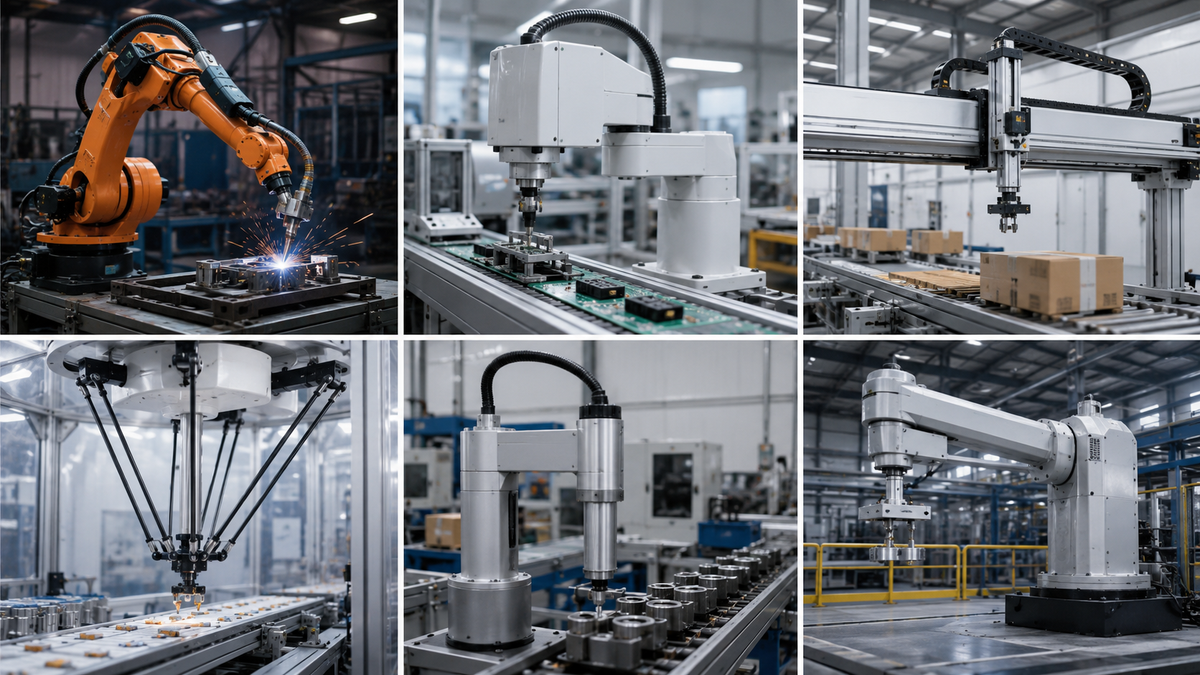
| Robot type | Motion or structure | Typical uses |
|---|---|---|
| Articulated | Multi-axis jointed arm with high rotational flexibility | Welding, machine tending, palletizing, and general factory automation |
| SCARA | Compact horizontal-joint structure suited to fast planar motion | Assembly, electronics work, and pick and place |
| Cartesian | Linear-axis structure built around straight-line X-Y-Z motion | Gantry handling, transfer, dispensing, and precise linear moves |
| Delta | Parallel-arm structure built for very fast, lightweight motion | High-speed pick and place, sorting, and light packaging |
| Cylindrical | Rotary and linear motion within a cylindrical work envelope | Simple handling, loading, and transfer tasks |
| Polar | Rotary motion within a polar or spherical work envelope | Older handling or transfer applications that need wide angular reach |
How to choose the right robot type for task, payload, and workspace
Different robot types are selected according to motion pattern, reach, payload, speed, accuracy, and workspace constraints. Common selection factors include:
| Selection factor | What to check | Why it matters |
|---|---|---|
| Task motion | Does the job need straight-line motion, rotational flexibility, or very fast repetitive movement? | The required motion pattern often determines which robot structure fits the task. |
| Payload and reach | How heavy is the part, and how far must the robot move it? | Payload and reach limits rule out undersized robots and affect cycle design. |
| Speed and repeatability | Is throughput the main constraint, or is precision the bigger concern? | Some robot types favor speed, while others are chosen for stable repeatability. |
| Workspace and safety | Is the robot working in a fenced cell, next to operators, or across multiple handoff points? | Cell layout and safety conditions affect both robot choice and system design. |
| Integration complexity | Will the robot connect to conveyors, CNC machines, scanners, pallets, or warehouse systems? | Integration scope influences engineering effort, controls design, and deployment cost. |
The selected robot has to match the task motion, payload, reach, speed, workspace, and integration requirements.
How Many Industrial Robots Are in Operation Today?
According to theIFR World Robotics 2025 release, published on September 25, 2025, 4,664,000 industrial robots were in operational use worldwide in 2024, up 9% from the previous year. This is the latest official global installed-base figure currently published by IFR.
Why Are Industrial Robots Important for Modern Factories?
Factories use industrial robots to automate repetitive physical tasks, maintain consistent cycle execution, keep equipment supplied, and separate operators from some hazardous processes. These systems are used in production cells, handling steps, and guarded work areas.
Productivity, consistency, safety, and labor availability
Industrial robots can improve productivity by reducing idle machine time and keeping repeated steps on schedule. They can improve consistency by repeating the same path and timing with less variation, which helps keep product quality more stable across runs. They can also improve safety by taking over hot, sharp, heavy, or hazardous handling steps. In plants that struggle to staff repetitive positions across shifts, the same tasks are often automated to reduce dependence on hard-to-fill manual roles.
The limits: integration cost, flexibility, engineering complexity, and a practical fit check
Industrial robots are not the only automation option in every process. Integration cost usually includes more than the robot arm itself, including tooling, guarding, interfaces, programming, commissioning, maintenance, and operator training. Flexibility is often narrower than expected when product mix changes frequently, fixturing is unstable, or part presentation varies too much between runs. Engineering complexity comes from making the robot, the process, and the surrounding equipment work together at the required cycle time and safety level. A practical fit check therefore starts with the task, bottleneck, payload, reach, floor space, and support capacity rather than the robot model alone.
A practical fit check can start with five questions:
- Is the task stable enough to standardize?
- Is the bottleneck large enough to justify the integration effort?
- Are payload, reach, and floor space already clear?
- Can upstream and downstream steps stay balanced after automation?
- Do you have the integration, maintenance, and training capacity to support the system after go-live?
If several of these points are still unclear, the project scope is not yet fully defined.
Want to know more about your options?
If you are assessing industrial robots for production, palletizing, machine tending, or warehouse automation, Coolyne's experts can provide afree project analysisto help you evaluate the process, constraints, and expected output.
Next Review
Move from article research to a scoped feasibility review.
Use the related products and solution paths below, then send your workflow and layout for a quick engineering review.
Related Solutions
Engineering Review