
Related Products
Automated Storage and Retrieval System (AS/RS): A Complete Guide
Learn how automated storage and retrieval systems work, including AS/RS types, components, WMS integration, applications, and deployment planning.
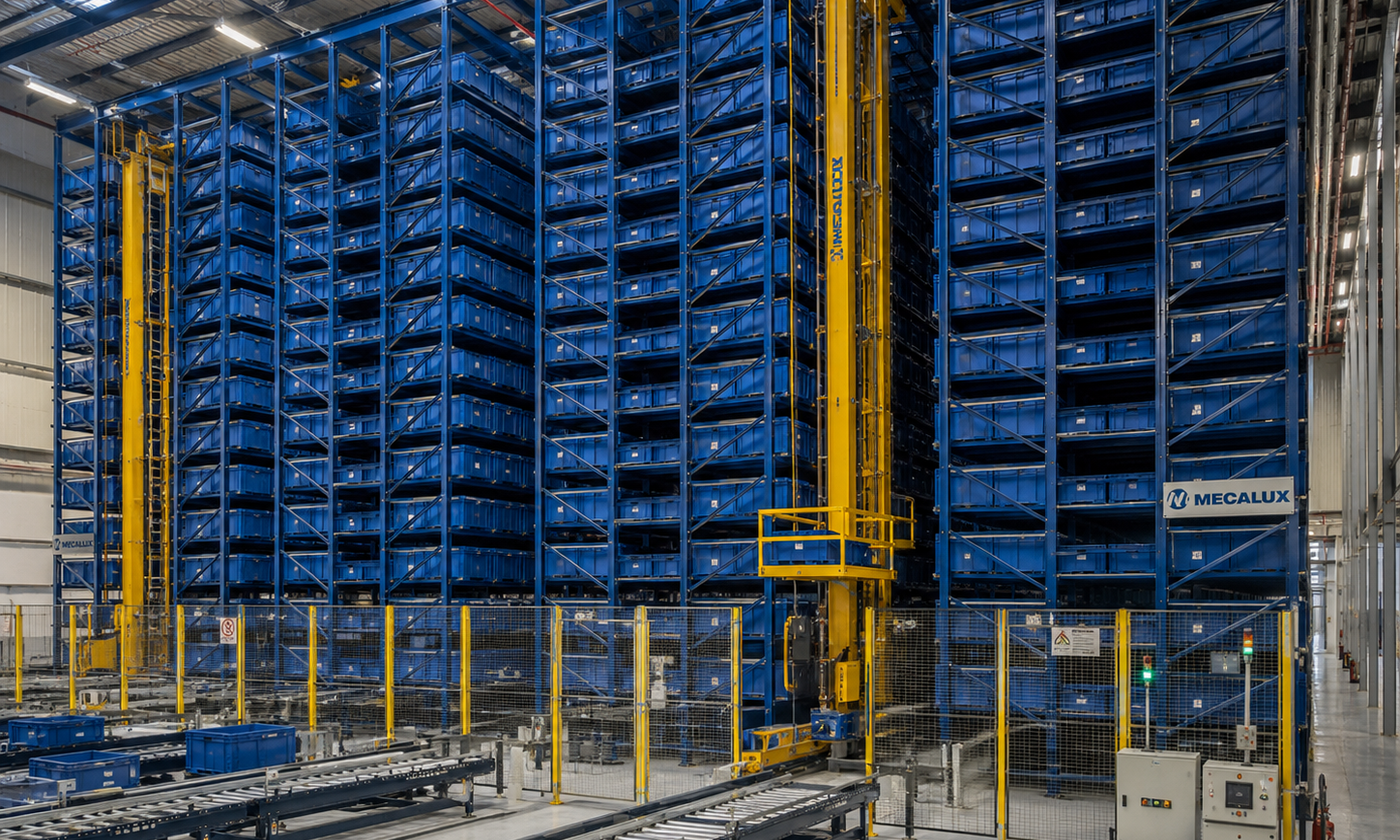
Learn how automated storage and retrieval systems work, including AS/RS types, components, WMS integration, applicati...
Automated storage and retrieval systems are not a recent invention. As early as the mid-20th century, manufacturers began using mechanical equipment to automatically store and retrieve materials from high-bay racking, reducing manual handling and making better use of warehouse space.
As sensors, computer controls, warehouse management systems, and mobile robotics have advanced, AS/RS technology has evolved from relatively fixed stacker crane systems into integrated warehouse automation solutions that may include shuttles, tote-handling robots, conveyors, and intelligent software. Today, these systems are widely used in manufacturing plants, distribution centers, e-commerce warehouses, cold storage facilities, and third-party logistics operations.
What Is an AS/RS?
An Automated Storage and Retrieval System (AS/RS) is a warehouse system that uses automated equipment to store, locate, move, and retrieve goods.
In a conventional warehouse, operators typically drive forklifts or walk through storage aisles to find products. In an AS/RS, pallets, totes, cartons, or other load carriers are automatically transported to assigned storage locations by stacker cranes, shuttles, conveyors, or mobile robots, and retrieved when needed.
An AS/RS is more than a collection of automated machines. A complete system generally connects with warehouse management, warehouse control, and enterprise systems so that inventory, orders, equipment tasks, and material flow can be coordinated.
Depending on the load size, storage unit, and application, an AS/RS can handle:
- Pallets and large loads
- Totes, bins, and cartons
- Parts and production materials
- Finished goods and work-in-process inventory
- Frozen, hazardous, or high-value products
The primary value of an AS/RS is not simply replacing labor. It enables a warehouse to create a more accurate, continuous, and predictable material flow within limited space.
How an AS/RS Works and Its Main Components
The AS/RS workflow generally begins when goods enter the automated storage area.
At the inbound station, barcode readers, RFID devices, or vision systems identify the load. The warehouse management system assigns an appropriate storage location based on the product type, inventory status, available capacity, and retrieval frequency.
A conveyor, stacker crane, shuttle, or other handling device then transports the load to the assigned location. When a production line, picking station, or outbound area requests the item, the system creates a retrieval task and automatically delivers the correct load to its destination.
A typical AS/RS consists of the following elements.
Racking and Storage Structures
Racking provides the primary storage structure for an AS/RS and can be designed around pallets, totes, or cartons. These systems often use high-density or high-bay racking to make full use of both horizontal and vertical warehouse space.
Automated Storage and Retrieval Equipment
Automated handling equipment moves goods between inbound stations, storage locations, and outbound stations. Common equipment includes stacker cranes, shuttles, tote-handling robots, lifts, and autonomous mobile robots.
Conveyors and Interface Equipment
Conveyors, roller lines, lifts, transfer units, and directional transfer devices connect the AS/RS with production lines, picking stations, packing areas, and loading zones.
Identification and Safety Equipment
Barcode scanners, RFID readers, position sensors, photoelectric sensors, and vision systems identify goods and confirm equipment positions. Safety fencing, light curtains, emergency stops, and anti-collision sensors help reduce operational risks.
Software and Control Systems
PLCs control individual machine movements, a warehouse control system (WCS) coordinates tasks across different devices, and a warehouse management system (WMS) manages inventory, storage locations, and orders.
AS/RS performance depends on how well these hardware and software elements work together, rather than on the speed of any single machine.
Types of AS/RS
Different types of AS/RS vary significantly in load format, storage density, throughput, and flexibility. The right system should be selected according to the goods being handled and the operational process.
Pallet Stacker Crane AS/RS
A pallet stacker crane AS/RS generally consists of high-bay racking and aisle-based stacker cranes. It is primarily used to store full pallet loads.
The crane travels along a fixed aisle, using a lifting carriage and telescopic fork to place pallets into or retrieve them from storage locations. This system is suitable for warehouses with large inventory volumes, relatively standardized pallet sizes, and high-density storage requirements.
Typical applications include raw material warehouses, finished goods warehouses, food and beverage facilities, and central storage areas in manufacturing plants.
Mini Load AS/RS
A Mini Load AS/RS primarily handles totes, cartons, and small parts. The system typically uses lightweight stacker cranes to retrieve containers from high-bay racking and deliver them to picking stations.
It is suitable for operations with many SKUs, relatively small items, and goods-to-person picking requirements, including electronics components, pharmaceuticals, automotive parts, and e-commerce orders.
Shuttle-Based AS/RS
A shuttle system uses vehicles that travel on rails within the racking to move pallets or totes. Depending on the system design, it may use single-level shuttles, multi-level shuttles, or four-way shuttles.
Compared with a conventional stacker crane system, a shuttle-based AS/RS can increase parallel handling capacity by adding more vehicles. It is therefore suitable for warehouses with high throughput or fluctuating demand.
Tote-Handling Robot Systems
Tote-handling robots can travel horizontally and vertically within a racking structure to automatically store, move, and retrieve totes.
Compared with conventional fixed stacker cranes, these systems are more modular. Businesses can gradually add racking, robots, and picking stations as inventory and order volumes grow. They are suitable for e-commerce warehousing, retail distribution, parts storage, and goods-to-person picking.
Vertical Lift Storage Systems
A vertical lift module uses trays and an internal lifting mechanism to automatically deliver requested items to an access opening.
It requires relatively little floor space and is suitable for tools, spare parts, molds, electronic components, and high-value items. Compared with a large automated warehouse, a vertical lift system is generally easier to install inside an existing plant or warehouse.
Integrating an AS/RS with Your Warehouse Management System
AS/RS equipment can move goods automatically, but the warehouse management system usually determines what should be stored, where it should be stored, when it should be retrieved, and where it should be delivered.
Once the AS/RS is integrated with the WMS, the system can automatically create storage and retrieval tasks based on real-time inventory and order requirements. For example, when goods arrive at the inbound station, the WMS confirms the product information and assigns a storage location. When a production line or outbound order requires the goods, the WMS sends a retrieval instruction to the control system.
In a typical software architecture, each system has a different role:
- ERP manages purchasing, production, sales, and enterprise resource data
- WMS manages inventory, orders, batches, and storage locations
- WCS coordinates conveyors, stacker cranes, shuttles, and robots
- PLCs control specific equipment movements
- The AS/RS performs the physical storage and retrieval tasks
Effective software integration helps businesses support FIFO inventory rotation, batch traceability, cycle counting, order sequencing, and exception handling.
If the equipment and software do not share consistent data interfaces, even fast individual machines may experience task delays, conveyor congestion, or inventory discrepancies. WMS integration should therefore be planned during the AS/RS design stage rather than addressed after equipment installation.
Applications of AS/RS in Manufacturing
In manufacturing plants, an AS/RS is not limited to finished goods storage. It can also become an internal logistics system connecting raw materials, production lines, and work-in-process areas.
Automated Raw Material Storage
After raw materials arrive at the plant, they can be transferred directly into the AS/RS through a conveyor system. The system assigns storage locations according to production plans and inventory status, then delivers materials to staging or line-side areas when production requires them.
This reduces frequent forklift traffic in production areas and shortens the time spent searching for materials.
Work-in-Process and Buffer Storage
Different production processes do not always operate at the same cycle time. An AS/RS can temporarily store semi-finished goods between processes and provide a controlled buffer.
When the downstream process requests material, the system releases it in the correct sequence, reducing line congestion, waiting time, and unorganized floor storage.
Line-Side Material Supply
An AS/RS can work with AGVs, AMRs, conveyors, or automated forklifts to deliver required materials to designated workstations according to the production schedule.
The system can also control delivery sequences based on production orders, helping reduce line-side inventory and improve material supply accuracy.
Automated Finished Goods Storage
After production and packaging are complete, products can move directly from the line into the AS/RS. The system records the product batch, production time, and storage location, then schedules retrieval according to the shipping plan.
This continuous process reduces repeated handling between the production line and the finished goods warehouse.
Applications of AS/RS in Warehousing and Logistics
In distribution centers and logistics warehouses, AS/RS solutions are primarily used to improve storage density, order-processing efficiency, and inventory accuracy.
High-Density Pallet Storage
For businesses operating in locations with high land costs or limited warehouse space, an AS/RS can use high-bay racking to reduce the required floor area.
Because automated equipment does not require the wide travel aisles needed by manual forklifts, more storage locations can be created within the same building footprint.
Goods-to-Person Picking
Mini Load systems, shuttles, and tote-handling robots can automatically deliver required products to operators at fixed picking stations.
Operators no longer need to walk long distances through storage aisles. Pick-to-light systems, on-screen instructions, and order verification can also help reduce picking errors.
Order Buffering and Sequencing
An AS/RS can temporarily store picked or packed orders and release them according to delivery routes, vehicle arrival times, or loading sequences.
This function is particularly useful for e-commerce fulfillment, retail distribution, and multi-store replenishment because it reduces congestion in outbound staging areas.
Cold Storage and Special Environments
In refrigerated, frozen, or other environments where people should not work for extended periods, an AS/RS can reduce the frequency with which employees must enter the storage area.
Automated equipment can continue performing storage and retrieval tasks while reducing requirements for personnel protection, lighting, and operator travel aisles.
Third-Party Logistics Warehouses
Third-party logistics providers often manage multiple customers, many SKUs, and constantly changing order requirements.
A modular AS/RS can be expanded with additional robots, workstations, and storage capacity as business volume grows, allowing the warehouse to increase automation while retaining room for future expansion.
How to Deploy an AS/RS
Before deploying an AS/RS, businesses should evaluate load dimensions, storage capacity, SKU count, inbound and outbound throughput, warehouse layout, and existing WMS or ERP systems.
Coolyne can use your warehouse data and operational processes to plan an integrated solution involving stacker cranes, shuttles, tote-handling robots, conveyors, and software systems. We also provide a free project feasibility assessment and preliminary ROI analysis.
If you are planning a new automated warehouse or upgrading an existing storage and picking process, contact Coolyne for AS/RS deployment recommendations tailored to your operational requirements.
Coolyne | Automated Storage and Retrieval System (AS/RS)
Next Review
Move from article research to a scoped feasibility review.
Use the related products and solution paths below, then send your workflow and layout for a quick engineering review.
Related Solutions
Engineering Review