
Related Products
What Is Intralogistics? How Intralogistics Automation Works
Learn what intralogistics means, how internal material flows work, which automation technologies fit different warehouse and manufacturing processes, and how to plan an intralogistics automation project.
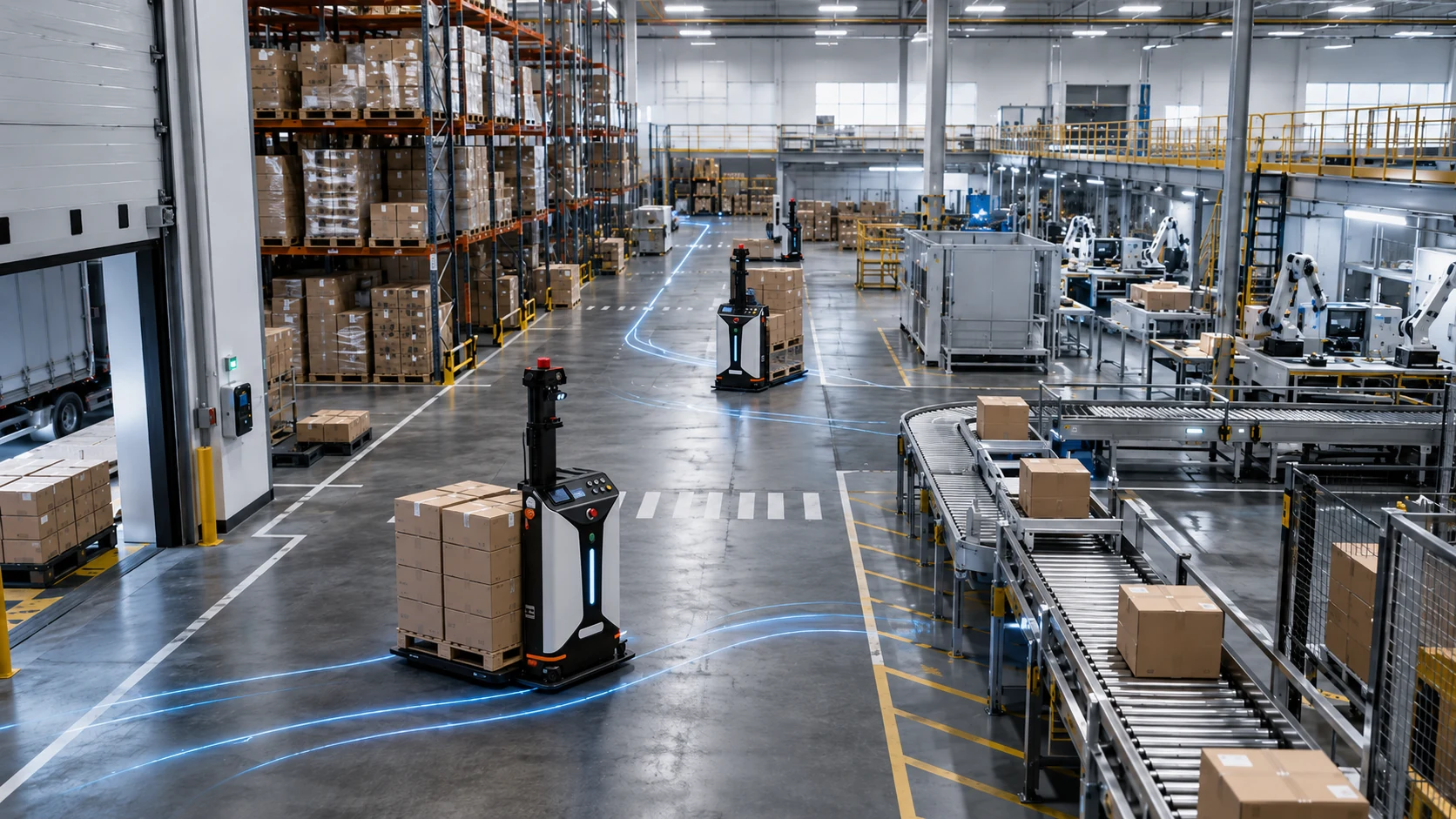
Learn what intralogistics means, how internal material flows work, which automation technologies fit different wareho...
Intralogistics refers to the planning, control, and optimization of material flows and the related information flows within a factory, warehouse, or distribution center.
It involves much more than simply moving goods from Point A to Point B. Receiving, putaway, storage, replenishment, picking, line-side delivery, work-in-process transfer, finished goods handling, and outbound staging are all part of intralogistics. Just as important is how these processes are connected and how inventory data, transport tasks, and automation equipment work together.
As AGVs, AMRs, AS/RS, conveyor systems, robots, and warehouse software continue to develop, more companies are turning to intralogistics automation to reduce repetitive manual handling while improving the stability and scalability of their internal material flows.
What Is Intralogistics?
Intralogistics can be understood as the logistics system within a facility.
While logistics typically refers to the movement of goods between suppliers, factories, warehouses, and customers, intralogistics focuses on how materials are moved, stored, handled, and processed after they enter a factory or warehouse.
For example:
| Scenario | Part of Intralogistics? |
|---|---|
| Moving inbound pallets from the unloading area to storage | Yes |
| Delivering raw materials from the warehouse to production lines | Yes |
| Transferring work-in-process between production stages | Yes |
| Moving totes from storage to a picking station | Yes |
| Transporting finished goods from packaging to outbound staging | Yes |
| Truck transportation from a factory to a customer warehouse | No |
| Ocean freight, air freight, or last-mile delivery | No |
The core purpose of intralogistics is therefore not centered on a particular type of equipment. It is about:
Getting the right material to the right place, at the right time, in the right way.
As operations grow, this process also needs to remain consistent, traceable, and coordinated with inventory and production systems.
How Does Intralogistics Work?
A complete intralogistics system usually consists of two closely connected flows:
physical flow and information flow.
Physical Flow
In a warehouse, a typical material flow may look like this:
Receiving → Putaway → Storage → Replenishment → Picking → Sorting/Packing → Staging → Shipping
In a manufacturing facility, the flow may look more like:
Raw Material Warehouse → Line-Side Delivery → Production → WIP Transfer → Finished Goods → Warehouse
A problem at any stage can affect downstream operations. Delayed replenishment may cause picking delays, while late line-side delivery can directly disrupt production.
For this reason, intralogistics optimization should not focus only on individual transport points. The connections between each stage of the material flow also need to be considered.
Information Flow
Automated material movement alone does not mean that intralogistics has been fully automated.
The system also needs to know:
- which material needs to be moved
- where the material is currently located
- where it needs to go
- when the task should be executed
- which equipment should perform the task
- whether the task has been completed
- and how exceptions should be handled.
Modern intralogistics therefore often follows an information chain such as:
ERP / MES / OMS → WMS → WCS / Robot Control → Automation Equipment → Task Feedback
For example, a WMS may generate a transport requirement based on inventory or order demand. The control system then assigns the task to an AGV, conveyor, or other automation equipment. Once the task is completed, the status is reported back to the upper-level system.
Coolyne’s software solutions follow the same principle by connecting WMS, WCS, robot scheduling, and 3D digital environments rather than controlling each piece of equipment independently.
What Is Intralogistics Automation?
Intralogistics automation is the use of automated equipment and software to automate storage, transport, picking, handling, and material flow control within factories and warehouses.
It is not simply a matter of purchasing an AGV or installing a conveyor.
A typical intralogistics automation system may include several functional layers:
Storage → Transport → Conveying → Picking/Handling → Software Control
Different technologies solve different internal logistics problems and are coordinated through software to operate as one system.
For example, an AS/RS may handle automated storage and retrieval, AGVs may move materials between different areas, robots may perform picking or palletizing, and WMS/WCS software may coordinate inventory, tasks, and equipment.
This is also why an automation project can still perform poorly even when the individual equipment is technically reliable. If task rules, transfer points, or system interfaces are not properly designed, the overall intralogistics process may remain unstable.
What Technologies Are Used in Intralogistics Automation?
Automated Storage and Retrieval Systems (AS/RS)
AS/RS is primarily used to automate the storage and retrieval of goods.
Depending on the load type and storage strategy, a system may use pallet-based automated storage, tote-based storage, or other automated storage technologies.
AS/RS is particularly suitable for operations that need higher storage density, less manual storage and retrieval, and closer integration between inventory operations and the WMS.
It mainly addresses the storage layer of intralogistics.
AGVs, AMRs, and Autonomous Forklifts
AGVs, AMRs, and autonomous forklifts mainly serve the transport layer of an intralogistics system.
Typical transport flows include:
Warehouse → Production Line
Production Station → Next Process
Storage Area → Picking Area
Production Area → Finished Goods Warehouse
Empty Pallets or Totes → Return Point
For repetitive transport tasks with relatively stable pickup and drop-off points, mobile robots can reduce manual forklift travel while allowing transport tasks to be centrally scheduled.
An AGV, therefore, is not a complete intralogistics automation system. It is one type of transport execution equipment within the broader system.
Conveyors and Automated Sortation Systems
When materials need to move continuously along a fixed, high-frequency route, conveyors are often more suitable than mobile robots.
Typical applications include:
Packaging Line → Sortation Area
Picking Station → Packing Area
Production Line → Next Fixed Workstation
Automated sortation systems can then route products to different destinations based on order, SKU, destination, or other predefined rules.
Conveyor systems are therefore particularly suitable for fixed routes, high transport frequency, and continuous material flow.
Robotic Picking and Material Handling
Robotic arms can be used for piece picking, bin picking, depalletizing, palletizing, machine loading and unloading, and other repetitive material-handling operations.
Within an intralogistics system, robots usually perform the actual handling or picking operation, while AGVs, AMRs, or conveyors transport materials to and from the robotic work area.
An automated picking system can further connect transport and handling into a coordinated workflow.
WMS, WCS, and Equipment Control Software
If AGVs, AS/RS, robots, and conveyors form the execution layer of an intralogistics system, software forms the control layer that connects them.
Warehouse automation software may need to manage:
- inventory status, task creation, task priorities, equipment dispatching, route coordination, system interfaces, equipment status, and exception handling.
This is one of the key differences between a complex intralogistics project and standalone equipment automation:
The objective is not only to automate individual machines, but to make different systems operate together as part of the same material flow.
Which Automation Technology Fits Different Intralogistics Flows?
There is no single technology that is suitable for every intralogistics application.
A better approach is to define the material flow first and then select the appropriate technology.
| Intralogistics Task | Common Automation Technology |
|---|---|
| Point-to-point pallet transport | AGV / Autonomous Forklift |
| Dynamic tote or small-load transport | AMR / Conveyor |
| High-frequency fixed-route transport | Conveyor |
| High-density automated storage | AS/RS |
| Goods-to-person picking | AS/RS / AGV / AMR |
| Piece or bin picking | Robotic Picking |
| Line-side delivery | AGV / AMR |
| Work-in-process transfer | AGV / AMR |
| Automated routing and diversion | Sortation System |
| Equipment and task coordination | WMS / WCS / Robot Control |
For example, if cartons need to move between two fixed points every minute, a conveyor may be the more suitable option.
If dozens of workstations require dynamic pallet movements throughout the day, AGVs or autonomous forklifts may provide greater routing flexibility.
So when selecting intralogistics technology, the first question should not be:
“Which robot is more advanced?”
It should be:
“What are the frequency, route, load type, and handoff requirements of this material flow?”
Intralogistics Automation in Warehouses
Warehouse intralogistics typically covers the entire internal material flow from receiving through outbound shipping.
Common automation applications include:
Inbound Pallet Transfer
After unloading, pallets can be transported by autonomous forklifts or AGVs to buffer zones or storage areas.
Automated Putaway and Storage
Pallets or totes can be automatically transferred into storage locations using conveyors, mobile robots, or AS/RS.
Replenishment
Based on inventory and picking demand, the system moves goods from reserve storage to forward picking locations.
Goods-to-Person Picking
AGVs, AMRs, or automated storage systems bring goods directly to picking stations, reducing the distance operators need to walk.
Outbound Staging
After picking, packing, or palletizing, goods can be automatically moved to the appropriate outbound staging area.
These processes can be combined in different ways depending on warehouse throughput, SKU count, order profile, and facility layout.
Intralogistics Automation in Manufacturing
Manufacturing intralogistics differs from conventional warehouse operations because internal material flow can directly affect production takt time and line performance.
Typical applications include:
Raw Material Delivery
Pallets, totes, or material racks are transported automatically from raw material storage to production areas.
Line-Side Delivery
Parts and materials are delivered to designated workstations according to production requirements, reducing manual forklift trips.
Work-in-Process Transfer
AGVs, AMRs, or other material handling automation systems can move WIP between machining, assembly, inspection, and other production stages.
Empty Container Return
After delivery, empty pallets, totes, or racks can be automatically returned from production areas to designated collection points.
Finished Goods Transport
Finished products can be transported from production areas to packaging, staging, or finished goods storage.
Compared with warehouse intralogistics, manufacturing applications often need closer synchronization with production schedules, workstation status, and MES systems. Automated transport therefore needs to respond to production tasks rather than simply operate according to fixed time intervals.
Which Intralogistics Processes Should Be Automated First?
Not every material flow needs to be automated at once.
A more practical approach is to begin with processes that are stable, repetitive, high-frequency, and operationally significant.
1. Identify the Real Logistics Bottleneck
First determine where the actual problem occurs.
Is there too much manual forklift transport?
Are production lines frequently waiting for materials?
Is replenishment delayed?
Do operators spend too much time walking?
Is traffic congestion affecting warehouse efficiency?
Automation only creates value when it addresses the actual bottleneck.
2. Define the Load Unit
What needs to be transported?
A pallet, tote, carton, rack, cart, or individual item?
The load unit directly affects equipment selection, pickup mechanisms, and transfer design.
3. Analyze Task Frequency and Throughput
How many transport tasks are required per day?
What is the average flow rate?
What is the peak flow rate?
If task volume is very low, automation may be technically possible but still fail to deliver a reasonable ROI.
4. Analyze the Route
Determine whether the transport flow involves:
- fixed or dynamic routes
- point-to-point movement or multi-stop delivery
- one-way flow or frequent crossing traffic.
Route structure can strongly influence whether conveyors, AGVs, or AMRs are the better choice.
5. Standardize Pickup and Drop-Off Conditions
Automation depends on stable pickup and drop-off points.
If pallet positions constantly vary, load dimensions are inconsistent, or transfer areas are frequently blocked, even highly accurate robots can experience repeated exceptions.
6. Define Software Interfaces
It is also necessary to determine where transport tasks originate.
ERP? MES? WMS?
How are tasks sent to the equipment, and how is completion status reported back?
7. Calculate ROI Last
Only after the process, task volume, and equipment solution have been defined does it make sense to evaluate labor savings, throughput improvements, and payback period.
ROI should therefore be the result of a material flow analysis, rather than an isolated calculation made at the beginning of the project.
Why Can Intralogistics Automation Projects Fail Even When the Equipment Works?
A common misconception is:
Good equipment = a successful automation project.
In practice, the two are not always the same.
For example, an AGV may be fully capable of navigation, obstacle avoidance, and pallet transport. But if:
- task release rules are poorly designed
- multiple vehicles enter the same area at the same time
- handoff points are frequently occupied by operators
- pallet positions are inconsistent
- WMS data and equipment status are not synchronized
- exception tasks cannot recover automatically
the system may still require frequent manual intervention.
The issue is not necessarily the AGV itself. It is the design of the overall intralogistics system.
Successful intralogistics automation therefore needs to consider:
Process + Load + Equipment + Software + Interface + Safety + Exception Handling
rather than comparing only the speed, payload, or navigation method of individual machines.
How Does a Typical Workshop Intralogistics Automation Project Work?
Consider a workshop that traditionally relies on manual forklifts.
Before automation, operators may drive forklifts between the warehouse, production workstations, and finished goods areas based on real-time requests from the shop floor.
This approach can work when task volumes are low. But as transport demand increases, it may result in waiting, intersecting traffic routes, and increasingly difficult manual dispatching.
After automation, the material flow may be redesigned as:
Warehouse → Autonomous Forklift → Production Station → Finished Goods Area
When a workstation requests replenishment, the central control system creates a transport task and assigns it to a suitable autonomous forklift based on vehicle availability and route conditions.
The forklift automatically picks up the load, transports it to the designated production area, completes the handoff, and then proceeds to its next task.
In this type of system, the autonomous forklift is only the execution equipment responsible for movement.
What keeps the overall process running is the complete closed loop of:
Task Creation → Vehicle Dispatching → Route Control → On-Site Handoff → Status Feedback
Coolyne applies a similar approach in its material handling projects, using autonomous forklifts, centralized task control, and route planning to replace part of the manual forklift transport and connect material flows between workshops and warehouses.
If you are evaluating whether your factory or warehouse is suitable for intralogistics automation, start by documenting your current layout, load types, pickup and drop-off points, and daily transport volume. This information can then be used for feasibility and ROI analysis.
Contact Coolyne to discuss your intralogistics automation project.
Next Review
Move from article research to a scoped feasibility review.
Use the related products and solution paths below, then send your workflow and layout for a quick engineering review.
Related Solutions
Engineering Review