
Related Products
Smart Factory IoT Solutions: Connecting Equipment, Production, and Intralogistics
Explore how smart factory IoT connects equipment data, production systems, and intralogistics to improve visibility, maintenance, and manufacturing performance.
Topic SummaryWhat This Covers
Explore how smart factory IoT connects equipment data, production systems, and intralogistics to improve visibility,...
When a machine stops unexpectedly, the shop-floor operator is often the first person to notice.
The problem is that the same event may appear differently across the factory. Management sees lower output, maintenance sees an alarm, MES shows a delayed production task, while the logistics system separately records AGV and material status.
Smart Factory IoT Solutions connect these equipment and operational data sources so manufacturers can monitor what is happening on the shop floor and relate machine conditions to production, maintenance, quality, and intralogistics.
IoT alone does not make a factory smart. The value comes from turning machine data into information that helps explain what happened, why it happened, and what action is needed.
How Do Smart Factory IoT Solutions Connect Manufacturing Equipment and Production Systems?
Much of the data used in a smart factory starts at the equipment level.
Motor temperature, machine status, cycle time, vibration, pressure, current, alarm codes, and sensor signals may come from PLCs, machine controllers, or standalone sensors.
When this information remains inside an individual machine, it is mainly used for local control and fault detection. Connecting it to higher-level systems makes it possible to view the machine as part of the wider production process.
A CNC machine, for instance, may enter an Idle state several times during a shift. Machine data alone shows that processing has stopped. Once MES production tasks and intralogistics data are added, a pattern may become visible: each Idle period begins after one batch is completed and before the next batch of raw material reaches the workstation.
What first appeared to be low machine utilization may actually be an unstable replenishment process.
A different machine may continue running while its cycle time slowly increases. Changes in vibration, temperature, or current during the same period can provide additional clues about tool wear, mechanical resistance, or other equipment conditions.
Machine data becomes much more useful when it is connected to the production activity surrounding the machine.
What Problems Can IoT Data Help Solve in Manufacturing?
Manufacturing plants usually generate plenty of data. The harder task is placing that data in the right operational context.
Consider an assembly line designed for a 45-second cycle. After several hours of production, some stations may gradually move to 48 or 50 seconds.
A final output figure confirms that capacity has been lost, but it does not show where the loss began.
Continuous records of Running, Waiting, and Fault states make it possible to see how time is actually being consumed at each workstation.
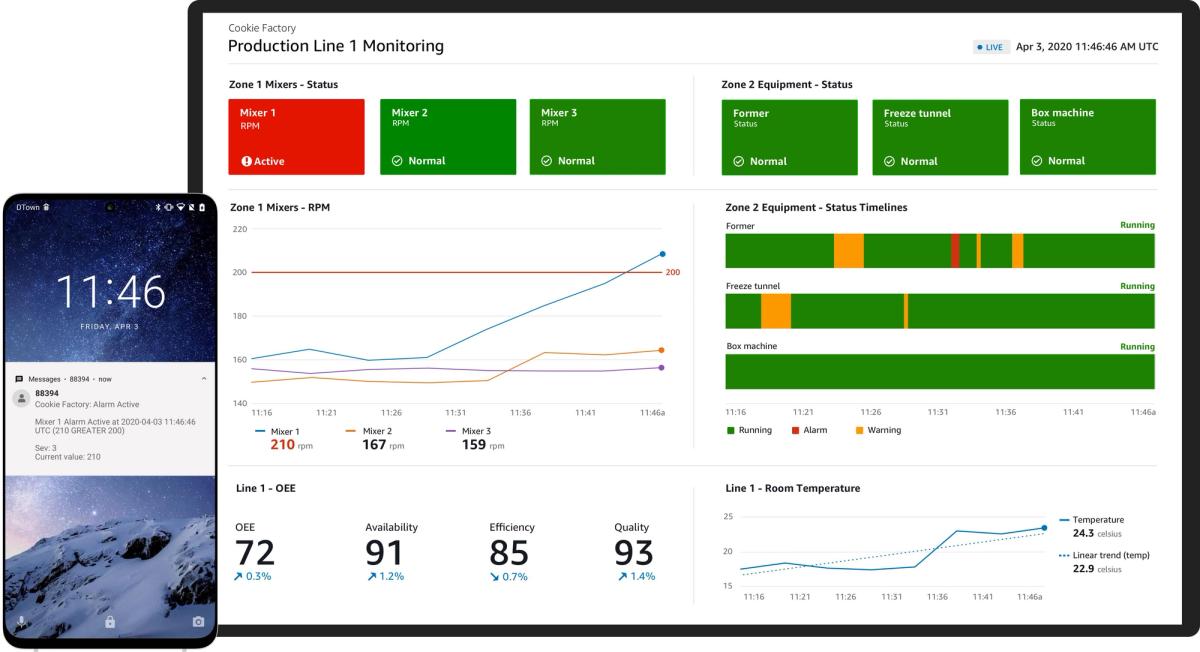
If processing time remains stable while waiting time increases, increasing machine speed would do little to help. The cause may instead lie in upstream material supply, WIP accumulation, or operator activity.
The same operating history is useful for maintenance.
Fixed maintenance intervals assume broadly similar equipment use, yet one machine may run 20 hours per day while another runs only six.
Operating hours, start-stop cycles, vibration, temperature, and other condition data provide a better picture of how heavily each machine is actually being used. Maintenance decisions can then be based more closely on real operating conditions.
Quality investigations can use the same data.
When a batch shows abnormal results, production time can be matched with machine parameters, process conditions, and raw-material lots to see whether the issue is concentrated around a specific machine state or production period.
The machine record then becomes part of the production history rather than an isolated equipment log.
How Do Smart Factory IoT Solutions Extend into Warehousing and Intralogistics?
Material movement inside the factory creates another large source of operational data.
Raw materials may leave storage through AS/RS, move along conveyors, transfer to AGVs or AMRs, enter line-side buffers, and finally reach production stations.
Each system may be functioning correctly on its own while the overall material flow still performs poorly.
An AGV fleet, for example, may show high utilization even though production lines continue to wait for material.
Looking deeper into the operating data may reveal that the vehicles are spending much of their time waiting at pickup stations rather than transporting loads.
Adding more AGVs would increase fleet capacity without removing the actual delay.
Connecting station sensors, AGV status, conveyor operation, warehouse tasks, and production demand makes it possible to follow the complete material-delivery process:
WMS / MES Task → Material Ready → AGV Pickup → Transport → Line-Side Delivery → Production Consumption
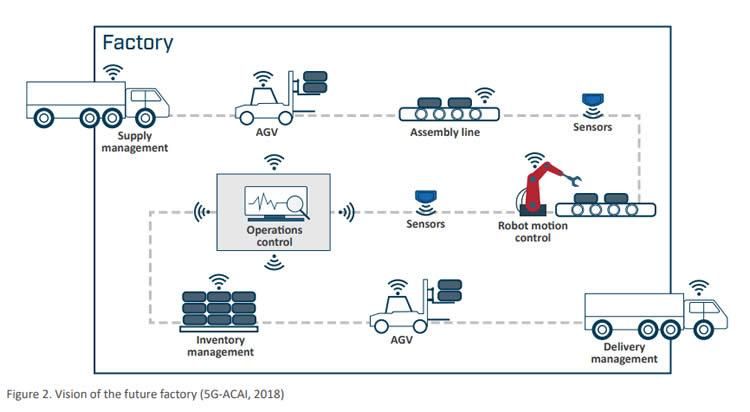
A delay at any point can propagate downstream.
For highly automated factories, the relationship between these steps is often more important than the utilization of any single AGV, conveyor, or storage machine.
What Systems Can Smart Factory IoT Solutions Work With?
IoT normally sits alongside existing manufacturing and warehouse systems rather than replacing them.
PLCs and machine controllers provide real-time equipment conditions. SCADA monitors and controls shop-floor equipment. MES adds production orders, process information, and execution status. ERP provides higher-level order, purchasing, and resource data.
Warehouse and intralogistics systems add another layer of context. WMS provides inventory and warehouse-task information, WCS provides automated equipment and material-flow status, and RCS provides AGV/AMR positions, tasks, and fleet information.
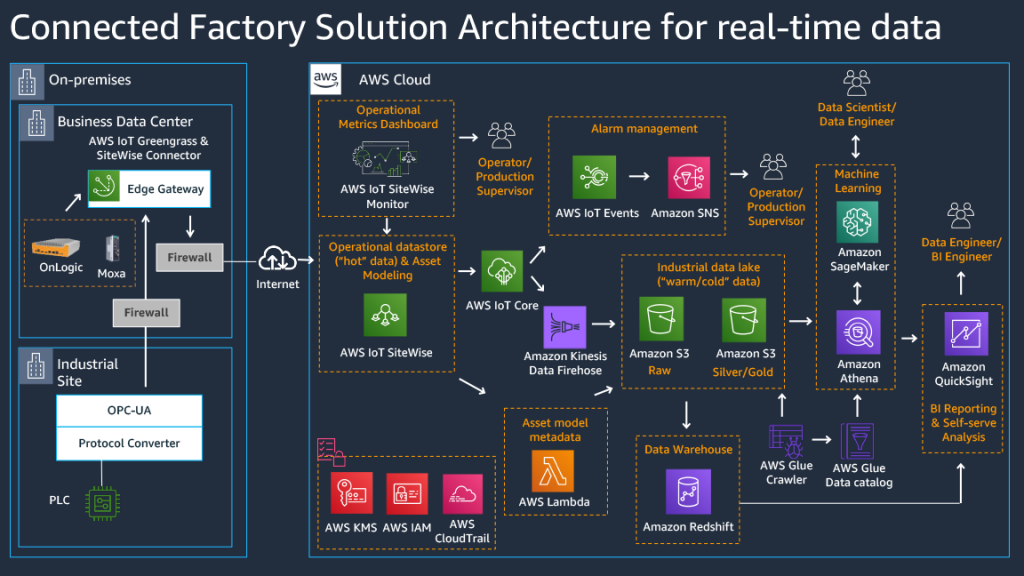
A single production event can therefore be traced across several systems.
A machine enters Idle →
IoT records the state change →
MES shows that the production order is still active →
RCS shows a delayed replenishment AGV →
WMS shows that the material has already left storage →
the delay is traced to the transport handoff
If the factory also uses a 3D Digital Twin System, the same information can be mapped to a virtual factory model, allowing equipment status, WIP, and logistics activity to be viewed in their physical locations.
Why Do Some Smart Factory IoT Projects Collect Large Amounts of Data Without Creating Much Value?
Collecting data is relatively easy.
A factory can add sensors to dozens or hundreds of machines and quickly build a large stream of temperature, vibration, current, cycle-time, and status records.
That does not guarantee that anyone will use the data.
A plant might record motor temperature every second without defining which temperature change matters or linking that information to failures, maintenance history, or production tasks. The result is a large dataset with little influence on daily operations.
The starting point matters.
If frequent downtime is the problem, identify which signals can help explain those stops. If production lines regularly wait for materials, track task release, material preparation, transport, and handoff times. If maintenance cost is the concern, focus on equipment conditions that can support maintenance decisions.
This usually produces a much narrower and more useful set of data than simply collecting every available signal.
The first IoT project also does not have to cover the entire factory. One production line, one machine group, or one intralogistics process is often enough to establish whether the data is helping engineers understand and improve the operation.
How Can Smart Factory IoT Solutions Deliver Measurable Benefits to Manufacturers?
The effect of an IoT project eventually has to appear in factory performance.
Earlier detection of changing equipment conditions may reduce unplanned downtime. Better visibility into material delivery can reduce line-side waiting. Continuous cycle-time records can show where production capacity is being lost before the issue becomes visible in final output.
Maintenance teams may spend less time performing unnecessary service while identifying deteriorating equipment earlier.
Quality teams may trace abnormal batches back to machine conditions and production periods faster.
In intralogistics, the improvement may appear as shorter waiting times, better use of AGVs and automated equipment, or the avoidance of unnecessary capacity expansion.
These results are easier to evaluate when the project begins with defined operating metrics such as Downtime, Cycle Time, WIP, Material Waiting Time, Throughput, or Equipment Failure Frequency.
After deployment, the same metrics provide a direct way to judge whether the IoT system has changed the operation.
If you are planning IoT, AGV/AMR, intralogistics, or automation-system integration for a manufacturing facility, you can contact Coolyne to discuss your current production processes, equipment data, and automation requirements.
Next Review
Move from article research to a scoped feasibility review.
Use the related products and solution paths below, then send your workflow and layout for a quick engineering review.
Related Solutions
Engineering Review