
Related Products
What Are Warehouse Robots? Types, How They Work, and When to Use Them
Learn what warehouse robots are, how autonomous warehouse robots work, which types fit different tasks, and how to evaluate implementation and partners.
Learn what warehouse robots are, how autonomous warehouse robots work, which types fit different tasks, and how to ev...
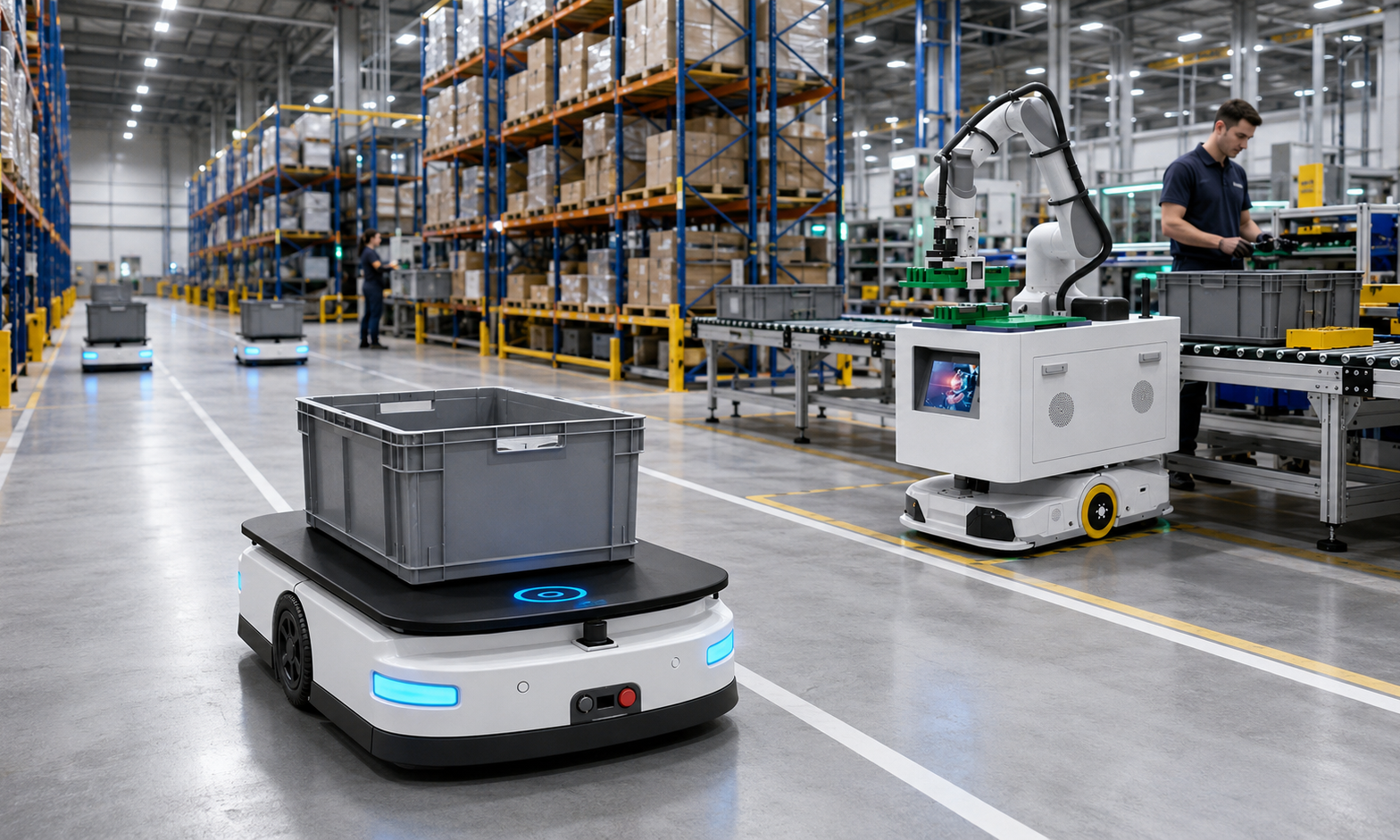
Most warehouses start looking at robots after the same moves begin eating too much labor. Pallet transfers repeat all day, replenishment runs stretch across the building, and internal transport loops start slowing output. Warehouse robots take over that kind of repetitive work, whether the job is moving totes, transporting pallets, retrieving storage containers, or supporting picking.
What are warehouse robots?
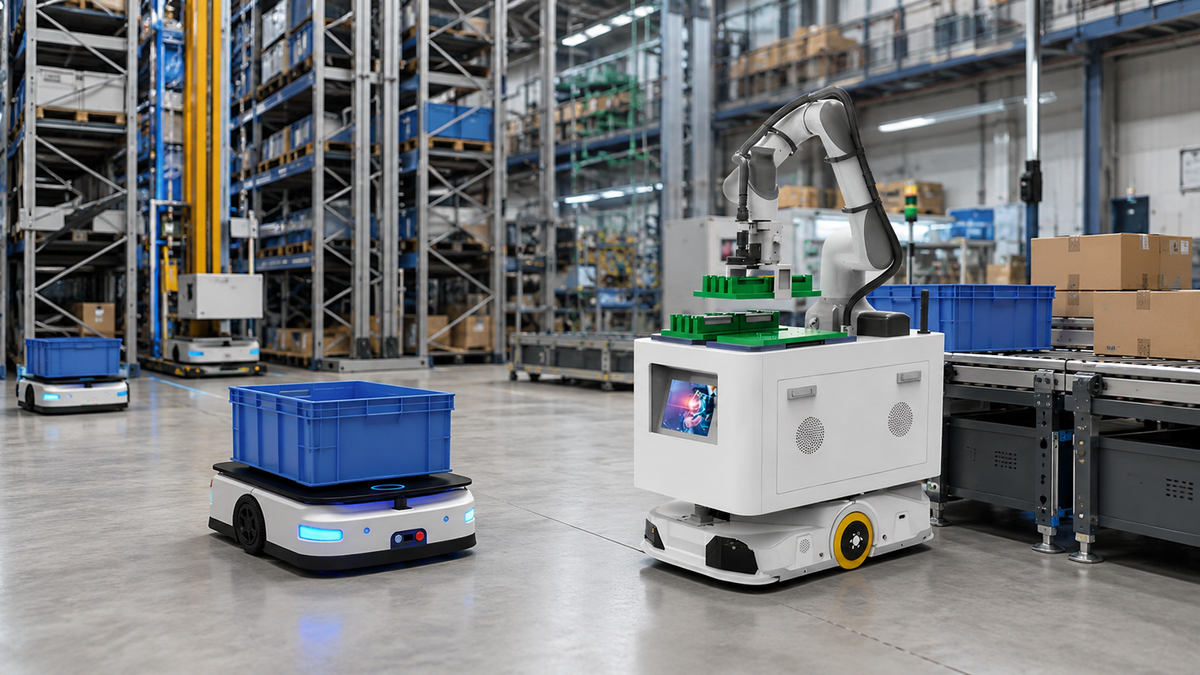
In most operations, “warehouse robots” means the machines people actually see doing the physical work. That may be a vehicle moving pallets between zones, a robot bringing totes to a picking station, or a storage robot pulling bins out of a dense system. They take over repeatable warehouse moves that teams no longer want to handle entirely with forklifts, carts, or walking labor.
Many first discussions start from the machine and stay there. Teams compare features, forms, or navigation methods before they have agreed on which job actually needs help. A clearer first step is to look at the work itself: which task repeats every shift, where labor keeps disappearing, and where delays start to build. Repeated transport, retrieval, and picking-support tasks usually rise to the top.
What are the different types of warehouse robots?
AMRs, AGVs, AS/RS robots, robotic arms, G2P systems, and drones
Most warehouses do not need every robot category. They need the category that matches the dominant movement or handling problem.
- AMRs: Autonomous Mobile Robots navigate dynamically with onboard sensors and software. They are often used for tote movement, replenishment, picking support, and flexible internal transport.
- AGVs: Automated Guided Vehicles usually follow fixed or semi-fixed paths and work best in stable point-to-point flows such as pallet transport between defined zones.
- AS/RS robots: Automated storage and retrieval systems use cranes, shuttles, or grid robots to place and retrieve goods from dense storage. MHI describes AS/RS as a combination of equipment and controls that store and retrieve materials with precision under a defined degree of automation (MHI).
- Robotic arms: These are most useful for picking, palletizing, depalletizing, packing, and other station-based tasks that require repeated handling.
- Goods-to-person systems: These systems bring inventory to operators instead of making operators walk to inventory. They are common where order-picking efficiency matters more than simple transport speed.
- Drones and scanning robots: These are typically used for inventory visibility, cycle counting, and high-shelf inspection rather than core transport.
Which robot type fits which warehouse task
Different robot categories solve different warehouse constraints. Some reduce travel, some increase storage density, and some take over repeatable handling at a fixed station. The choice gets easier once the bottleneck is clear.
| Robot type | Best fit | Typical use | Weak fit |
|---|---|---|---|
| AMR | Flexible internal transport in changing environments | Tote movement, replenishment, cart replacement, station-to-station flow | Highly fixed routes where lower-cost guided transport is enough |
| AGV | Stable point-to-point transport with defined paths | Pallet movement between receiving, storage, production, and shipping zones | Environments with frequent layout changes or heavy traffic variation |
| AS/RS robot | High-density storage with frequent retrieval requirements | Bin retrieval, pallet storage, dense automated storage and retrieval | Operations where the main issue is transport rather than storage density |
| Robotic arm | Repeatable handling at a fixed workstation | Picking, palletizing, depalletizing, packing, sorting | Workflows that change too often in item presentation or handling logic |
| Goods-to-person system | Walking-heavy picking environments | Delivering bins or totes to operators for order fulfillment | Operations where picking labor is not the main bottleneck |
In practice, selection usually comes down to where the operation is losing time today. If pallets keep waiting between receiving and storage, transport automation moves higher on the list. If pickers spend too much of the shift walking, goods-to-person systems deserve a closer look. If the work changes every hour and exceptions dominate the day, the operation usually needs process cleanup before any robot type will hold up well.
How do autonomous warehouse robots work?
Autonomous warehouse robots work by combining navigation hardware, sensing, task software, and safety logic into one coordinated operating loop. In a typical workflow, a warehouse management or execution system creates a task, sends it to a robot or fleet controller, and the robot then moves to the pickup point, confirms the load, travels through the assigned path or zone, and completes the handoff before updating the system status.
The autonomy comes from how the robot handles movement and decisions inside that loop. AMRs, for example, use sensors, cameras, LiDAR, or similar perception tools to understand where they are and what is around them. That lets them avoid obstacles, slow down in shared zones, and reroute when conditions change instead of stopping at the first exception. ASCM notes that AMRs can support warehouse operations through autonomous material movement, real-time data capture, and integration with operations-level systems such as warehouse management and execution platforms (ASCM).
That does not mean the robots are acting independently from the rest of the operation. The better way to think about autonomous warehouse robots is that they are physically autonomous but operationally orchestrated. They still rely on software to prioritize missions, sequence traffic, manage charging, and keep inventory movements aligned with the larger workflow.
How warehouse robotics improve efficiency and safety
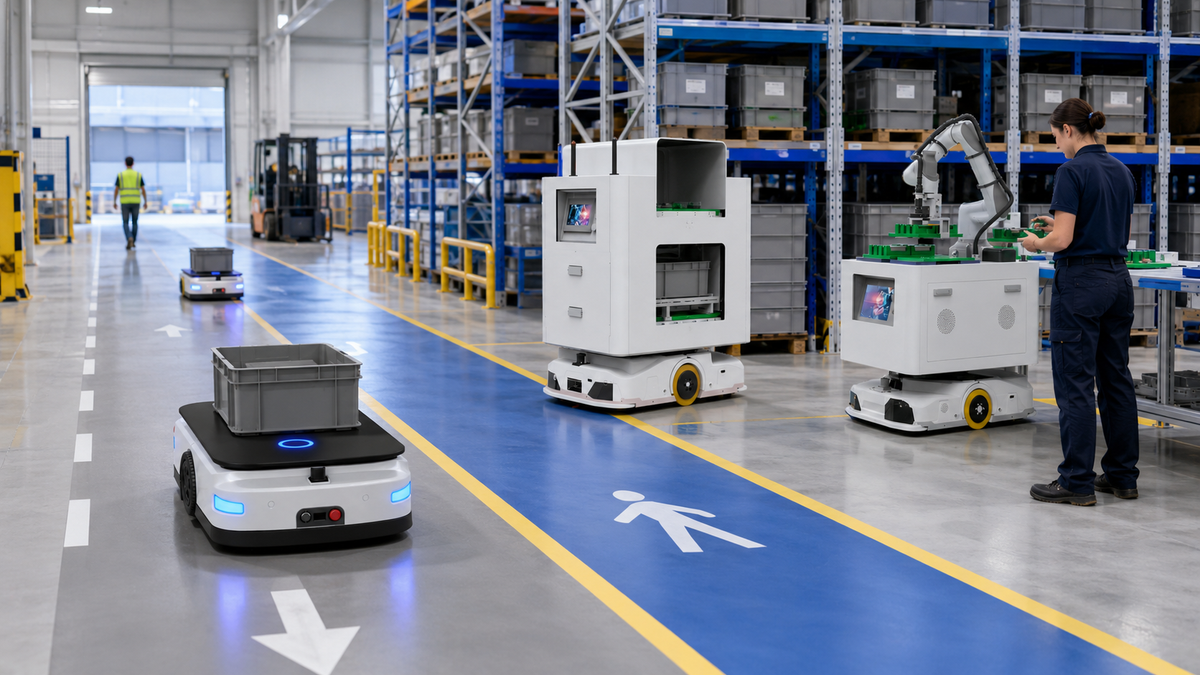
Warehouse robotics improve efficiency first by removing low-value travel. When operators spend a large share of the shift moving pallets, bringing stock to pick faces, or transferring work between fixed zones, robots can take over that travel portion and leave people to handle exceptions, quality checks, and judgment-heavy tasks.
They also improve consistency. Robots do not solve every process problem, but they do repeat the same move under the same rules more reliably than a fully manual transport model. That makes queue time, route conflict, replenishment rhythm, and handoff timing easier to see and easier to improve.
Safety gains usually come from taking over the tasks that create repeated exposure to manual handling, mixed traffic, and rushed movement. The National Safety Council’s Work to Zero program highlights robotics as one of the safety technologies that can help reduce serious injuries and fatalities when deployed with the right safeguards and planning (NSC). In warehouse operations, that often means fewer repetitive forklift trips, less manual strain, and more controlled movement through shared areas.
The limit is just as important as the upside. Warehouse robotics improve a clear process faster than they rescue a broken one. If inventory accuracy is poor, handoff rules are inconsistent, or exceptions dominate the daily flow, automation usually exposes those weaknesses before it pays back.
Where warehouse robots make the most sense
Warehouse robots usually earn their place by taking over one stretch of work that people keep repeating all day. In many sites, that starts with pallets piling up between receiving and reserve storage, replenishment runs from reserve to pick faces, line-side delivery in manufacturing cells, or tote movement between fixed workstations.
What these jobs share is not “advanced automation.” They share repetition. The starting point stays the same, the destination stays the same, the handoff looks similar, and the delay shows up in the same place every shift. That is where warehouse robots can remove walking, waiting, and low-value forklift travel without needing operators to improvise every few minutes.
Many good projects begin in a small slice of the building. One receiving-to-storage loop, one replenishment lane, one row of production-side deliveries, or one family of tote moves is often enough to show whether the workflow is ready. A warehouse does not need to look futuristic for robotics to make sense. It needs one problem that stays put long enough to solve.
Still, a repeated move is not always ready for robots on day one. If staging locations keep moving, loads arrive in different conditions every hour, inventory records are unreliable, or the team spends most of the day handling exceptions, robots usually struggle. In that case, workflow cleanup comes first. Once the work follows the same path most of the time and the numbers can be trusted, automation becomes much easier to justify.
How to implement autonomous warehouse robots
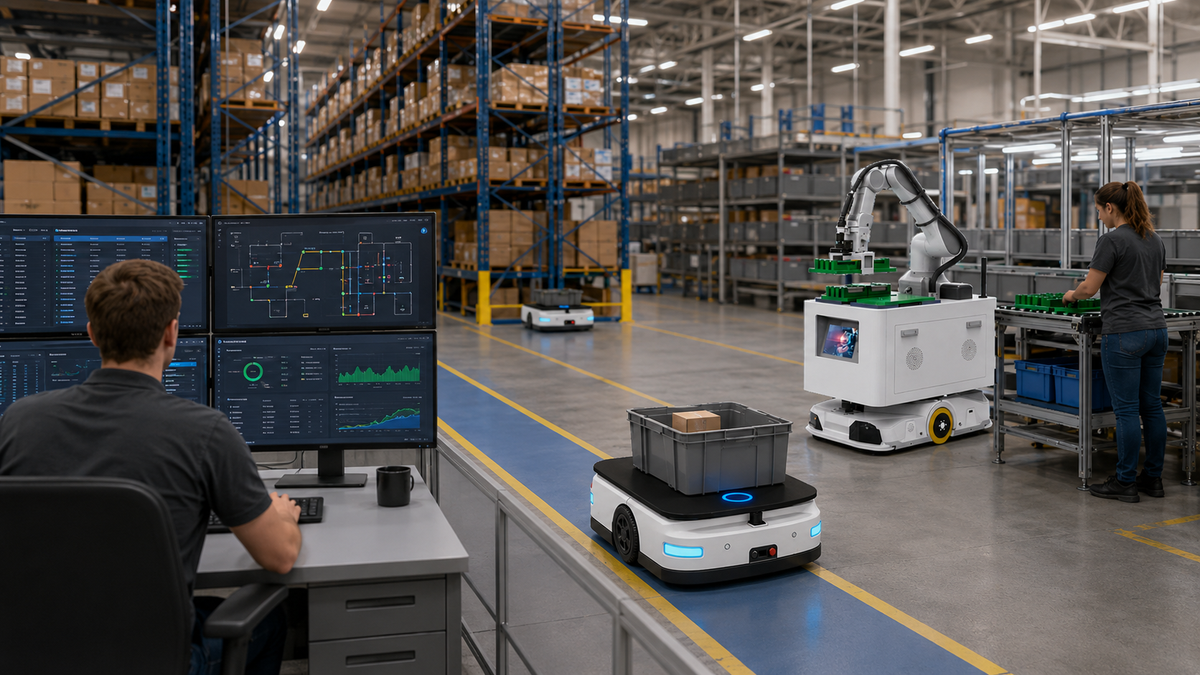
First projects usually work better when the team limits the first phase to one repeatable move, such as a receiving-to-storage transfer or a fixed replenishment route. Then the team can map where that move starts and ends, measure how much waiting or labor sits inside it, and decide what a clean handoff should look like. That gives the project a boundary the operation can actually manage.
Some routes look repetitive on paper and still fail once the project reaches the floor. Robots need a few basic conditions to stay stable: aisles cannot be too tight, traffic conflicts cannot keep happening, loads need to arrive in a consistent way, the network has to stay available, and task data has to be reliable enough for dispatch. Coolyne also frames early project work around feasibility, workflow scoping, and ROI analysis before a full deployment decision is made, which is closer to how these projects are usually judged in practice (coolyne).
Once those basics are in place, the next step is usually a pilot that is small enough to control but large enough to show whether the workflow really works. Then the team can validate integration with WMS, WCS, or fleet software, measure actual route performance, and decide whether the next step should be more vehicles, more zones, or deeper workflow integration.
How to choose a warehouse robotics partner
When a team chooses a warehouse robotics partner, the real question is not only which machine they sell. The harder part starts after that. Someone still has to define where the robot picks up and drops off, connect those moves to the software, train the people on site, and keep the system working once production begins.
That is why the first questions can stay very simple. Can this partner explain where your time is being lost today? Can they show how robot tasks connect to your current software and daily workflow? After launch, who helps when dispatch rules need adjustment, operators need retraining, or the process no longer runs as expected?
Software matters here because one robot on one route can sometimes be managed with extra manual effort, but several routes, more vehicles, and more handoff points quickly become harder to control. Coolyne describes its software as the layer for execution control, fleet coordination, analytics, and enterprise integration (coolyne software). That is the part buyers should understand before they assume a pilot will scale cleanly.
If the project is still early, a workflow review and a rough ROI model usually help more than asking for price first. Coolyne also puts feasibility, scope mapping, and ROI analysis ahead of pricing discussions (coolyne). For many teams, that is a better way to judge whether the project is ready at all.
FAQ about warehouse robots
What is an example of a warehouse robot?
An autonomous mobile robot that moves totes or pallets between fixed zones is one of the most common examples. An AS/RS shuttle or grid robot that stores and retrieves goods in dense storage is another strong example in high-density warehouse operations.
What are the different types of warehouse robots?
The main types usually include AMRs, AGVs, AS/RS robots, robotic arms, goods-to-person systems, and inventory drones or scanning robots. The right category depends less on popularity and more on whether the task is transport, storage, retrieval, picking, or station-based handling.
How much does a warehouse robot cost?
Cost varies widely by robot type and by project scope. The unit price matters, but software, charging, safety design, integration, support, and rollout complexity often have just as much impact on the real investment decision as the robot itself.
Warehouse robots are most useful when they solve one specific operational problem clearly enough to justify the system around them. If the workflow is repetitive, delays are visible, and the handoff logic can be standardized, robots often become a practical improvement instead of a technology experiment.
If your team is still deciding where to start, begin with one transport or replenishment loop. Measure where the delay is, how much labor it absorbs, and whether the workflow stays stable long enough to automate. Coolyne can support that stage through feasibility review, workflow scoping, and ROI analysis before a full deployment decision is made (contact).
Next Review
Move from article research to a scoped feasibility review.
Use the related products and solution paths below, then send your workflow and layout for a quick engineering review.
Related Solutions
Engineering Review