
Related Products
AGV vs AMR: What Is the Difference, and Which One Should Your Business Choose?
Compare AGV vs AMR navigation, safety, cost, deployment, flexibility, and applications to choose the right mobile robot for your warehouse or factory.
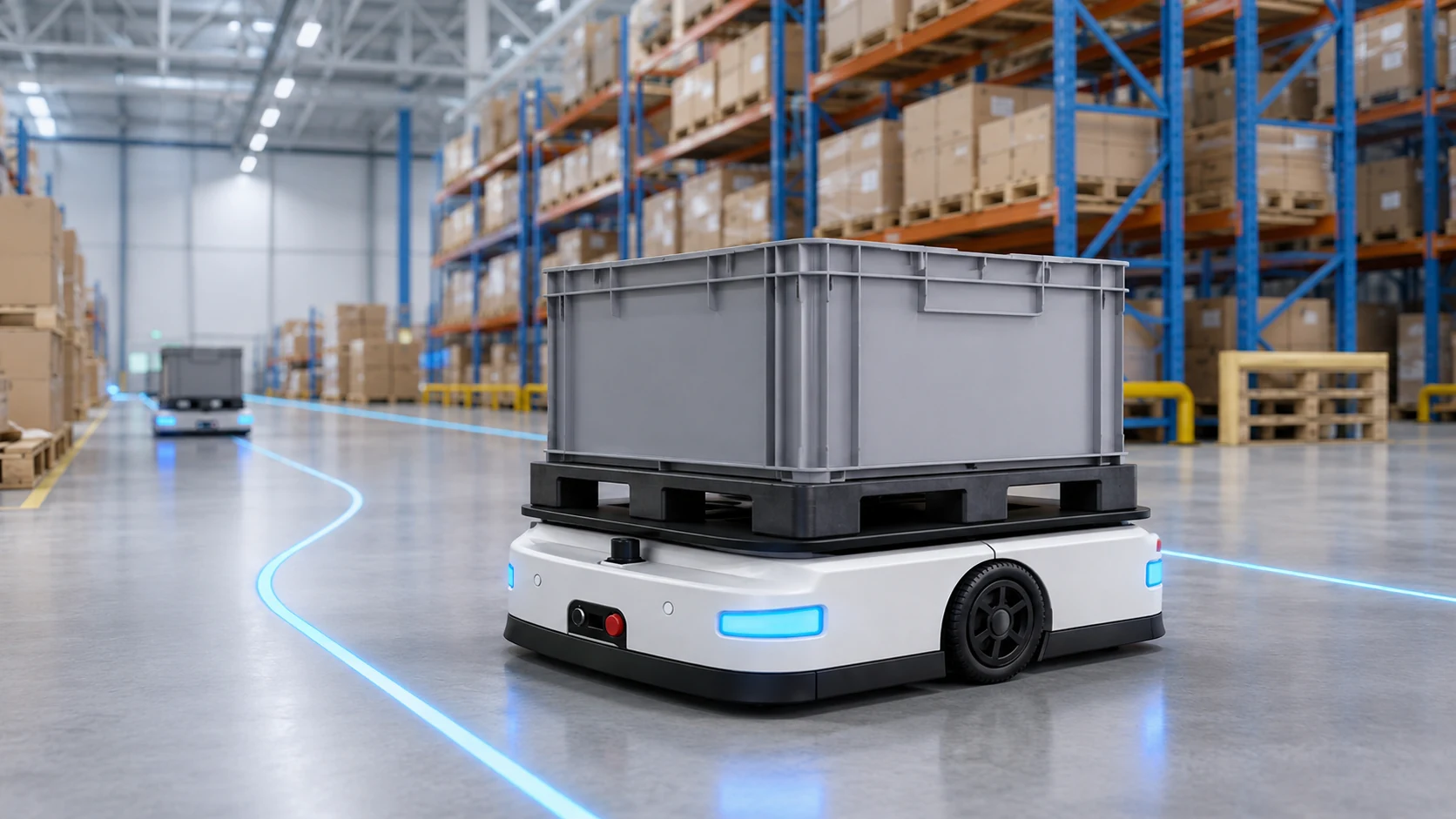
Navigation style. Safety trade-offs. Flexibility. Cost fit. Selection logic.
In factory and warehouse automation projects, both automated guided vehicles and autonomous mobile robots can handle material transportation tasks such as pallet transfer, line-side delivery, work-in-process movement, and internal warehouse transportation. As a result, many companies face a practical question when planning automation: AGV vs AMR—which one should they choose?
In the past, the difference was often summarized as follows: AGVs follow fixed routes, while AMRs move autonomously. Although this explanation is not entirely wrong, it no longer tells the whole story. As navigation technologies, sensors, and fleet management systems have advanced, some newer AGVs have gained stronger environmental perception and limited dynamic obstacle-avoidance capabilities.
Companies should therefore evaluate more than the product name. Navigation, obstacle avoidance, safety, total cost of ownership, deployment, application suitability, flexibility, responsiveness, and maintenance should all be considered.
This article compares AGVs and AMRs across these key areas to help you determine which system is more suitable for your operation.
Introduction to AMRs and AGVs
AGV stands for Automated Guided Vehicle. Its core characteristic is that it performs transportation tasks according to predefined routes and operating rules. Traditional AGVs commonly use magnetic tape, magnetic markers, QR codes, reflectors, or other fixed navigation methods. They are therefore well suited to stable processes with clearly defined transportation routes.
AMR stands for Autonomous Mobile Robot. An AMR typically uses LiDAR, cameras, encoders, and software algorithms to perceive and locate itself within its environment. It can then plan a route to its destination based on the assigned task. Compared with a traditional AGV, an AMR generally adapts more effectively to dynamic operating environments.
However, AGVs and AMRs are not completely separate categories in real-world projects. Many modern AGVs also use natural-feature or laser navigation, and some can perform limited dynamic route adjustments. For this reason, companies should focus on the vehicle’s actual capabilities, rather than relying only on whether it is marketed as an AGV or an AMR.
Differences Between AGVs and AMRs
The differences between AGVs and AMRs go beyond whether the vehicle can drive around an obstacle. More importantly, they differ in system logic, environmental adaptability, deployment requirements, and long-term scalability.
Navigation
| Comparison | AGV | AMR |
|---|---|---|
| Key difference | Usually follows predefined routes using magnetic tape, QR codes, reflectors, or configured paths | Uses maps, LiDAR, and sensors to localize itself and plan routes autonomously |
An AGV focuses more on which predefined route it should follow, while an AMR focuses on how it can reach the assigned destination.
For stable environments with clearly defined transportation lanes, an AGV’s navigation logic may be entirely sufficient. In facilities where routes, destinations, or traffic conditions change frequently, an AMR generally offers greater flexibility.
Obstacle Avoidance
| Comparison | AGV | AMR |
|---|---|---|
| Key difference | Usually slows down or stops when an obstacle is detected and waits for the route to become clear | Can normally recalculate its route and, when conditions allow, navigate around the obstacle |
This is one of the most commonly discussed differences between AGVs and AMRs. A traditional AGV usually stops when temporary objects, workers, or forklifts block its route. An AMR is more likely to assess the surrounding space and find another available route.
However, obstacle avoidance does not mean that an AMR can always drive around anything. If the aisle is too narrow, the obstacle enters the safety field, or the alternative path does not meet turning-radius or load-stability requirements, the AMR must also stop.
Safety
| Comparison | AGV | AMR |
|---|---|---|
| Key difference | Relies on safety sensors, emergency stops, bumpers, speed control, and predefined operating rules | Uses similar safety devices while combining them with more dynamic environmental perception |
It is not accurate to say that AMRs are always safer than AGVs. The safety of either system depends on its safety laser scanners, emergency-stop devices, bumpers, speed control, braking distance, load stability, traffic rules, and site-specific risk assessment.
In facilities where workers, forklifts, and robots share the same space, the AMR’s stronger environmental awareness may provide an advantage. In controlled areas with dedicated transportation lanes, an AGV can also operate within a stable and reliable safety system.
Total Cost of Ownership
| Comparison | AGV | AMR |
|---|---|---|
| Key difference | Vehicle purchase cost is often lower, but additional navigation infrastructure may be required | Individual vehicle cost may be higher, but dependence on fixed navigation infrastructure is usually lower |
Companies should compare the total cost of ownership, not just the price of the vehicle.
AGVs may offer a lower initial equipment cost. However, projects may also require magnetic tape, QR codes, reflectors, floor modifications, traffic-control equipment, and route commissioning. If the facility layout changes, some of this infrastructure may need to be relocated or replaced.
AMRs may have higher vehicle and software costs, but they usually require fewer physical changes to the facility. New destinations, traffic zones, or routes can often be added through map and software configuration.
In a stable process that is unlikely to change, an AGV may provide a lower total cost. In a dynamic environment, the AMR’s lower reconfiguration requirements may create better long-term value.
Deployment
| Comparison | AGV | AMR |
|---|---|---|
| Key difference | Requires route planning and may require magnetic tape, QR codes, reflectors, or other navigation infrastructure | Usually deployed through facility mapping and software configuration, with less reliance on fixed infrastructure |
An AGV project generally begins with route design, followed by the installation of navigation infrastructure, stations, and traffic-control equipment. If the layout changes substantially, route redesign and physical modifications may be required.
An AMR is generally deployed by mapping the facility, creating stations, defining restricted areas, configuring speed zones, and setting operating rules in software. This makes AMRs particularly suitable for pilot projects, phased implementation, and gradual fleet expansion.
However, AMRs are not simply placed on the floor and put into operation immediately. They still require mapping, station calibration, safety validation, system integration, traffic-rule configuration, and employee training.
Applications
| Comparison | AGV | AMR |
|---|---|---|
| Key difference | Fixed-route material transport, line-side delivery, standardized pallet movement, and repetitive towing | Multi-point pickup and delivery, dynamic warehouse transport, goods-to-person picking, and flexible manufacturing support |
AGVs are generally more suitable for highly repetitive, low-variability transportation tasks. Examples include moving materials from a warehouse to a fixed workstation, transporting components to an assembly line, or transferring finished products to a designated buffer area.
AMRs are generally more suitable for dynamic and variable operations, such as multi-station delivery, e-commerce order fulfillment, goods-to-person picking, and flexible manufacturing environments where transportation routes frequently change.
This does not mean that AGVs can only perform simple tasks or that AMRs are suitable for every complex application. Payload, load-handling method, positioning accuracy, transportation cycle time, and interface requirements must still be evaluated.
Flexibility
| Comparison | AGV | AMR |
|---|---|---|
| Key difference | Route and station changes may require replanning and, in some cases, modification of navigation infrastructure | Maps, missions, destinations, and operating zones can usually be changed through software |
If a company expects its production layout to remain stable for several years, the lower flexibility of an AGV may not be a disadvantage. A predictable route can make vehicle behavior easier to control and manage.
However, if the facility regularly adds workstations, relocates equipment, changes storage areas, or modifies material flows, an AMR usually adapts more easily.
Its routes, destinations, restricted areas, and task priorities can often be adjusted through software without physically modifying the floor.
Responsiveness
| Comparison | AGV | AMR |
|---|---|---|
| Key difference | Better suited to stable transportation cycles and repetitive tasks; relatively limited response to unexpected changes | Can respond more dynamically to obstacles, congestion, and changing task priorities |
In environments where order volumes fluctuate, priorities change frequently, or transportation routes are temporarily blocked, AMRs generally provide stronger real-time responsiveness.
AGVs can also receive tasks and route instructions from a fleet management system. However, their operating logic is often better suited to predictable workflows and consistent transportation cycles.
The responsiveness of the overall system also depends on fleet management software, wireless network performance, traffic-control rules, and integration with the WMS, WCS, MES, or other business systems.
Maintenance
| Comparison | AGV | AMR |
|---|---|---|
| Key difference | Requires maintenance of the vehicle as well as magnetic tape, QR codes, reflectors, or other navigation infrastructure | Focuses more on the vehicle, sensors, software, maps, and wireless network |
Traditional AGVs may require regular inspections to ensure that magnetic tape, QR codes, reflectors, and other navigation markers have not become damaged, displaced, covered, or worn.
AMRs reduce the need to maintain floor-based navigation infrastructure, but they rely more heavily on LiDAR, cameras, localization software, map data, and network connectivity. If the facility changes substantially, maps and station positions may also need to be checked or updated.
In general, AGV maintenance focuses more on mechanical components and physical navigation infrastructure, while AMR maintenance places greater emphasis on sensors, software, maps, and network performance.
When Is an AGV More Suitable?
An AGV is often the more economical and reliable choice when your operation has the following characteristics:
- Pickup points, destinations, and transportation routes remain fixed
- Production cycles are stable and tasks are highly repetitive
- Transportation lanes are controlled and temporary obstacles are uncommon
- Process layouts and routes do not change frequently
- Project cost control and operating stability are major priorities
- Standardized transportation processes need to be replicated at scale
For example, many automotive parts, appliance manufacturing, and food and beverage facilities have predictable material flows and stable production cycles. In these environments, AGVs can provide consistent, reliable, and cost-controlled material transportation.
In other words, if the objective is to move the same materials along the same routes to the same destinations, an AGV may already provide all the functionality the project requires.
The goal of automation is not to select the vehicle with the greatest number of features. It is to select a system that can complete the required transportation tasks reliably and economically.
When Is an AMR More Suitable?
An AMR is generally more suitable when the facility and its transportation requirements are more dynamic, especially in the following situations:
- Workstations, storage locations, or operating areas change regularly
- Transportation tasks involve multiple pickup and delivery points
- Robots must share aisles with workers, forklifts, or other equipment
- Routes may be blocked by pallets, materials, or temporary equipment
- Order volumes and task priorities change frequently
- The company wants to begin with a pilot project and expand gradually
- The system must receive tasks dynamically from a WMS, MES, or other software
- The company wants to reduce dependence on floor-based navigation infrastructure
AMRs are particularly suitable for electronics manufacturing, e-commerce warehouses, third-party logistics operations, pharmaceutical distribution, and flexible production environments.
In these applications, material flows are not always predictable. The system must adapt to changes in destinations, priorities, traffic conditions, and facility layouts.
If the objective is to move different materials efficiently to different destinations within a changing environment, an AMR should generally receive stronger consideration.
AGV or AMR: Coolyne Helps Your Company Select the Right System
Neither AGVs nor AMRs are inherently superior in every application.
AGVs are well suited to fixed, repetitive, and predictable transportation processes. AMRs are better suited to dynamic environments where flexibility, route adaptability, and rapid reconfiguration are more important.
The correct question is therefore not, “Which technology is more advanced?” Instead, companies should ask:
Which system can meet our current and future material-handling requirements at a reasonable total cost of ownership?
When planning a mobile robot project, Coolyne evaluates more than the vehicle itself. Key project conditions include:
- Transportation volume per hour and per day
- Pickup points, destinations, and typical travel routes
- Pallet, tote, rack, or material dimensions and weights
- Aisle width, turning space, and floor conditions
- Interaction between workers, forklifts, and mobile robots
- Load pickup and placement methods
- Required positioning accuracy
- Charging strategy and expected vehicle utilization
- Integration with WMS, WCS, MES, and production equipment
- Project investment, operating costs, and expected ROI
Some projects are best suited to AGVs, while others require AMRs. In certain facilities, a mixed system may provide the best result. For example, AGVs can handle stable, high-volume transportation routes, while AMRs manage variable deliveries between multiple workstations.
Coolyne can evaluate your facility layout, material types, transportation cycles, traffic conditions, and future expansion plans to help determine whether an AGV, AMR, or mixed mobile robot system is the most appropriate solution. To discuss your application and receive a project feasibility and ROI assessment, please contact the Coolyne team.
Coolyne | Warehouse and Intralogistics Automation
Next Review
Move from article research to a scoped feasibility review.
Use the related products and solution paths below, then send your workflow and layout for a quick engineering review.
Related Solutions
Engineering Review