
Related Products
What Is a Machine Tending Robot? Components, Benefits, and Applications
Learn what a machine tending robot is, its key components, benefits, applications, and the factors to evaluate before automating machine loading and unloading.

Learn what a machine tending robot is, its key components, benefits, applications, and the factors to evaluate before...
In machining, component manufacturing, and high-volume production, operators often repeat the same tasks throughout the day: collecting parts, loading them into a machine, starting the machining cycle, unloading finished parts, and transferring them to the next station. These tasks are highly repetitive and may involve heavy components, sharp edges, hot surfaces, or exposure to cutting fluids.
A machine tending robot can perform these loading, unloading, and transfer tasks automatically. However, a complete machine tending system involves more than installing a robotic arm beside a machine. The robot must work together with grippers, vision systems, machine controls, safety equipment, and material-handling devices to create a stable and efficient automated process.
What Is a Machine Tending Robot?
A machine tending robot is an industrial robotic system used to load, unload, and transfer parts for machine tools or other production equipment. It can collect unprocessed parts from trays, racks, conveyors, or mobile robots, accurately position them inside a machine, and remove the finished or partially processed components after the machining cycle is complete.
A typical machine tending process includes:
- Picking up a raw or partially processed component from a designated location;
- Identifying the part’s position, orientation, or model;
- Opening the machine door and, when necessary, cleaning the fixture area;
- Loading the part into a chuck, fixture, or positioning device;
- Sending a signal to start the machining cycle;
- Removing the part after machining is complete;
- Placing it in a finished-parts area, inspection station, or downstream machine.
Unlike general material handling, machine tending is directly connected to the production cycle of the equipment. Robot accuracy, gripper stability, machine communication, and exception-handling capabilities can therefore affect the performance of the entire production line.
Key Components of a Machine Tending Robot
A complete machine tending system generally includes the robot itself, an end-of-arm tool, a material supply system, control equipment, and safety devices. These components must be selected according to the part characteristics and machining process rather than simply combining a standard robot with an existing machine.
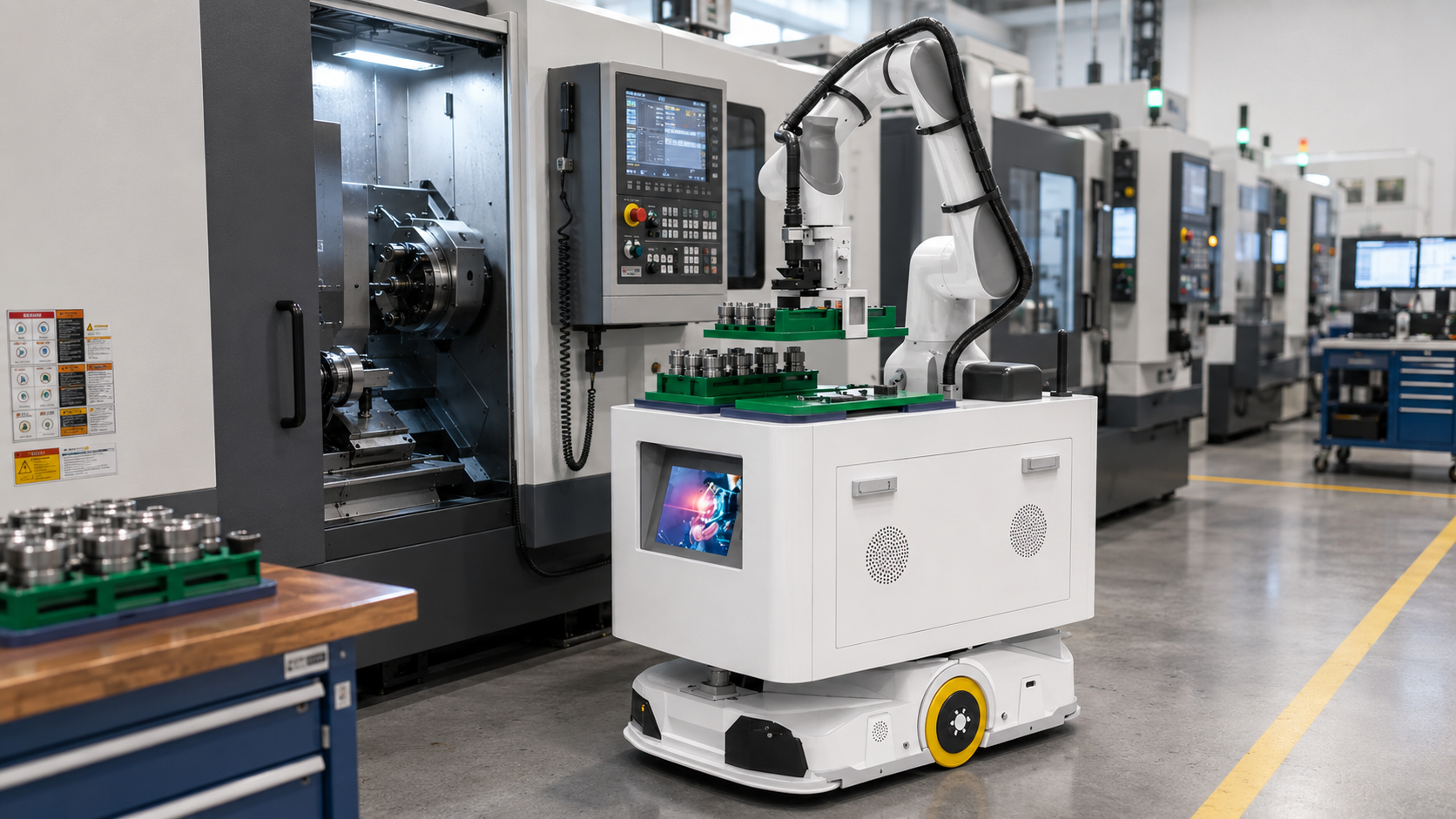
Robot Arm
The industrial robot arm is the primary motion device in a machine tending system. Robot selection normally depends on payload capacity, reach, repeatability, operating speed, and installation method.
Compact, high-speed robots may be suitable for small precision parts. Heavier castings, wheels, molds, or large metal components require robots with higher payload capacities and longer working ranges.
End-of-Arm Tooling
The end-of-arm tool comes into direct contact with the workpiece. Common options include mechanical grippers, pneumatic grippers, electric grippers, vacuum cups, and magnetic grippers.
The gripper must be designed around the part’s size, weight, surface condition, and shape before and after machining. For example, a raw part and a finished part may require different gripping positions.
Some machine tending systems use dual grippers. One gripper removes the finished component while the other immediately loads a new workpiece, reducing the amount of time the machine remains idle between cycles.
Vision and Inspection Systems
When parts are not arranged in fixed positions or when several part models are processed in the same production area, machine vision can identify their location, orientation, and visible characteristics.
Vision systems can also confirm whether a part has been gripped correctly, check whether a workpiece remains inside the machine, and verify that the new part has been loaded into the correct position.
However, not every machine tending project requires vision. When parts are presented in accurately positioned trays or fixtures, mechanical positioning may provide a simpler and more stable solution.
Material Supply and Buffering Equipment
The robot requires a continuous supply of unprocessed parts and sufficient space for finished components. Common material supply methods include trays, drawer-style storage systems, conveyors, vibratory feeders, pallets, and mobile robots.
When one robot serves several machines or materials must be transported across a larger production area, AGVs or AMRs can deliver raw parts to the machine tending station and transport finished parts to inspection, cleaning, or packaging areas.
Control and Communication System
The control system coordinates the robot, machine tool, automatic door, fixture, inspection equipment, and material supply devices.
The robot must receive information about the machine’s operating status and send signals indicating that loading is complete, the machining cycle may begin, or an abnormal condition has occurred.
Depending on the equipment, communication may be established through digital I/O, a PLC, an industrial communication protocol, or a dedicated machine interface. Available communication methods and control permissions can vary considerably between machine brands and between newer and older equipment.
Safety System
Machine tending cells commonly include safety fencing, interlocked doors, light curtains, laser scanners, emergency-stop devices, and area sensors.
The safety design should be based on a risk assessment that considers the robot’s movement range, operating speed, workpiece weight, and the ways in which personnel may enter the work area.
Benefits of Machine Tending Automation
The value of machine tending automation extends beyond reducing the amount of manual part loading and unloading. Its primary benefit is that it provides machines with a more consistent material supply and a more predictable production cycle.
Longer Effective Machine Operating Time
In a manual process, machines may remain idle when operators are away from the station, changing shifts, or managing several machines at the same time.
A robot can complete loading and unloading tasks according to a consistent cycle, reducing the waiting time between machining operations. When sufficient material buffering is available and the machining process is stable, the system can also support production during night shifts or other minimally staffed periods.
This can increase the utilization of existing production equipment without immediately requiring additional machine tools.
More Consistent Production Cycles
Manual loading speed can vary according to operator experience, fatigue, and working conditions. A robot repeats the same gripping, positioning, and loading motions each time, making the auxiliary time between machining cycles more consistent.
A stable machine tending cycle also helps manufacturers estimate capacity, schedule production, and identify abnormal downtime more accurately.
Improved Safety and Working Conditions
Machine tending tasks may involve sharp edges, heavy workpieces, hot components, cutting fluids, and machinery with rapidly moving parts.
Robots can reduce the frequency with which employees enter hazardous areas, lowering the risk of pinching injuries, cuts, burns, and strain caused by repetitive lifting.
Automation can also allow employees to move from repetitive handling work to quality inspection, equipment maintenance, production coordination, and exception management.
Reduced Variation in Part Loading
A robot follows a programmed path and places each part in a defined position. This can reduce problems such as incorrect orientation, incomplete insertion, and inconsistent clamping depth.
However, a robot cannot automatically resolve every quality issue. Fixture design, workpiece tolerances, positioning references, and machine condition must still be verified before the system is deployed.
Support for Multi-Machine Production
Depending on the machine layout and machining cycle, one robot may serve a single machine or move between two or more machines.
For components that require several consecutive operations, the robot may also transfer parts from the first machine to the second, helping connect multiple production processes.
Factors to Consider Before Automating Machine Tending
Not every machine tending task is immediately suitable for robotic automation. A project should be evaluated from several perspectives, including the workpiece, process stability, equipment interfaces, production cycle, and site layout.
Can the Workpiece Be Gripped Reliably?
The first consideration is whether the part has a stable and accessible gripping position.
Large variations in part size and weight, easily deformed surfaces, oil contamination, and a lack of clear positioning features can make gripper design more difficult.
The shape of the part before and after machining must also be considered. A finished component may no longer have the gripping surface used for the raw part, or the machined surface may require protection from direct contact with the gripper.
Is the Machining Process Stable Enough?
If operators frequently need to adjust tools, modify machining parameters, remove chips, or reposition workpieces, automating the loading and unloading process alone may not support reliable unattended production.
Before introducing machine tending automation, manufacturers should address common machining abnormalities and define which conditions can be handled automatically and which require operator intervention.
What Are the Production Volume and Changeover Frequency?
High-volume, repetitive production is generally easier to automate successfully. However, this does not mean that machine tending robots are unsuitable for low-volume manufacturing.
In high-mix, low-volume environments, the project should focus on whether grippers can be changed quickly, whether robot programs are easy to select, and whether the vision system can identify different workpieces.
If product changeovers require excessive time, the practical value of flexible automation may be reduced.
Does the Robot Cycle Match the Machining Cycle?
The time required for the robot to collect a part, open the machine door, unload the finished part, clean the loading area, insert the next part, and close the door should be evaluated against the machine’s processing cycle.
For short machining cycles, robot speed and dual-gripper designs become particularly important. For longer machining cycles, one robot may be able to serve several machines, improving robot utilization.
Can the Existing Machine Be Integrated?
Newer machines often provide automatic doors, controllable fixtures, and standardized communication interfaces. Older equipment may also be automated, but additional devices may be required, such as automatic door mechanisms, external PLCs, signal modules, or customized control interfaces.
During project evaluation, it is necessary to confirm whether the machine can provide signals for cycle completion, alarms, door position, and fixture status. It is also necessary to determine whether the robot can receive permission to initiate a machining cycle.
Is the Site Layout and Material Flow Suitable?
The robot requires not only sufficient operating space but also clearly planned areas for raw parts, finished parts, personnel access, maintenance, and safety protection.
If materials are stored far from the machine or the work cell frequently stops because components are not replenished on time, automating only the machine loading process will not deliver the full potential benefit.
In such cases, the project may also require material racks, conveyors, buffering systems, or mobile robots.
Does the Expected ROI Support the Project?
A machine tending project should not be evaluated only by comparing the purchase price of the robot with direct labor costs.
The analysis should also include machine utilization, the ability to operate during minimally staffed shifts, production consistency, changeover time, maintenance costs, and losses caused by unplanned downtime.
The source of value differs between projects. Some companies automate because qualified operators are difficult to recruit. Others need to increase machine capacity or reduce heavy lifting and hazardous manual operations.
Common Machine Tending Applications
Machine tending robots can be used with many types of machining and production equipment. The specific system configuration depends on the workpiece, machine interface, and process requirements.
CNC Lathe Loading and Unloading
The robot collects raw parts from a tray or storage system, loads them into the lathe chuck, and removes them after machining.
A part-flipping station may also be added so that the robot can turn the workpiece around for machining on the opposite end.
CNC Machining Center Loading and Unloading
For milling, drilling, and combined machining processes, the robot can load workpieces into fixtures or onto machining pallets.
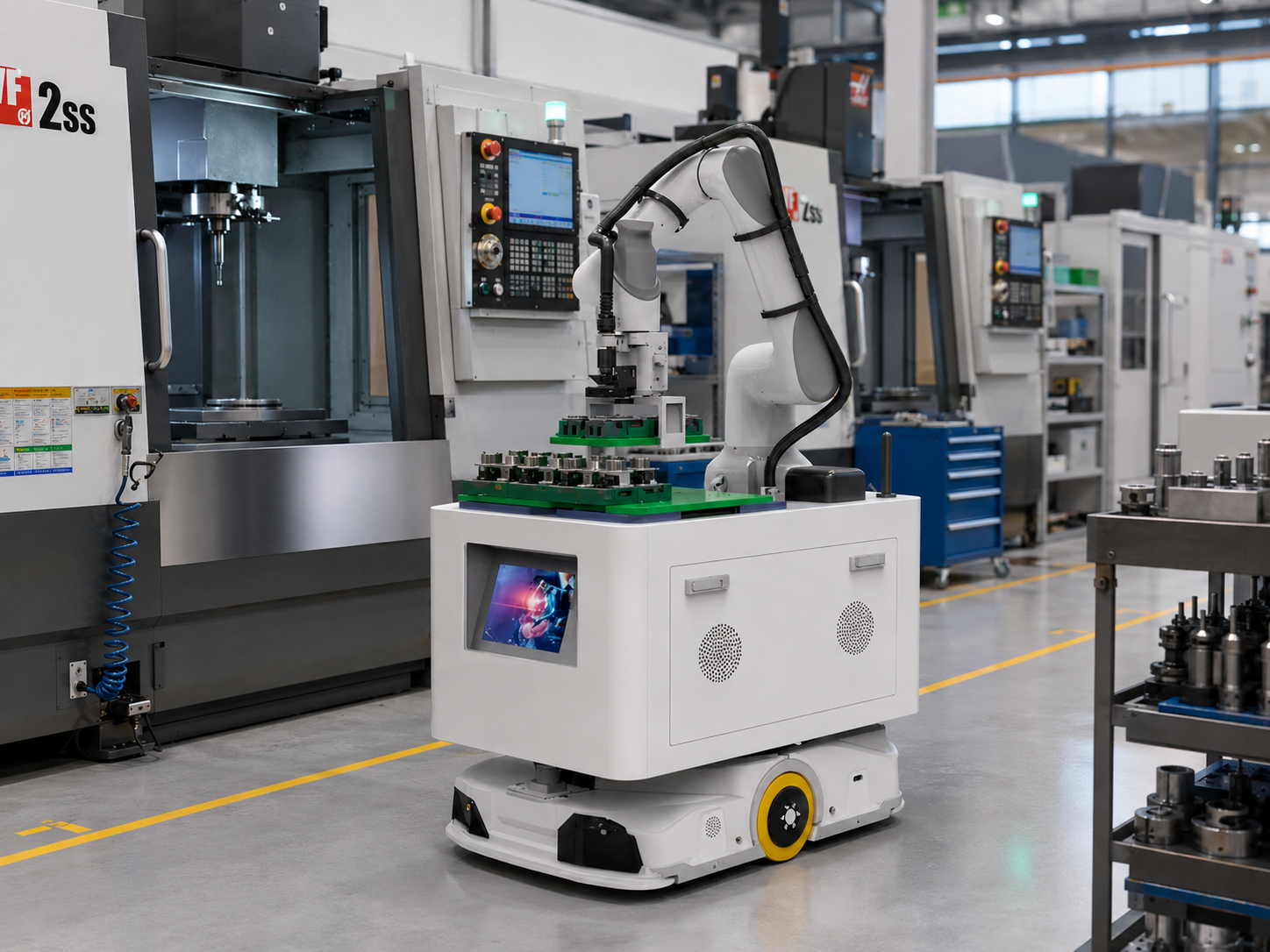
Parts requiring machining on several surfaces may require a flipping device, zero-point positioning system, or multi-station fixture.
Press Loading and Unloading
A robot can load sheet metal or metal blanks into a press and remove the formed components.
These applications generally require careful control of cycle time, safety interlocks, and sheet-separation performance.
Die-Casting and Injection-Molding Part Removal
A robot can remove molded parts from a die-casting or injection-molding machine and transfer them to cooling, deburring, coating, inspection, or packaging stations.
High-temperature components may require heat-resistant grippers, along with an assessment of how thermal radiation could affect robot components.
Grinding, Deburring, and Polishing Machine Tending
Robots can supply parts to grinding machines, deburring equipment, and polishing systems.
Because these processes may generate dust, debris, and changes to the workpiece surface, gripper protection and environmental resistance are particularly important.
Inspection and Testing Equipment Tending
Machine tending is not limited to machining equipment. Robots can also load components into measuring devices, leak-testing systems, vision inspection stations, or functional testing equipment.
This helps connect machining processes with automated quality inspection.
What Makes Coolyne’s Robotic Technology Different?
Coolyne provides a composite mobile robot for machine tending applications. The system integrates a mobile robot platform, an industrial robotic arm, vision and positioning systems, and end-of-arm tooling into a single unit.
It can autonomously travel to different CNC machines or production equipment to load, unload, and transport workpieces.
Unlike a conventional robotic arm installed in a fixed position, Coolyne’s composite mobile robot is not limited to serving one machine. It can move between workstations according to production requirements, allowing one robot to support multiple machines or processes.
Combining Material Transport and Machine Tending
Traditional machine tending systems usually perform only the loading and unloading tasks beside the machine. Raw materials and finished parts must still be delivered by employees or separate material-handling equipment.
Coolyne’s composite mobile robot can collect parts from a buffer area, rack, or designated pickup position, transport them to the machine, and complete the loading process. After machining, it can deliver the finished component to an inspection station, cleaning system, downstream process, or finished-parts buffer.
This connects material transport and machine operation into a continuous workflow, reducing manual replenishment, inter-station handling, and machine waiting time.
One Robot Can Serve Multiple Workstations
When the machining cycle is considerably longer than the robot’s loading and unloading cycle, a fixed robot may remain idle for much of the processing time.
After completing a task at one machine, a composite mobile robot can travel to another machine and continue working. The system can arrange tasks according to machine status, production priority, and material requirements, improving robot utilization in multi-machine environments.
This approach is particularly suitable for factories with dispersed equipment, machines with different cycle times, or production areas where installing a dedicated robot beside every machine is not practical.
Easier Adaptation to Production Changes
A fixed robotic work cell is normally tied to a particular machine and location. When equipment layouts, product models, or production assignments change, the cell may need to be redesigned or relocated.
A mobile machine tending robot can adapt to new production arrangements by updating its navigation map, task sequence, gripper, and robot program.
This can provide greater flexibility in high-mix, low-volume environments or production facilities with frequent changeovers.
Flexibility does not eliminate the need for engineering, however. Workpiece gripping, machine interfaces, automatic doors, safety zones, and positioning accuracy must still be designed for the specific application.
Connecting Multiple Production Processes
In addition to CNC machine tending, a composite mobile robot can connect inspection equipment, cleaning systems, part-flipping stations, and material buffers.
For example, the robot can transport a raw part to the first machine, move it to a flipping station after the initial process, load it into a second machine, and finally deliver the finished component to a vision inspection or dimensional measurement station.
This approach can connect previously separated equipment into a more continuous production cell without relying entirely on fixed conveyor systems.
Integration Based on the Actual Process
Coolyne configures the mobile platform, robotic arm payload, end-of-arm tooling, vision system, material racks, and safety equipment according to the workpiece weight, dimensions, gripping positions, machine quantity, production cycle, and facility layout.
For existing machines, the project must also evaluate automatic doors, chuck or fixture controls, cycle-completion signals, alarm signals, and machine-start permissions to determine how the robot can communicate reliably with the equipment.
Project Feasibility and ROI Analysis
Before selecting a machine tending solution, manufacturers should determine whether a fixed robot or a composite mobile robot is more suitable for their production environment.
Coolyne can evaluate machine quantities, operating shifts, labor requirements, equipment utilization, workpiece types, and expected production capacity to assess project feasibility and potential ROI. This analysis helps determine how many machines the robot should serve, how materials should be buffered, and whether the automation project should be deployed in phases.
Companies evaluating CNC machine tending automation can contact Coolyne and provide information about their workpieces, machine quantities, production cycles, and facility layout for a more detailed technical feasibility assessment.
Next Review
Move from article research to a scoped feasibility review.
Use the related products and solution paths below, then send your workflow and layout for a quick engineering review.
Related Solutions
Engineering Review