
Related Products
Types of Warehouse Robots: 8 Common Types and Their Applications
From the moment goods arrive until orders are shipped, there are plenty of warehouse tasks that robots can handle.
Autonomous Mobile Robots (AMRs) · Automated Guided Vehicles (AGVs) · Automated Storage and Retrieval Systems (AS/RS)
From the moment goods arrive until orders are shipped, there are plenty of warehouse tasks that robots can handle. Automated forklifts transport pallets, mobile robots carry order items through warehouse aisles, and robotic arms perform tasks such as case packing and palletizing.
Today, warehouse robots are used in material handling, storage, order picking, sorting, and packaging. Here are eight common types and the jobs they perform in a warehouse.
Autonomous Mobile Robots (AMRs)
In a large warehouse, pickers can spend a good part of their day walking. They move between storage aisles to find products, then have to transport the picked orders to the next work area.
Autonomous Mobile Robots (AMRs) can take over some of that transportation, giving employees more time to focus on picking.
AMRs typically use sensors such as LiDAR and cameras to perceive their surroundings, then combine map and localization data to plan their routes. If an obstacle appears ahead, a robot can slow down, stop, or replan its route, depending on its capabilities and safety configuration.
AMRs are commonly used in two types of warehouse picking operations.
One is collaborative picking. Employees pick items from the shelves while AMRs carry the order goods and travel to their assigned destinations. Workers don't have to transport each completed batch of orders back to the packing area themselves.
The other is goods-to-person picking. In some goods-to-person systems that use mobile robots, the robot travels underneath a storage rack and brings the entire rack to a fixed picking station. An employee picks the required items at the station, and the robot returns the rack to storage.
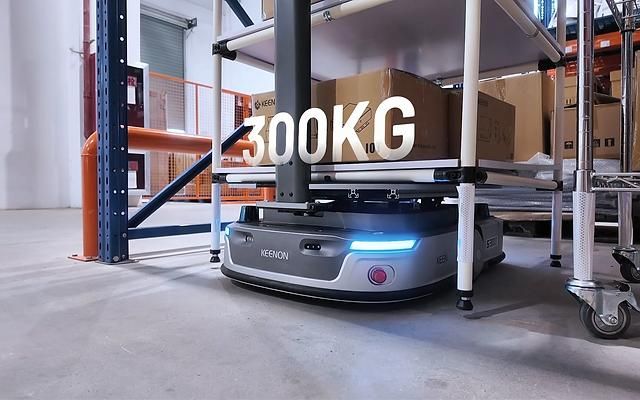
One advantage of AMRs is that their routes don't depend on physical tracks. When pickup and delivery points change, transport routes can usually be updated through maps and task configurations.
Of course, a warehouse running dozens or even hundreds of robots still needs a fleet management system to coordinate traffic. Otherwise, even robots capable of autonomous navigation can end up congesting narrow aisles or the areas around workstations.
Automated Guided Vehicles (AGVs)
Automated Guided Vehicles (AGVs) are another common type of automated transport equipment in warehouses.
In a large warehouse, pallets may need to move constantly from receiving to storage, while picked goods must be transferred to outbound staging areas. These transport jobs often follow relatively consistent routes and repeat throughout the day.
With AGVs, the warehouse can assign these jobs through a scheduling system, reducing the need for employees to drive material handling vehicles.
AGVs come in different forms. Some use lifting mechanisms to move racks or other load carriers, some tow carts filled with goods, and others have low-profile bodies that travel underneath a load carrier to transport it.
Their navigation methods vary as well.
Traditional AGVs often follow magnetic tape, magnetic markers, or other guidance infrastructure. Modern AGVs can also use laser navigation, SLAM, and similar technologies, without necessarily requiring navigation markers on the floor.
That has made the distinction between AGVs and AMRs less clear than it used to be.
Traditional AGVs generally rely more on predefined routes, while AMRs place greater emphasis on autonomous path planning. But some modern AGVs can already adjust their routes in response to their surroundings and even navigate around obstacles.
For a closer look at navigation, obstacle avoidance, and deployment, see our AGV vs. AMR comparison.
Automated Storage and Retrieval Systems (AS/RS)
Not all warehouse robots travel across the floor. Some are built to place goods into storage racks and retrieve them when needed.
These machines are often part of an Automated Storage and Retrieval System (AS/RS).
Strictly speaking, AS/RS isn't a single robot type. It's a system made up of automated storage and retrieval equipment, racks, conveyors, and control software.
Consider a pallet-based automated warehouse.
After a pallet enters the storage area on a conveyor, a stacker crane travels along the storage aisle, lifts the pallet to the required height, and places it in the designated storage location. When the pallet needs to leave storage, the stacker crane retrieves it and transfers it to the outbound conveyor.
A warehouse storing smaller products may use very different equipment.
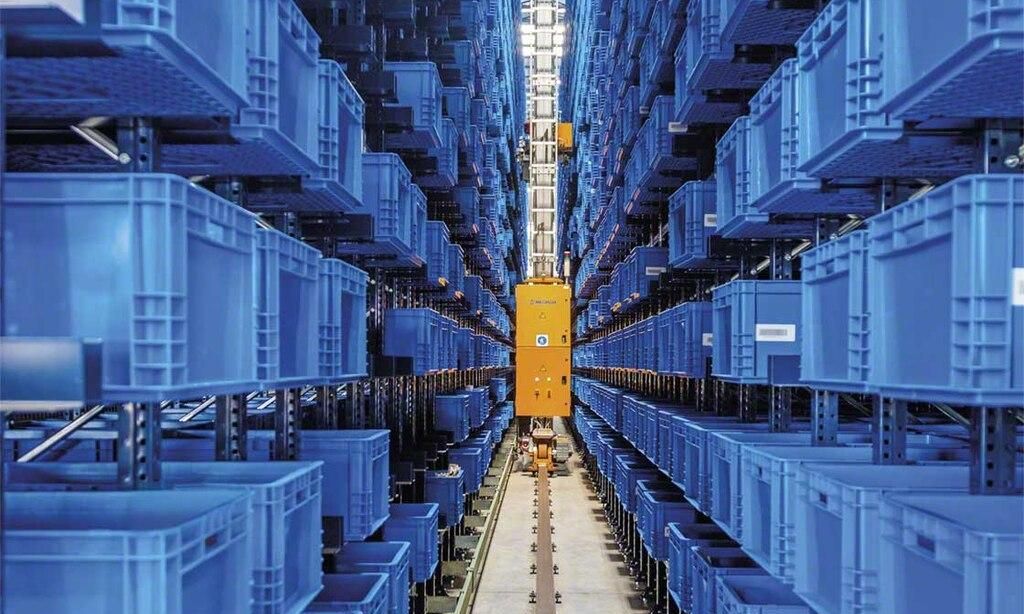
For example, a bin-based AS/RS may use shuttles or bin-handling robots to store and retrieve bins inside racks or along storage aisles. Some systems also bring retrieved bins to picking stations so employees can pick orders directly from them.
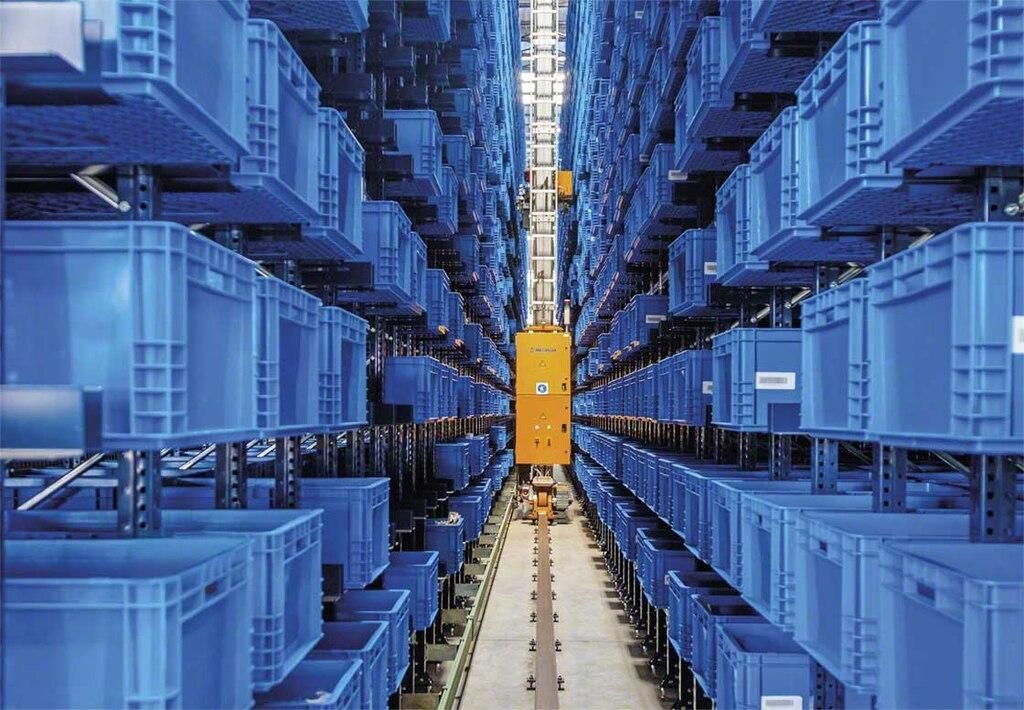
AS/RS is commonly used in warehouses with frequent storage and retrieval operations or high storage-density requirements. It's also worth considering when a business wants to reduce the need for employees to enter high-bay racking areas.
Collaborative Robots (Cobots)
Not every warehouse task needs to be fully automated. Sometimes it makes more sense for employees and robots to split the work.
Collaborative Robots, or Cobots, are designed for collaborative applications. In warehouses, these are often collaborative robotic arms that can pick products, pack orders, or handle simple material transfers using suitable grippers and end-of-arm tools.
For example, an order processing station may handle products in many different sizes. An employee can sort and verify the items, while the collaborative arm places products that are suitable for automated gripping into the appropriate containers.
Items with unusual shapes or unclear gripping points can still be handled by employees, rather than expecting the robot to perform every action.
Collaborative arms can also be integrated into existing manual workstations. How much weight they can handle and how large an area they can reach, however, depend on the model.
And "collaborative" doesn't mean that no safety measures are needed. The gripper, the goods being handled, the robot's movements, and where employees work all need to be considered in the safety assessment.
Palletizing and Depalletizing Robots
Before goods leave a warehouse, large numbers of cartons often need to be stacked onto pallets for transport.
Palletizing robots automate this work.
They typically use an industrial robotic arm fitted with vacuum grippers or other end effectors to pick cartons from a conveyor and stack them on a pallet, layer by layer, according to a predefined pattern.
For cartons of consistent size arriving in a steady flow, the robot can repeat the same palletizing sequence, reducing manual lifting while making it easier to maintain a consistent stacking pattern.
Depalletizing robots do the reverse: they remove goods from pallets.
For instance, when a pallet of cartons arrives in the receiving area, a depalletizing robot can remove the cartons individually or by layer and place them onto a conveyor for sorting or storage.
Depalletizing can sometimes be harder than palletizing because the incoming loads may not be neatly arranged.
Some cartons may be tilted, others may be crushed or deformed, and some pallets may contain products of different sizes. The robot needs to locate each item and select an appropriate gripping approach, often with the help of machine vision and suitable end effectors.
So even though palletizing and depalletizing are opposite operations, they don't necessarily call for the same vision systems, grippers, or picking strategies.
Sorting Robots
In a distribution center, incoming parcels need to be sorted by order, destination, or delivery route.
A facility may process thousands of parcels every day. Identifying and moving every parcel manually would take a considerable amount of labor.
Mobile sorting robots are one way to automate part of this work.
These robots typically carry a small conveyor belt or tilt-tray mechanism on top. After a parcel passes a scanner, the system determines its destination from the barcode or other data and sends the robot to the corresponding sortation chute.
At the designated point, the robot discharges the parcel using its onboard mechanism before moving on to the next task.
Other sorting robots use robotic arms.
With a vision system, an arm can identify a particular item among mixed goods, pick it up, and place it in the appropriate container or on a conveyor.
Warehouses also use conventional automated sortation equipment, such as cross-belt and sliding-shoe sorters. These systems typically operate along fixed conveyor routes and are suited to handling high volumes of goods continuously.
Mobile robotic sortation systems, by contrast, can adapt to different operating needs through fleet size and system configuration. Their actual throughput still depends on the number of robots, available sortation destinations, and the time required to handle each parcel.
Packaging Robots
After items are picked, they still need to be packed before they can be shipped.
Some warehouses don't have particularly complicated packing tasks, but the number of daily orders is large. Employees may spend much of their time repeatedly picking up products, arranging them, and placing them into cartons.
Packaging robots can handle some of these actions.
For example, when products arrive at a case-packing station on a conveyor, a robotic arm can pick them up and place them into a carton. The packed carton then moves on to equipment such as case sealers and labeling machines.
If an order contains several different products, the robot can also use vision technology to locate the items and place them according to the packing requirements.
Packaging robots and conventional packaging automation equipment aren't quite the same thing.
Automatic case erectors, case sealers, and labeling machines are typically dedicated machines. Packaging robots, on the other hand, mainly use robotic arms to pick, move, arrange, and place products.
For orders with consistent product sizes and packing methods, it's generally easier to have a robot follow an established case-packing program. If product shapes vary widely or the job involves protecting fragile items and complex placement requirements, more advanced vision, gripping, and packing-planning capabilities are needed.
Automated Forklifts
Automated Forklifts retain the forks and lifting mechanisms of conventional forklifts while adding navigation, localization, and automated control systems. They can move pallets without requiring continuous operation by a driver.
Unlike robots that mainly handle horizontal transport, some automated forklifts can also put pallets onto racks and retrieve them, depending on their design and lifting capacity.
For example, when a pallet arrives in the receiving area, an automated forklift can pick it up, drive to the assigned rack, adjust its position and fork height, and place the pallet into the designated storage location.
The vehicle can also retrieve a pallet from a rack and take it to the outbound area.
In terms of navigation, automated forklifts overlap with the AGVs and AMRs discussed earlier. Some products are forklift-type AGVs, while others use more autonomous navigation and path-planning technologies.
What makes forklift automation challenging isn't just getting the vehicle from one location to another. It's also the transfer between the forks, the pallet, and the storage rack.
A pallet may be slightly out of position on the floor, and the storage location also requires the vehicle to stop accurately. The robot needs to identify the pallet, adjust the forks, and coordinate driving and lifting to complete the task.
That means planning an automated forklift system involves more than transport routes. Pallet specifications, rack structures, aisle widths, storage heights, and load-transfer methods all matter.
Considering robotic automation for your warehouse? Coolyne can help you evaluate suitable AGV/AMR solutions based on your warehouse layout, load types, and operational requirements. Contact us to discuss your project needs.
Next Review
Move from article research to a scoped feasibility review.
Use the related products and solution paths below, then send your workflow and layout for a quick engineering review.
Related Solutions
Engineering Review