
Related Products
What Is a Vertical Lift Module (VLM)? How It Works, Benefits, and System Components
A VLM is an enclosed automated storage system commonly used for parts, tools, spare parts, and other items managed on trays.
Benefits and Applications of Vertical Lift Modules · VLM vs. AS/RS: What Is the Difference? · Make Better Use of Vertical Space
In manufacturing plants, spare-parts rooms and tool rooms often face a similar problem: there are many different items to store, but only a small quantity of each. Employees may have to search across several shelves to find what they need. As the number of SKUs grows, making good use of limited warehouse space becomes harder.
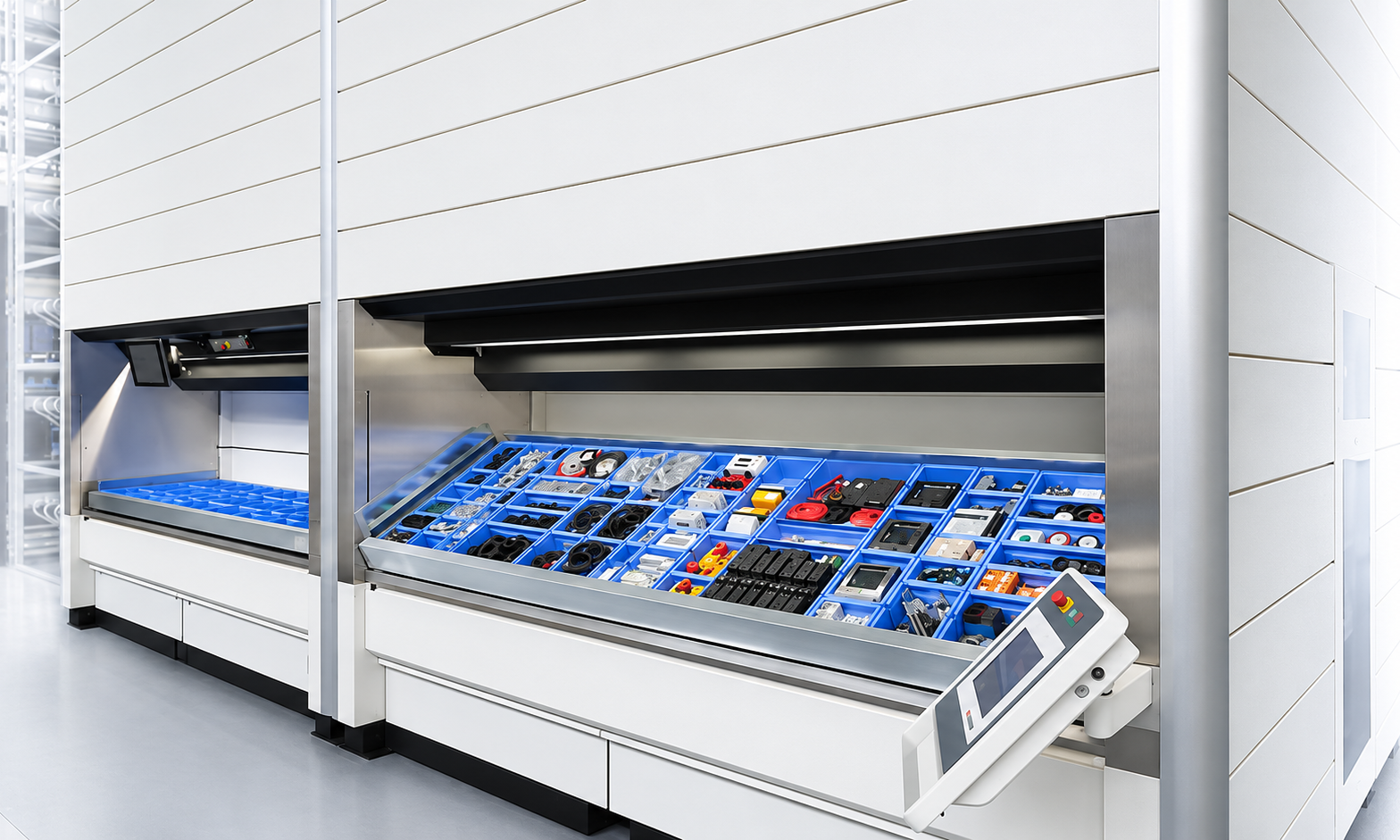
A Vertical Lift Module (VLM) is designed for this kind of storage. It arranges storage trays vertically inside an enclosed unit and uses a central inserter/extractor to bring the requested tray to an access opening. Employees can retrieve items from a fixed workstation instead of walking through the storage area.
What Is a Vertical Lift Module?
A VLM is an enclosed automated storage system commonly used for parts, tools, spare parts, and other items managed on trays. The size and weight of the items it can handle depend on the tray dimensions and the system’s load capacity.
A typical VLM has two vertical columns of storage trays with a central inserter/extractor between them. When an operator submits a retrieval request through the control panel or inventory software, the system identifies the required tray. The inserter/extractor retrieves it and delivers it to the access opening. After the operator picks the required items, the tray is returned to its storage position.
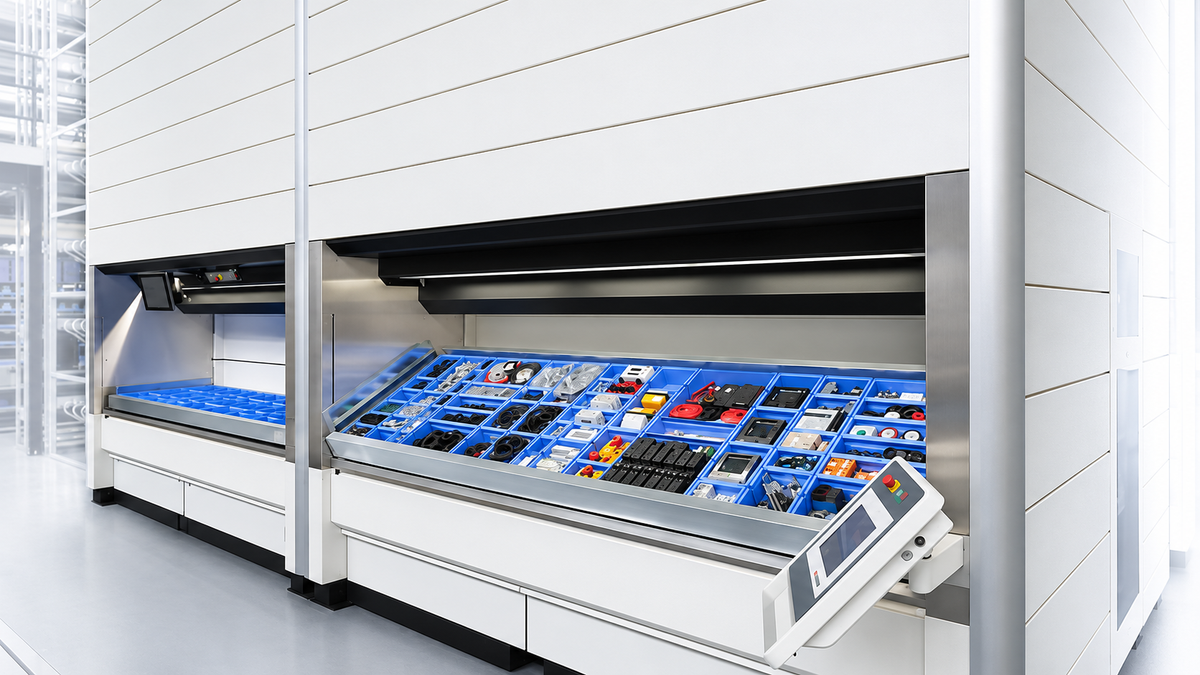
This is a Goods-to-Person (GTP) process: the goods come to the operator, rather than the operator walking between shelves to find them.
The unit’s height and tray configuration can be tailored to the available building clearance, item dimensions, and storage requirements. For warehouses with many SKUs and limited floor space, vertical storage can reduce the floor area needed for conventional shelving.
Benefits and Applications of Vertical Lift Modules
VLMs are useful for more than simply stacking shelves higher. They change how employees access stored items and can make better use of the space and time available.
1. Make Better Use of Vertical Space
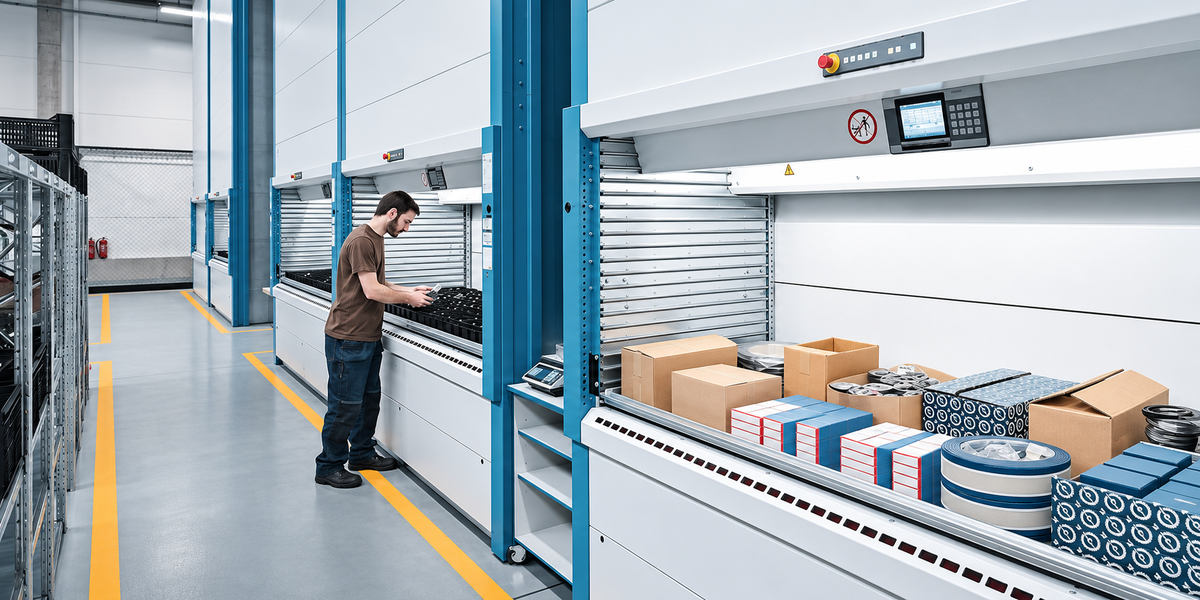
Conventional shelving needs aisles for employees to walk through and retrieve items. The usable shelf height is also limited by what employees can safely reach.
A VLM keeps the trays inside the unit and brings the required tray to a fixed access opening. This allows the system to use available overhead space while keeping its footprint relatively compact. The actual storage capacity depends on the building height, item dimensions, tray spacing, and unit configuration.
2. Reduce Walking and Item Search Time
In a conventional shelving area, employees have to walk to the relevant location and then find the specific item they need.
With a VLM, the operator submits a retrieval request and the system brings the corresponding tray to the access opening. When the unit is integrated with barcode scanning, inventory software, or pick-to-light equipment, employees can also confirm item locations and quantities more easily.
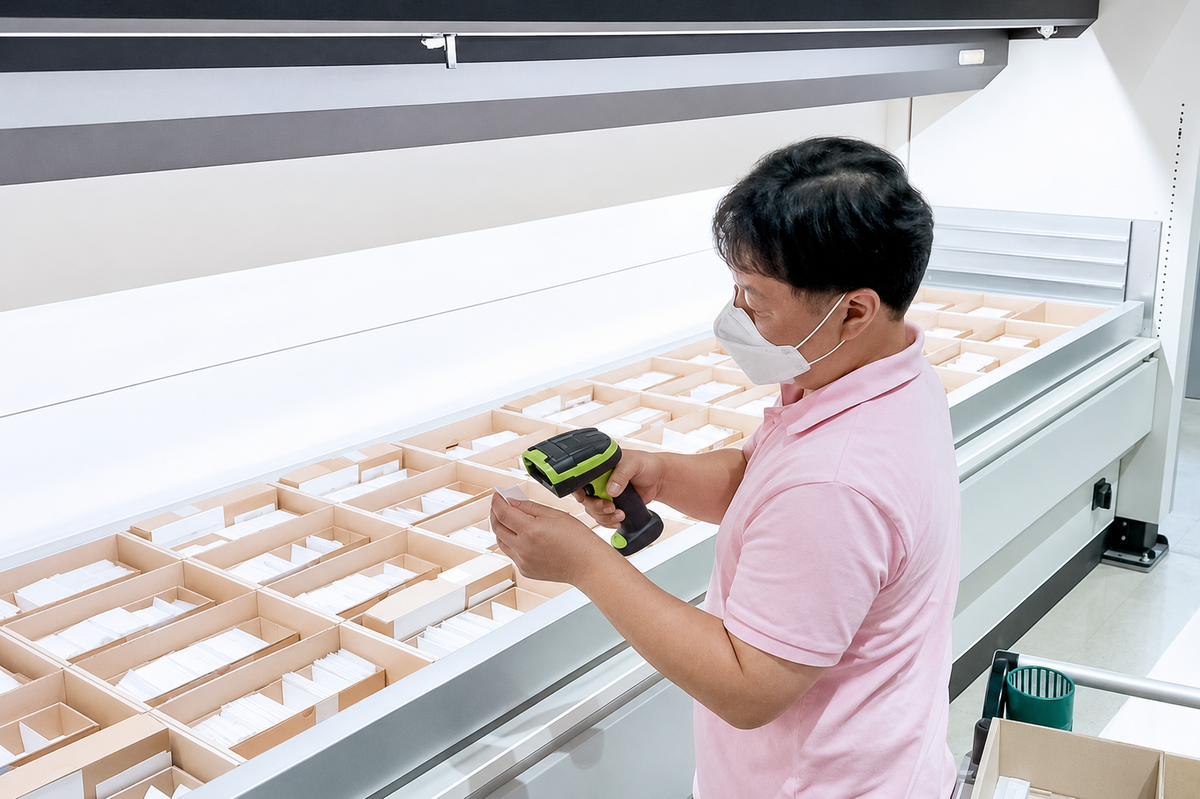
This can reduce repeated walking in spare-parts rooms and component stores where employees handle many small picking tasks throughout the day.
3. Improve the Picking Environment
Retrieving items from conventional shelves can involve repeated bending, using step ladders, or reaching overhead.
A VLM delivers the tray to a fixed access opening, allowing employees to pick items at a more convenient working height. Its enclosed storage area also reduces the need for employees to enter the storage mechanism directly. When combined with user authentication and access controls, the system can restrict access to inventory and record retrieval activity.
Typical VLM Applications
- Manufacturing parts storage: Store electronic components, mechanical parts, fasteners, and production supplies, then retrieve the required items for production tasks.
- Tools and maintenance spare parts: Keep tools, replacement parts, and maintenance supplies organized and easier for maintenance staff to locate.
- E-commerce and order fulfillment: Store smaller items with a wide range of SKUs and bring the required trays to picking workstations.
- Medical supplies: Organize medicines, medical supplies, and other items that require controlled storage and access. The system configuration must meet the relevant storage requirements.
VLMs are well suited to parts, tools, spare parts, and other goods stored on trays. For full-pallet storage, oversized loads, or operations that require very high continuous throughput, a pallet AS/RS or shuttle system may be a better fit. The choice depends on tray dimensions, load per tray, retrieval frequency, and equipment capabilities.
VLM vs. AS/RS: What Is the Difference?
VLM and AS/RS are often discussed together, but they are not two parallel equipment categories.
AS/RS (Automated Storage and Retrieval System) is an umbrella term for a range of automated storage technologies. A VLM is one type of AS/RS.
Other common AS/RS technologies include pallet systems that use stacker cranes, Mini Load AS/RS for tote storage, and shuttle systems. They use different storage structures and retrieval methods, and are suited to different types of goods.
VLM vs. Other AS/RS Technologies
Comparison
VLM
Other Common AS/RS
Storage method
Trays are arranged vertically inside an enclosed unit.
Depending on the system, storage may use high-bay racks, aisles, or shuttle-based racking.
Retrieval method
A central inserter/extractor brings the selected tray to the access opening.
Stacker cranes, shuttles, or other automated equipment perform storage and retrieval.
Typical goods
Parts, tools, spare parts, and other items stored on trays.
Pallets, totes, cartons, and other loads.
Space utilization
Uses building height with a relatively compact footprint.
Provides high-density storage based on the rack structure and system layout.
Typical applications
Parts stores, tool rooms, spare-parts stores, and order picking.
Automated warehouses, pallet stores, and tote storage systems.
The choice is not simply a matter of one replacing the other. VLMs are commonly used for tray-based storage of parts and other smaller items, while other AS/RS technologies can be configured for different load sizes and throughput requirements. For more detail, see our guide to Automated Storage and Retrieval Systems.
Understanding the Components of a Vertical Lift Module System
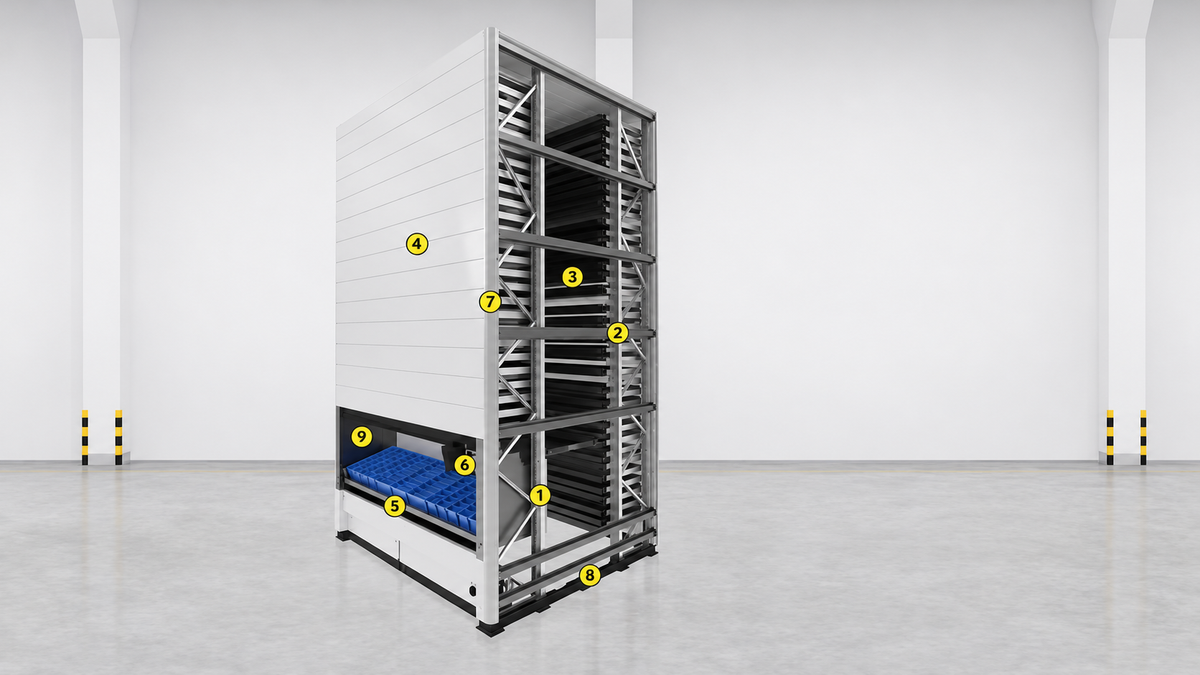
VLM designs vary by manufacturer, but a typical system includes several main components.
1. Storage Trays
Storage trays hold parts, tools, and other items. They are arranged on both sides of the central inserter/extractor.
Dividers and partitions can be added to suit different item sizes and create separate storage locations within a tray. Some VLMs also measure the height of the items on each tray and adjust tray spacing to reduce unused vertical space.
2. Central Inserter/Extractor
Located between the two columns of trays, the central inserter/extractor is the core mechanical component of a VLM.
It moves vertically to the required level, retrieves the selected tray from its storage position, and transfers it to the access opening.
3. Frame and Enclosure
The frame supports the entire unit and provides the structure for the trays and the movement of the inserter/extractor. The enclosure separates the internal storage area from the operator access area and helps prevent direct contact with moving components.
The unit’s overall height, width, and tray count are selected according to the available warehouse space and storage requirements.
4. Access Opening
The access opening is where employees interact with the VLM.
Once a tray arrives, the operator can pick or place items. Some systems also include indicator lights, barcode scanners, or pick-confirmation devices to help employees locate the correct items on the tray.
5. Control System and Inventory Software
These two components have different responsibilities.
The control system manages equipment movements, including the positioning of the inserter/extractor, tray retrieval, and machine operation.
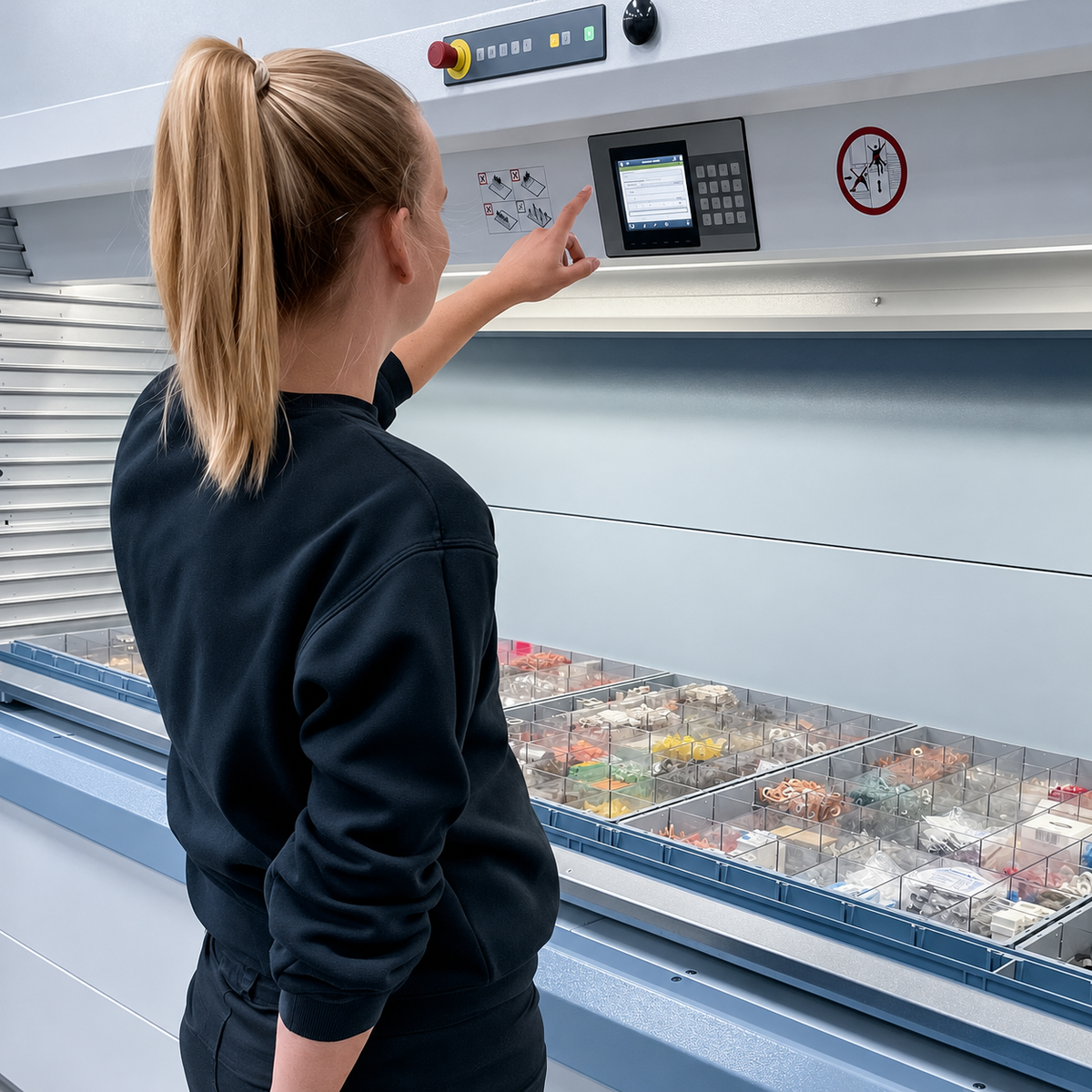
Inventory software tracks which items are stored on each tray, their locations, and their quantities. When an operator submits a retrieval request, the software identifies the target tray and sends the corresponding command to the equipment.
A VLM can also connect to a Warehouse Management System (WMS) or Enterprise Resource Planning (ERP) system to exchange inventory information and work orders.
6. Sensors and Safety Devices
Sensors help the VLM identify tray positions, monitor equipment status, and support safe operation.
Common devices include position sensors, tray-detection sensors, and safety interlocks. Some models also use height-detection sensors to measure the items on a tray and allocate storage space more efficiently.
The exact configuration varies by model and application, with different devices supporting positioning, storage-space optimization, and operational safety.
If your warehouse also needs automated material handling, Coolyne can help assess AGV/AMR solutions based on your facility layout, load types, and transport workflows. Contact us to discuss your project requirements.
Next Review
Move from article research to a scoped feasibility review.
Use the related products and solution paths below, then send your workflow and layout for a quick engineering review.
Related Solutions
Engineering Review