
Related Products
ROI for AGV Projects: How to Calculate Return on Investment
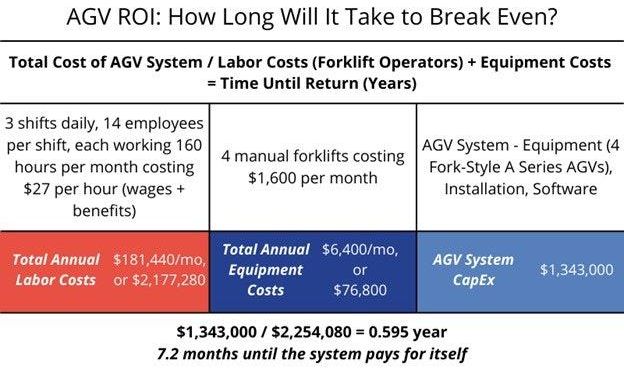
An AGV project typically involves spending on vehicles, fleet management software, charging equipment, system integration, and facility modifications.
Why ROI Is a Key Metric for AGV Projects · Information Needed to Calculate AGV ROI · How to Calculate AGV ROI
An AGV project typically involves spending on vehicles, fleet management software, charging equipment, system integration, and facility modifications. Once the system is in operation, maintenance, energy, and software support add ongoing costs.
Return on investment (ROI) measures a project’s financial return over a defined period. Calculating AGV ROI requires the cost of existing material-handling operations, projected savings, and operating data such as transport volume, shift schedules, and vehicle utilization.
Why ROI Is a Key Metric for AGV Projects
1. Assess the Financial Viability of an AGV Investment
AGVs can handle repetitive material-handling tasks, but purchasing and deploying them requires an upfront investment.
For warehouses with relatively few transport tasks, continuing to use manually operated forklifts may be more economical. In facilities with frequent transport tasks, relatively fixed routes, and multiple shifts per day, AGVs generally have more opportunities to reduce long-term handling costs.
An ROI analysis compares the costs of the existing material-handling process with those of an AGV system, including the initial investment, annual operating expenses, and costs that can actually be eliminated.
2. Compare Different AGV Fleet Configurations
Too few AGVs may leave a facility unable to meet peak transport demand. Too many increase purchase, maintenance, and charging costs.
A factory might add vehicles to handle peak workloads, or it could improve the throughput of its existing fleet by adjusting routes, reducing waiting time, or optimizing charging schedules.
If two AGV configurations can both meet transport requirements, the company can compare their upfront investments, annual operating costs, and payback periods.
Information Needed to Calculate AGV ROI
Calculating AGV ROI requires data on current material-handling costs, the AGV project investment, future operating expenses, and transport demand.
1. Current Material-Handling Costs
Annual material-handling expenses generally include:
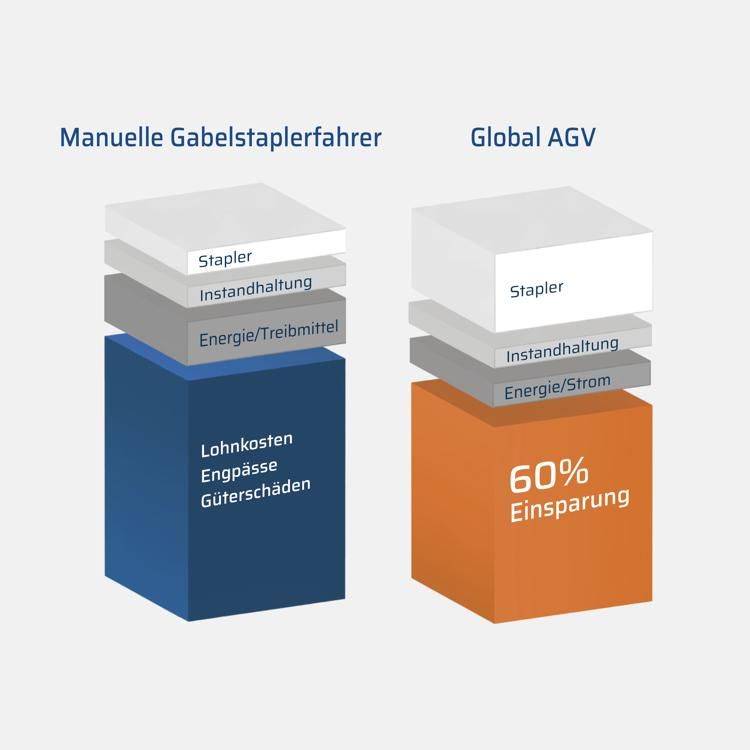
- Labor costs: Wages, benefits, employer-paid expenses, and shift schedules for forklift operators and material-handling staff.
- Existing equipment costs: Forklift rental, maintenance, replacement parts, fuel or charging expenses, and future equipment replacement costs that could be avoided.
- Other operating costs: Overtime, product damage, temporary labor, and other expenses directly related to material handling.
If overtime is listed separately, it should not also be included in base labor costs. The historical purchase price of an already-owned forklift cannot be counted as a future cash saving from AGV deployment.
2. Initial AGV Project Investment
An AGV project typically includes:
- AGV vehicles and onboard load-handling mechanisms.
- Fleet scheduling and control software.
- Automatic charging equipment and supporting infrastructure.
- Integration with WMS, WCS, MES, or ERP systems.
- Facility modifications, communication networks, and pickup/drop-off stations.
- Installation, commissioning, training, and project implementation costs.
For forklift AGV applications, payload capacity, lift height, navigation method, and software configuration all affect vehicle pricing. See our AGV Forklift Price in 2026 article for a breakdown of these factors.
For other costs involved in automation projects, see Warehouse Automation ROI.
3. Annual AGV Operating Expenses
After deployment, AGVs typically incur the following ongoing expenses:
- Equipment maintenance and replacement parts.
- Battery maintenance and charging.
- Software licensing, updates, and technical support.
- System maintenance, exception handling, and related labor costs.
4. Transport Tasks and Fleet Operating Data
AGV transport volume and cycle time affect both the required fleet size and vehicle utilization. The following data is needed for ROI calculations:
- Transport volume: Number of transport tasks per day and per shift, including peak-period demand.
- Travel distance: Distance between pickup and drop-off points, routes, and aisle conditions.
- Load characteristics: Weight, dimensions, and load type for each transport task.
- Transport cycle time: Loading, loaded travel, unloading, empty return, positioning, and waiting time.
- Operating schedule: Number of shifts, planned operating hours, and charging arrangements.
- Vehicle utilization: Actual operating time, vehicle availability, and maintenance downtime.
Transport tasks per AGV per shift ≈ Time available for transport ÷ Average complete transport cycle time
Assume one AGV has 420 minutes available for transport per shift and an average complete transport cycle takes 7 minutes:
420 ÷ 7 = 60 transport tasks
Actual fleet sizing must also account for peak demand, vehicle availability, and congestion in aisles and at loading and unloading stations.
How to Calculate AGV ROI
Step 1. Calculate Current Annual Material-Handling Costs
Assume a factory currently relies mainly on manually operated forklifts for material transport. Its annual costs are:
| Cost Item | Annual Cost |
|---|---|
| Wages and benefits (excluding overtime below) | $100,000 |
| Forklift maintenance and energy | $20,000 |
| Overtime and product damage | $15,000 |
| Total annual cost | $135,000 |
Step 2. Determine Fleet Size and Initial Investment
Assume the factory needs to complete 100 material-transport tasks per shift.
Based on the estimated capacity of 60 transport tasks per AGV per shift:
Required number of AGVs = 100 ÷ 60 ≈ 1.67
The preliminary fleet size is 2 AGVs, with a theoretical combined capacity of approximately 120 transport tasks per shift.
For this example, assume that an on-site review of routes and peak demand confirms that two AGVs can meet the factory’s transport requirements.
Initial project investment
| Investment Item | Cost |
|---|---|
| 2 AGVs ($80,000 each) | $160,000 |
| Fleet scheduling and control software | $25,000 |
| Automatic charging equipment | $15,000 |
| System integration and facility modifications | $40,000 |
| Installation, commissioning, and training | $10,000 |
| Total initial investment | $250,000 |
Step 3. Calculate Annual Savings
Assume the AGV system reduces the factory’s annual labor, forklift operating, overtime, and product-damage costs by the following amounts:
| Savings Category | Annual Savings |
|---|---|
| Labor costs | $65,000 |
| Forklift maintenance and energy | $15,000 |
| Overtime and product damage | $10,000 |
| Total quantifiable annual savings | $90,000 |
Of the original $100,000 in labor costs, assume $35,000 is still needed for loading and unloading coordination, on-site supervision, and exception handling. Only the $65,000 actually eliminated is counted as labor savings.
Step 4. Calculate Annual AGV Operating Expenses
Assume the AGV system has the following annual operating expenses:
| Operating Expense | Annual Cost |
|---|---|
| Equipment maintenance and replacement parts | $9,000 |
| Charging and energy | $3,000 |
| Software support and technical services | $8,000 |
| Total annual operating expenses | $20,000 |
Annual net savings = Quantifiable annual savings − Annual AGV operating expenses
$90,000 − $20,000 = $70,000
Step 5. Calculate the Payback Period
The payback period is the time required for cumulative net savings to recover the initial investment.
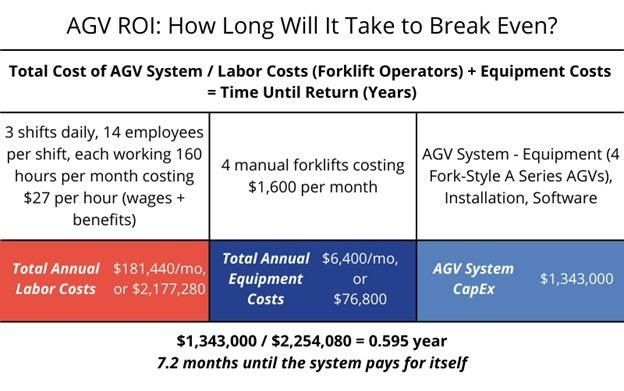
Payback period = Initial AGV project investment ÷ Annual net savings
$250,000 ÷ $70,000 ≈ 3.57 years
Step 6. Calculate AGV ROI
ROI measures the project’s cumulative net return over a specified evaluation period as a percentage of the initial investment.
ROI = (Cumulative net savings over the evaluation period − Initial investment) ÷ Initial investment × 100%
Assume the AGVs operate for five years, generating $70,000 in net savings each year:
ROI = ($70,000 × 5 − $250,000) ÷ $250,000 × 100%
Five-year cumulative ROI: 40% | Cumulative net benefit: $100,000
This is an undiscounted cumulative ROI calculation. Net present value (NPV) and internal rate of return (IRR) can also be used when a project evaluation needs to account for the time value of money and changes in annual cash flow.
Coolyne can help assess AGV fleet configurations and project ROI based on your existing material-handling workflows, transport requirements, and facility layout. Contact us to discuss your AGV automation project.
Next Review
Move from article research to a scoped feasibility review.
Use the related products and solution paths below, then send your workflow and layout for a quick engineering review.
Related Solutions
Engineering Review