
Related Products
What Is a Mobile Manipulator Robot? How It Works, Applications, and Advantages
Learn how mobile manipulator robots combine autonomous navigation and robotic arms for machine tending, warehouse picking, and flexible material handling.
Learn how mobile manipulator robots combine autonomous navigation and robotic arms for machine tending, warehouse pic...
Traditional industrial robotic arms are highly effective at performing picking, assembly, welding, and machine tending tasks at fixed workstations. However, their operating range is generally limited by where they are installed. AGVs and AMRs can transport materials throughout factories and warehouses, but they usually cannot actively grip, load, or manipulate workpieces.
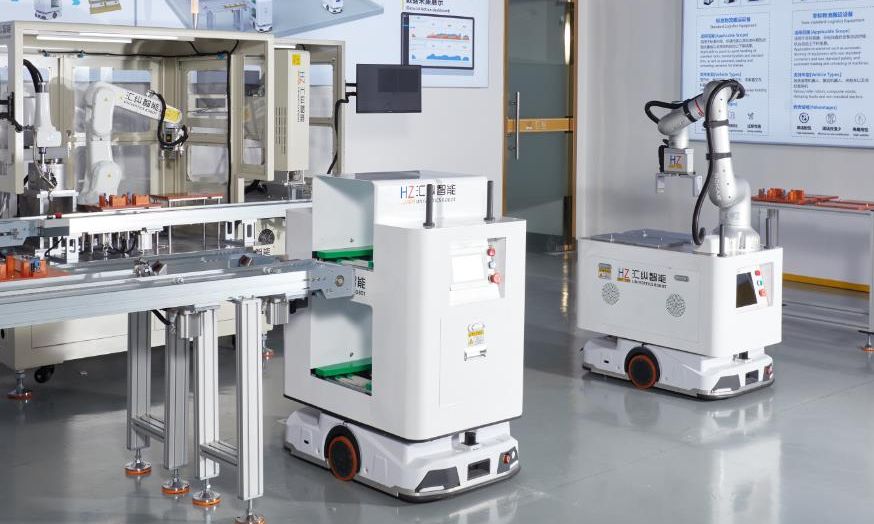
A mobile manipulator robot combines a mobile platform with a robotic arm in a single system. This allows the robot to travel autonomously to different work areas and then perform tasks such as picking, placing, assembly, inspection, and machine tending.
This combination extends automation beyond a single fixed workstation. For facilities where equipment is distributed across different locations, task positions change frequently, or both material transportation and precise manipulation are required, a mobile manipulator robot can provide a more flexible automation solution.
Understanding Mobile Manipulator Robots
A mobile manipulator robot typically consists of a mobile base, an industrial robotic arm, end-of-arm tooling, a vision system, navigation sensors, and control software.
Its basic structure can be understood as:
Mobile robot platform + industrial robotic arm + perception and control system
The mobile platform enables autonomous movement through factories, warehouses, or laboratories. The robotic arm performs picking and manipulation tasks after reaching the target location. Vision systems, LiDAR, and other sensors help the robot understand its environment, identify workpieces, and determine its position relative to machines and workstations.
Unlike a standard AMR, a mobile manipulator does more than transport materials to a designated location. It can also actively pick up, load, unload, and place items. Unlike a fixed robotic arm, it is not permanently installed beside one workstation and can travel between different machines and work areas as required.
A mobile manipulator robot is therefore more than a robotic arm mounted on a mobile base. Navigation, positioning, visual recognition, and robotic manipulation must operate as one coordinated system for the robot to perform tasks reliably after reaching each workstation.
How Does a Mobile Manipulator Robot Work?
The operating process of a mobile manipulator robot can generally be divided into several stages: task assignment, autonomous navigation, workstation positioning, object recognition, robotic manipulation, and task reporting.
Receiving a Task
An upper-level control system first assigns a task to the robot. Typical tasks may include:
- Collecting a batch of workpieces from a buffer area;
- Traveling to a designated CNC machine to perform loading and unloading;
- Transferring a tray to an inspection system;
- Picking materials from a rack and delivering them to an assembly station.
The control system may schedule tasks according to priority, robot location, machine status, and remaining battery capacity.
Navigating to the Target Area
After receiving a task, the mobile platform plans a route using a previously created map of the operating environment.
The robot may use LiDAR, cameras, QR codes, reflectors, or other navigation technologies to determine its position. During travel, safety sensors continuously detect people, vehicles, and other obstacles. The robot can then slow down, stop, or adjust its route according to the conditions in the surrounding area.
Positioning Accurately at the Workstation
Reaching the general target area does not necessarily mean that the robot can begin manipulating the workpiece immediately.
The base of a fixed robotic arm remains in the same position, while a mobile manipulator may arrive at a workstation with small variations in position and orientation. The system therefore needs high-precision navigation, mechanical docking devices, visual markers, or secondary positioning sensors to confirm the relative position between the robotic arm and the machine, rack, or worktable.
Positioning errors can directly affect gripping and loading accuracy. Precise workstation alignment is therefore a critical part of mobile manipulation.
Identifying and Gripping the Target
A vision system can identify the position, orientation, model, and gripping point of a workpiece. The robot controller then calculates the required motion path and controls the gripper, suction cup, or other end-of-arm tool to pick up the item.
When workpieces are consistently arranged in accurately positioned trays, mechanical positioning may be used instead of a more complex vision system.
Performing the Task and Reporting the Result
After gripping the workpiece, the robotic arm can place it inside a machine, fixture, inspection system, container, or downstream workstation.
The robot may also communicate with machines and other automation equipment through a PLC, digital I/O, or an industrial communication protocol. In a CNC machine tending application, for example, the system must confirm that machining is complete, the automatic door is open, and the chuck is ready before the robotic arm enters the machine. After loading is complete, the robot can send a signal to start the next machining cycle.
Once the task is completed, the robot reports the result to the upper-level control system and either proceeds to the next task or travels to a charging station.
One of the main technical challenges is coordinating the mobile base with the robotic arm. Even when the arm itself has high repeatability, the end-of-arm tool may still fail to reach the correct position if the mobile platform does not stop accurately.
Mobile Manipulator Robot Applications Across Industries
Mobile manipulator robots are particularly suitable for tasks distributed across multiple locations where actual interaction with workpieces is required at each station.
Their applications have expanded beyond research environments into manufacturing, warehousing, inspection, laboratory automation, and internal logistics.
Machining and Machine Tending
A mobile manipulator can transport raw workpieces between CNC lathes, machining centers, grinding machines, and other production equipment. It can load the part into the machine and remove the finished component after processing.
When several machines have relatively long machining cycles, one mobile manipulator may serve them in sequence. This can reduce the need to install a dedicated fixed robotic arm beside every machine.
The robot can also deliver processed parts to cleaning, flipping, inspection, or downstream machining stations, connecting machine tending with internal factory logistics.
Automotive and Component Manufacturing
Automotive component production often involves multiple machining, assembly, and inspection stations.
A mobile manipulator robot can transport parts between these stations and perform tasks such as tray handling, fixture loading, component placement, and inspection support.
When product models or production schedules change, the robot can serve different workstations by adjusting its task sequence and robotic arm program. This reduces dependence on fixed conveyors and dedicated automation cells.
Electronics Manufacturing
Electronics manufacturing often involves short product life cycles, numerous component types, and frequent production changeovers.
A mobile manipulator can transport trays, containers, and electronic components while performing precise pick-and-place operations at testing, assembly, or inspection stations.
Applications in electrostatic-discharge-sensitive or clean environments may require appropriate materials, tooling, and protective designs.
Warehousing and Order Fulfillment
In warehouses, standard mobile robots mainly transport racks, totes, or pallets to designated locations. A mobile manipulator can go one step further by performing shelf picking, tote handling, order consolidation, and workstation replenishment.
For example, the robot can autonomously travel to a storage area, pick a specified item from a shelf or container, and deliver it to an order-processing or packaging area.
The feasibility of automated warehouse picking depends on product dimensions, shapes, packaging, and storage conditions. The greater the variation between SKUs, the more demanding the vision system and gripper requirements generally become.
Line-Side Material Delivery
A mobile manipulator can collect materials from a supermarket area, buffer zone, or warehouse, deliver them to the production line, and place them directly into a designated rack, machine, or fixture.
When a standard AGV or AMR is used, an operator may still need to unload materials after delivery. A mobile manipulator can complete this final handoff, reducing manual handling between the mobile robot and the workstation.
Inspection and Laboratory Automation
In quality laboratories, testing centers, and production inspection areas, a mobile manipulator can transport samples between instruments and perform sample loading, unloading, and sorting.
Compared with connecting all inspection equipment using fixed conveyors, a mobile robot can link distributed instruments and worktables without requiring major changes to the existing layout.
Packaging and Interprocess Transfer
Mobile manipulators can also serve labeling, boxing, weighing, scanning, and packaging equipment.
The robot can transport products to the packaging area, load them into equipment, remove the packaged products, and deliver them to palletizing or temporary storage areas. This helps connect production processes that were previously handled as separate operations.
Advantages of Mobile Manipulators Compared with Traditional Robotic Arms
Traditional robotic arms and mobile manipulators are not direct replacements for one another.
Fixed robotic arms are generally more suitable for high-speed, highly repetitive tasks performed at a permanent location. The main advantages of mobile manipulators are their ability to operate across multiple workstations and adapt to changing production requirements.
A Larger Effective Working Range
Once a robotic arm is installed on a mobile platform, it is no longer directly limited by the reach of a fixed base.
The robot can travel to racks, machines, inspection equipment, and assembly stations to perform different tasks at multiple locations. This is especially useful in distributed production environments that cannot be covered by a single fixed robotic arm.
Higher Robot Utilization in Multi-Machine Environments
When a machine has a long machining or testing cycle, a fixed robotic arm may remain idle while waiting for the process to finish.
After completing a loading or unloading task at one machine, a mobile manipulator can travel to another machine and continue working. With effective task scheduling, one robot can be shared among several workstations, increasing its utilization.
Less Dependence on Fixed Automation Infrastructure
Fixed conveyors and dedicated robotic cells can provide stable production cycles, but they are difficult to modify after installation.
A mobile manipulator can use existing facility aisles to travel between workstations, reducing the need to install separate conveyor systems for every section of the material flow.
This approach may be easier to deploy in phases, particularly when upgrading an existing factory or working in a facility where production processes change regularly.
Connecting Transportation and Manipulation
Traditional internal logistics often treats transportation and workstation operations as two separate stages. An AGV delivers the material, and an operator or fixed robotic arm completes the next task.
A mobile manipulator can perform movement, object recognition, gripping, and placement within the same task. This creates a more continuous connection between material delivery and workstation operation.
Greater Flexibility for High-Mix Production
A mobile manipulator can handle different products by changing robotic arm programs, end-of-arm tools, and task routes.
However, flexibility does not mean that the robot can process any workpiece without engineering preparation. The greater the variation between products, the more carefully the project must evaluate gripper changes, visual recognition, workstation positioning, and production cycle requirements.
The main advantages of a mobile manipulator come from distributed tasks and layout flexibility. When all work is performed at one fixed location and very short cycle times are required, a fixed robotic arm may still be the more direct solution.
Coolyne Mobile Manipulator Robot
Coolyne’s composite mobile robot integrates a mobile platform, industrial robotic arm, vision positioning system, and end-of-arm tooling into a single unit. It can be used for machine tending, workstation material replenishment, inspection, and material transfer between production processes.
Unlike a fixed robotic arm, it can autonomously move between multiple machines or workstations while performing both material transport and precise pick-and-place operations. The number of machines that one robot can serve depends on factors such as machining cycle time, travel distance, and loading and unloading time.
Coolyne can configure the robotic arm payload, gripper, vision system, and safety solution according to the workpiece weight, dimensions, gripping position, equipment interfaces, and facility layout. For CNC machine tending projects, the system can also be integrated with automatic doors, chucks, fixtures, and machine communication signals.
Companies evaluating a mobile manipulator robot project can contact Coolyne and provide information about their workpieces, task flow, and facility layout for a more detailed assessment of technical feasibility and potential return on investment.
Next Review
Move from article research to a scoped feasibility review.
Use the related products and solution paths below, then send your workflow and layout for a quick engineering review.
Related Solutions
Engineering Review