
Related Products
Automated Warehouse Picking Systems: Types, Benefits, and Selection Guide
Explore automated warehouse picking systems, including goods-to-person, AS/RS, conveyors, and robotic picking, and learn how to select the right solution.
Explore automated warehouse picking systems, including goods-to-person, AS/RS, conveyors, and robotic picking, and le...
Order picking is often one of the most labor-intensive, travel-heavy, and error-prone processes in a warehouse. In a traditional manual picking operation, employees repeatedly travel between storage locations, locate products, confirm quantities, and then send completed orders to verification, consolidation, or packing areas.
As order volumes increase, SKU counts expand, or fulfillment windows become shorter, simply adding more pickers often fails to provide sustainable improvements. A larger workforce may also lead to aisle congestion, higher training costs, and more picking errors.
Automated warehouse picking systems use mobile robots, automated storage equipment, conveyors, picking workstations, and warehouse software to reorganize how goods reach the picking location.
Different systems solve different operational problems. Some bring racks or totes to the operator, some automate the movement of order containers, and others use robotic arms to pick individual items. The objective is not necessarily to achieve the highest possible level of automation, but to select a system that matches the warehouse’s order profile, SKU characteristics, facility layout, and expected business growth.
Types of Automated Warehouse Picking Systems
Automated warehouse picking systems can be classified according to how products reach the picking location and whether the final item-picking task is completed by an operator or a robot.
AGV- or AMR-Based Goods-to-Person Picking Systems
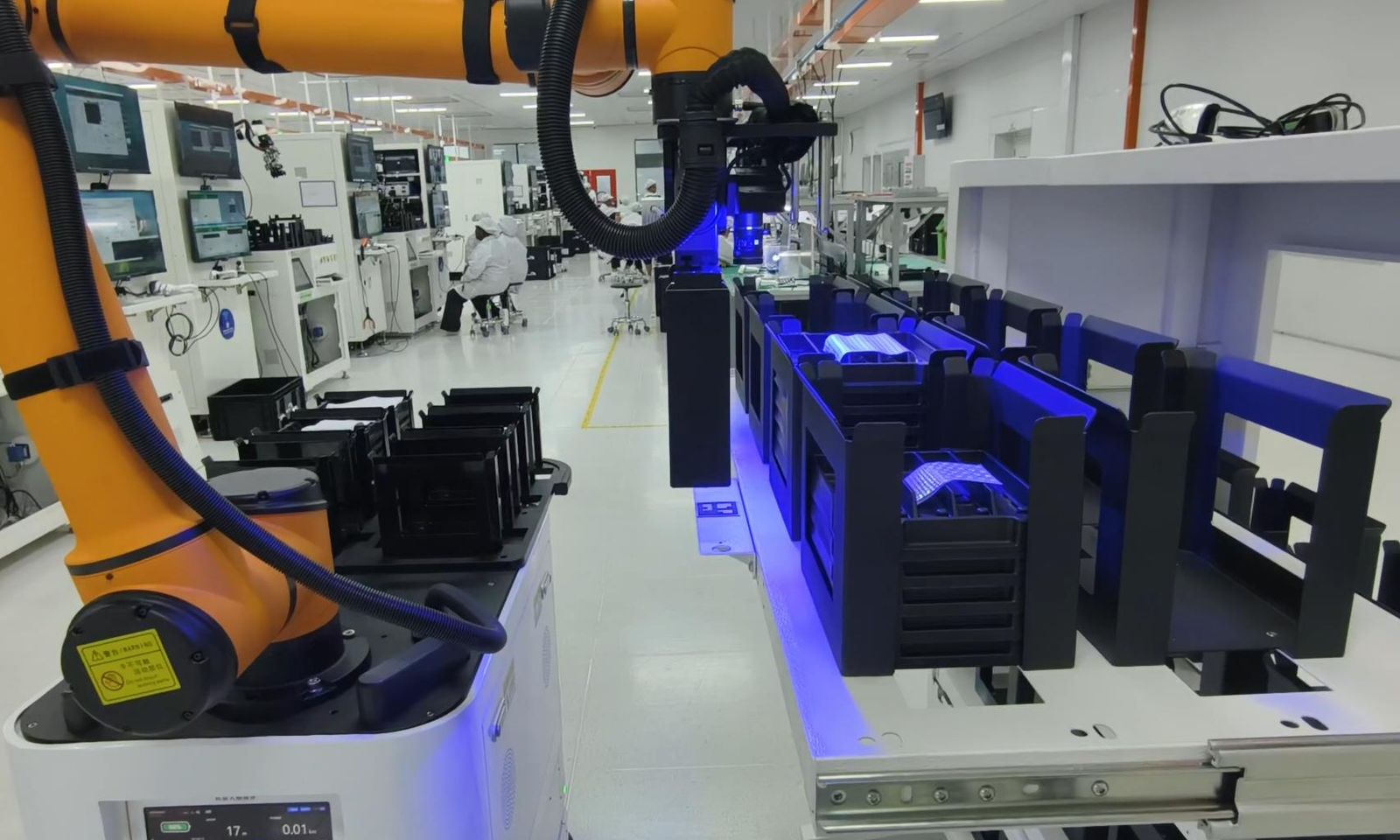
In a goods-to-person system, AGVs or AMRs transport mobile racks, pallets, totes, or other load carriers to fixed picking workstations. Operators no longer need to walk long distances through the warehouse. Instead, they remain at the workstation to pick items, confirm quantities, and allocate products to orders.
After a picking task is completed, the robot can return the storage unit to its original location or deliver it to another workstation based on the next task.
This type of system is suitable for warehouses with large SKU counts, frequent order batches, and a need to maintain operational flexibility. Companies can begin with a limited number of robots and workstations, then expand the system as order volumes grow.
AS/RS Tote-to-Person Systems
An automated storage and retrieval system uses stacker cranes, shuttles, lifts, or tote-handling robots to retrieve specified totes from high-density storage racks and deliver them to picking workstations.
Compared with mobile-rack goods-to-person systems, AS/RS solutions generally provide higher storage density. They are especially suitable for facilities with limited floor space, large SKU counts, or a need to make better use of vertical warehouse space.
However, these systems usually place greater demands on the building structure, racking configuration, lifting equipment, and conveyor layout. They also tend to require more detailed planning and longer installation periods.
Automated Conveyor and Sortation Systems
Conveyors connect storage, picking, verification, order consolidation, and packing areas while continuously transporting cartons, totes, or individual products. Automated sorters then direct these items to different destinations according to the order, shipping route, or delivery location.
These systems are suitable for warehouses with high product flow, relatively fixed material routes, and predictable operating patterns, such as e-commerce fulfillment centers, parcel distribution hubs, and retail distribution centers.
Conveyor systems can provide stable throughput, but they are difficult to modify after installation. The design must therefore account for future business growth and the capacity limits of downstream packing and sortation areas.
Pick-to-Light, Put-to-Light, and Voice Picking
Pick-to-Light systems use illuminated location indicators and digital displays to show operators where to pick and how many items are required.
Put-to-Light systems indicate which order container should receive each item. They are commonly used with batch picking or goods-to-person systems, allowing operators to distribute a group of picked products among several order containers.
Voice picking systems provide instructions through a headset. Operators confirm task completion using voice commands, barcode scanning, or control buttons.
These technologies do not automatically transport or physically pick products. However, they can reduce search time, eliminate paper-based instructions, and lower the risk of order allocation errors. They are often practical options for warehouses that are not yet ready for major equipment-based automation.
Robotic Piece-Picking Systems
Robotic piece-picking systems use a robotic arm, vision system, and end-of-arm tooling to identify and pick individual products from totes, conveyors, or storage locations.
These systems can support order picking, depalletizing, packing, sorting, and returns processing. Their performance depends on product dimensions, shape, material, packaging, and presentation.
Products with regular shapes, clearly identifiable positions, and stable gripping surfaces are generally easier to automate. When SKU variation is high or products are soft, reflective, deformable, or likely to become entangled, the vision and gripper requirements become significantly more complex.
Hybrid Automated Picking Systems
Large warehouses rarely rely on only one picking technology.
For example, an AS/RS may handle high-density storage and tote retrieval, AGVs may provide flexible transportation between operational areas, conveyors may connect packing and sortation zones, and operators or robotic arms may complete the final picking task at workstations.
When items for the same order come from different storage areas, the system must also support order consolidation. The WMS or WES must track separate order containers and confirm that all order lines have arrived before the order enters the packing area.
Hybrid systems allow warehouses to use different handling methods for SKUs with different turnover rates, dimensions, and order profiles. However, they also require stronger software integration and task coordination.
Benefits of Automated Warehouse Picking Systems
The value of automated picking extends beyond using robots to replace employee travel. More importantly, it reduces non-value-added movement, stabilizes order-processing capacity, and improves visibility into inventory and warehouse operations.
Reduced Picker Travel Time
In traditional manual picking, a significant amount of working time is spent traveling between storage locations rather than physically picking products.
Goods-to-person systems bring racks, totes, or pallets directly to the operator, allowing employees to focus on identifying, picking, and confirming items. In warehouses where SKUs are distributed across a large area, this can substantially reduce non-value-added movement.
Higher Order-Processing Capacity
Automated systems can continuously allocate tasks according to order priority, inventory location, and workstation workload, creating a more stable material flow.
During peak periods, companies can increase the number of robots, activate additional workstations, or extend operating hours to improve capacity without relying entirely on the rapid recruitment of large numbers of experienced pickers.
Fewer Picking Errors
Automated picking systems commonly use barcodes, electronic labels, indicator lights, weighing devices, or vision verification to confirm the correct SKU and quantity.
Goods-to-person systems can also limit the number of tasks presented to an operator at one time, reducing errors caused by visiting the wrong location, selecting the wrong product, or missing an order line.
Better Ergonomics and Working Conditions
Long-distance walking, repeated bending, reaching at height, and lifting heavy products can cause operator fatigue.
Goods-to-person workstations can present products at a more suitable working height while reducing the need for employees to enter dense storage areas. Lifting equipment and material-handling robots can also be used for heavier totes or pallets, reducing repetitive manual handling.
Greater Inventory and Order Visibility
Automated systems continuously record inventory locations, robot assignments, workstation output, and order status.
Warehouse managers can identify shortages, inventory discrepancies, aisle congestion, equipment downtime, and unbalanced workstation loads more quickly. Compared with operations that rely primarily on manual experience, system data provides a stronger basis for continuous warehouse optimization.
Support for Phased Expansion
Modular AGV or AMR systems can begin with a limited number of robots and workstations, then expand as order volume increases.
This approach reduces the pressure of automating an entire warehouse at once. It also allows companies to verify throughput, software interfaces, and return on investment in one operational area before expanding the system.
How to Choose an Automated Picking System
Warehouses vary significantly in their product characteristics, order profiles, and service requirements. A solution designed for small-item e-commerce fulfillment may not be suitable for a pallet-based manufacturing warehouse or a multi-client 3PL facility.
Analyze Order and SKU Characteristics
The first step is to evaluate daily order volume, hourly order lines, average SKUs per order, total SKU count, product turnover, and the proportion of piece, case, and pallet picking.
Fast-moving SKUs can be placed closer to workstations or handled through dedicated high-speed picking methods. Slow-moving products can be stored in higher-density areas.
A warehouse where most orders contain only one or two SKUs will require a different system design from a facility processing complex multi-line orders.
Define Fulfillment Deadlines and Peak Demand
Two warehouses with the same average daily order volume may require completely different systems if their order cutoff times are different.
Companies should determine when orders must be completed, whether same-day or next-day delivery is offered, whether urgent orders can be inserted into the active task queue, and how significantly peak demand exceeds average demand.
When most orders must be completed within a short time window, the system must be designed around peak throughput rather than average daily volume.
Confirm Whether Products Are Suitable for Automation
Product dimensions, weight, packaging format, and stability directly affect equipment selection.
Standard totes and regular cartons are well suited to conveyors and tote-handling systems. Palletized goods are generally suitable for forklift AGVs or pallet-handling robots. Products with significant dimensional variation may be better suited to mobile-rack goods-to-person systems.
When robotic piece picking is being considered, each product must also have a stable and identifiable gripping position.
Balance Storage Density and Throughput
AS/RS solutions can make effective use of vertical space, but their inbound and outbound capacity is limited by the number of aisles, shuttles, lifts, and conveyors.
AGV-based goods-to-person systems provide greater layout flexibility, but sufficient space must be reserved for robot travel, rack movement, and workstation queues.
Adding more robots does not necessarily increase throughput in a linear way. If picking workstations, lifts, conveyors, or packing areas have already reached capacity, additional robots will only create longer queues and more congestion.
The system design should therefore consider robot quantity, workstation capacity, replenishment speed, and the capacity of packing and sortation areas as one connected process.
Evaluate Replenishment and Order Consolidation
Picking capacity and replenishment capacity must remain balanced. Even when robots and workstations operate quickly, orders will still be delayed if the picking area does not receive inventory on time.
When items for the same order come from multiple storage areas, the warehouse must also determine how order containers will be tracked, brought together, and released to packing. Otherwise, improving upstream picking speed may simply move the bottleneck to the consolidation area.
Assess the Warehouse Layout and Retrofit Conditions
An existing warehouse must be evaluated for floor condition, column placement, fire-safety requirements, aisle width, clear height, and employee work areas.
Fixed conveyors and AS/RS solutions generally require more extensive infrastructure changes. AGV and AMR systems are more adaptable to existing buildings, but they still require planned robot routes, charging areas, picking workstations, and human–robot interaction zones.
Confirm Software Integration Capabilities
Automated picking systems need to exchange inventory, order, and task information with the WMS, WCS, WES, ERP, or order management system.
The software must coordinate order priorities, inventory locations, robot status, workstation loads, replenishment tasks, and order consolidation progress.
Without unified scheduling, even high-speed equipment may fail to achieve its designed throughput because robots, workstations, and downstream processes are waiting for one another.
Consider Deployment, Training, and Maintenance
Project evaluation should cover more than equipment specifications. Companies must also determine how the existing warehouse will transition to the new system.
Before deployment, SKU dimensions, weights, inventory locations, and historical order data should be verified. The business should also decide whether the system will be introduced by area or in phases.
Operators must be trained not only in routine picking but also in handling barcode errors, stock shortages, equipment alarms, and manual task takeover. Maintenance responsibilities, critical spare parts, and degraded operating procedures for partial equipment downtime should also be defined in advance.
Calculate the Complete Return on Investment
Project costs include more than the purchase price of robots and automation equipment. They may also include racking, workstations, software interfaces, safety equipment, installation, commissioning, employee training, and ongoing maintenance.
Potential benefits include:
- Reduced walking and manual handling
- Higher order-processing capacity
- Lower picking error rates
- Reduced overtime costs
- Changes in labor requirements
- Better use of warehouse space
- Delayed or avoided warehouse expansion.
The most suitable solution is not necessarily the one with the lowest purchase price. It is the system that can generate stable operational value over the company’s target investment period.
How Coolyne Uses AGV Robots for Automated Picking
Through its automated picking solution, Coolyne can use AGVs or AMRs to transport racks, totes, or pallets from storage areas to fixed picking workstations, creating a goods-to-person picking system.
After the WMS generates a task, the scheduling system assigns it according to inventory location, robot status, and workstation workload. The robot delivers the required goods to the operator and then returns the load carrier to storage or sends it to the next workstation after picking is complete.
Depending on the load type, the system may use mobile racks, tote-handling robots, lifting AGVs, or forklift AGVs. It can also connect storage, picking, verification, consolidation, and packing processes.
System design should consider SKU count, order profile, replenishment method, workstation capacity, and peak throughput to avoid moving the bottleneck to warehouse aisles or packing areas.
Companies evaluating an automated warehouse picking project can contact Coolyne and provide their warehouse layout, SKU information, and order data for a more detailed feasibility and ROI assessment.
Next Review
Move from article research to a scoped feasibility review.
Use the related products and solution paths below, then send your workflow and layout for a quick engineering review.
Related Solutions
Engineering Review